Burrard Inlet
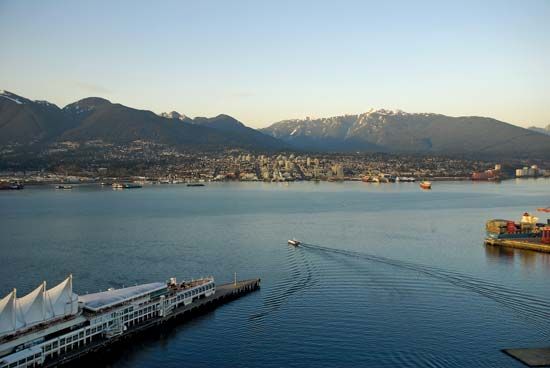
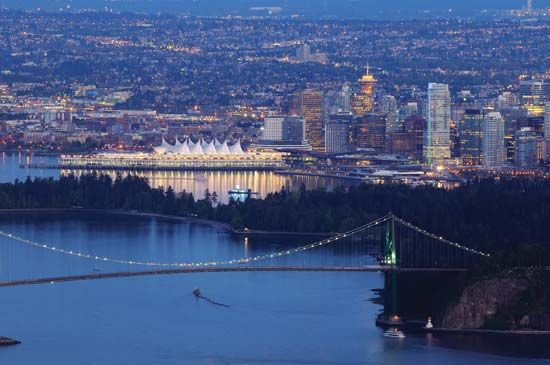
Burrard Inlet is an eastern arm of the Strait of Georgia located in southeastern British Columbia, Canada. Extending 23 miles (37 km) inland, the inlet…
What is Burrard Inlet?
Burrard Inlet is an eastern arm of the Strait of Georgia located in southeastern British Columbia, Canada. Extending 23 miles (37 km) inland, the inlet ranges from 1 to 4 miles in width and serves as the site for Vancouver Harbour, which is recognized as one of the premier natural harbours on the Pacific coast of North America.12
The inlet is bordered by the city of Vancouver on its south shore and North Vancouver on its north, with Port Moody and Ioco situated near its eastern terminus. It was first explored in 1792 by the British navigator George Vancouver, who named the waterway in honor of Sir Harry Burrard, a colleague with whom he had served in the West Indies.1
Who was George Vancouver and what were his explorations?
George Vancouver (1757–1798) was an English Royal Navy officer and navigator renowned for conducting one of the most precise surveys of the North American Pacific coast. Having served under Captain James Cook on his second and third voyages, Vancouver later commanded his own expedition from 1791 to 1795.3
His primary explorations included:
- Pacific Coast Survey: He meticulously charted the coastline from San Francisco northward to British Columbia, verifying that no continuous Northwest Passage existed between the Pacific Ocean and Hudson Bay.31
- Regional Mapping: He surveyed the intricate inlets around Vancouver Island, naming landmarks such as Puget Sound and the Gulf of Georgia.3
- Global Reach: His journey included surveys of the Australian coast, stops in Tahiti and the Hawaiian Islands, and explorations as far north as Cook Inlet in Alaska.3
His findings were published posthumously in his three-volume Voyage of Discovery to the North Pacific Ocean and Round the World.3
What makes a natural harbour ideal for shipping?
A natural harbour is considered ideal for shipping primarily because it provides inherent protection from the elements, reducing the need for expensive and complex engineering interventions. The following factors contribute to their suitability:
- Shelter: The most critical feature is the presence of natural landforms—such as inlets, bays, and estuaries—that provide calm water for ships to anchor or berth safely, shielding them from the full force of open-sea weather conditions.56
- Depth: Ideal locations offer sufficient water depth to accommodate the draft of large modern vessels, allowing them to remain afloat without the risk of structural strain from contact with the seabed.7
- Accessibility: While some natural harbours may require dredging or the addition of port structures, they generally offer a more cost-effective foundation for maritime trade than constructing an artificial harbour from scratch on an unsheltered coastline.5
- Operational Efficiency: Natural harbours that are open to the tide range allow for maximum freedom in shipping schedules, avoiding the operational restrictions and maintenance requirements associated with enclosed docks and lock systems.8
How does the Strait of Georgia connect to the Pacific Ocean?
The Strait of Georgia connects to the Pacific Ocean primarily through the Juan de Fuca Strait to the south. Vessels traveling between the Pacific and the Strait of Georgia typically navigate through the Haro Strait, which serves as a vital passage between the San Juan Islands and the islands of British Columbia.1010
To the north, the Strait of Georgia is separated from the open ocean by a complex network of islands that lead toward the Johnstone Strait and the Queen Charlotte Strait. These passages collectively form part of the Inside Passage, a sheltered maritime route that provides a protected link along the coast of North America.1112
Sources
- Burrard Inlet — Encyclopædia Britannica
- Burrard Inlet — Merriam-Webster
- George Vancouver — Encyclopædia Britannica
- British Columbia - Explorations and trading posts — Encyclopædia Britannica
- Harbors and sea works - Natural and artificial harbors — Encyclopædia Britannica
- Harbors and sea works - Bulk terminals — Encyclopædia Britannica
- Harbors and sea works - Enclosed docks — Encyclopædia Britannica
- Harbors and sea works - Docks and quays — Encyclopædia Britannica
- Harbors and sea works - Floating breakwaters — Encyclopædia Britannica
- Strait of Georgia — Encyclopædia Britannica
- Haro Strait — Encyclopædia Britannica
- Vancouver Island — Encyclopædia Britannica
Published on · 3 min read