Bussa Rapids
Bussa Rapids were a series of rapids located on the Niger River in Nigeria, situated south of Yelwa and below the river's confluence with the Sokoto River.…
What is Bussa Rapids?
Bussa Rapids were a series of rapids located on the Niger River in Nigeria, situated south of Yelwa and below the river’s confluence with the Sokoto River. These rapids, formed where the river cut through ancient basement rock, extended for approximately 50 miles (80 km) toward Jebba and historically served as a significant obstacle to navigation.1
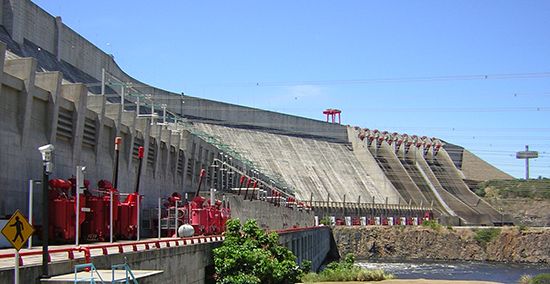
The rapids were effectively eliminated following the construction of the Kainji Dam and the creation of Kainji Lake in the late 1960s. The resulting reservoir submerged the original town of Bussa, necessitating the relocation of its inhabitants to the newly established town of New Bussa. Today, the dam provides essential hydroelectric power, irrigation, and improved navigation along the river.12
How does the Kainji Dam generate electricity?
The Kainji Dam generates electricity by harnessing the potential energy of the Niger River through a process common to hydroelectric power plants.34
The generation process works as follows:
- Water Storage: The dam impounds the river, creating Kainji Lake, which raises the water level to create a significant “head”—the vertical distance between the stored water and the lower elevation where the powerhouse is located.34
- Energy Conversion: Water is directed downward through large pipes or tunnels known as penstocks. As the water falls, its potential energy is converted into mechanical energy that causes turbines to rotate.3
- Electricity Production: These rotating turbines drive generators, which convert the mechanical energy into electricity.3
- Transmission: Transformers then increase the voltage of the generated electricity, making it suitable for long-distance transmission to power grids.3
What is the historical significance of the Niger River?
The Niger River has served as a vital artery for western Africa for centuries, functioning as a primary corridor for communication, trade, and the development of major civilizations.56
Historical Significance
- Heartland of Empires: From the 13th to the 16th century, the Niger valley was the center of the Mali and Songhai empires. The river provided a natural communication route that linked goldfields to key trading cities like Timbuktu and Gao, which were essential hubs for trans-Saharan trade.67
- Economic and Cultural Exchange: The river facilitated the spread of Islam and literacy through the activities of Mande merchants, known as the Dyula, who traded across the region. It also supported specialized occupations, such as fishing, which remains a critical activity along the river system today.67
- European Exploration and Trade: During the 18th and 19th centuries, the river became a focal point for European exploration as Britain sought to bypass coastal slave-trading states to access the interior. The Niger delta became a major site for the export of palm oil, which replaced the slave trade as a primary commodity.8
Today, the river continues to be essential for agriculture, transportation, and power generation, particularly through projects like the Kainji Dam.9
What wildlife lives in Kainji Lake National Park?
Kainji Lake National Park, which encompasses the Borgu and Zugurma game reserves, is home to a diverse array of wildlife. The park’s rich ecosystem supports several species, including:
- Baboons
- Duikers
- Hippopotamuses
- Hyenas
- Kobs
- Roans
- Warthogs
These animals thrive within the park’s expansive 2,062-square-mile (5,341-square-km) territory, which was established following the creation of the Kainji Dam and the resulting Kainji Lake reservoir.2
Sources
- Bussa Rapids — Encyclopædia Britannica
- Kainji Lake — Encyclopædia Britannica
- Niger Dams Project — Encyclopædia Britannica
- hydroelectric power — Encyclopædia Britannica
- Niger River — Encyclopædia Britannica
- Western Africa - The early kingdoms and empires of the western Sudan — Encyclopædia Britannica
- Western Africa - The British in the Niger delta — Encyclopædia Britannica
- Nigeria: Top Questions — Encyclopædia Britannica
- Niger River - People and economy — Encyclopædia Britannica
- Niger River - Physiography — Encyclopædia Britannica
- history of Niger - Early cultures — Encyclopædia Britannica
- Niger - Early cultures — Encyclopædia Britannica
Published on · 2 min read