Butcherbird
The term butcherbird refers to any bird that impales its prey—such as large insects or small vertebrates—on thorns or wedges it into crevices to tear or…
What is Butcherbird?
The term butcherbird refers to any bird that impales its prey—such as large insects or small vertebrates—on thorns or wedges it into crevices to tear or store it.1
This name applies to two distinct groups:
- Shrikes: Members of the family Laniidae, specifically species in the genus Lanius.1
- Australian Butcherbirds: Four to seven species within the genus Cracticus, which belong to the family Cracticidae.1
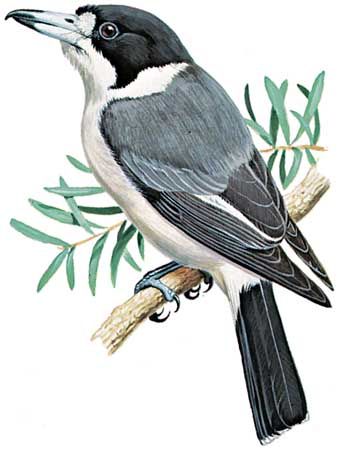
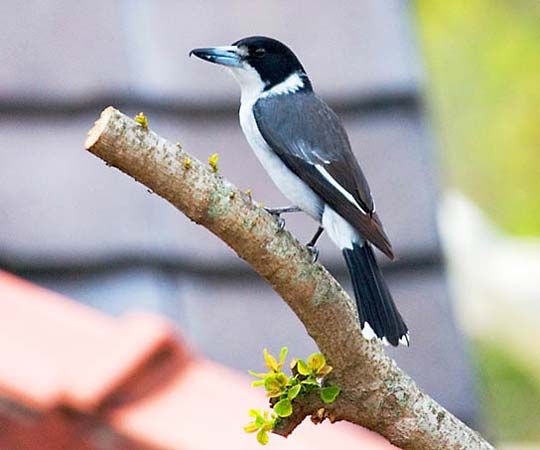
Australian butcherbirds are stocky, black-gray-and-white birds measuring about 28 cm (11 inches) in length, characterized by their heavy, hook-tipped bills and large feet. They are known for defending their territories year-round—occasionally attacking humans—and for singing complex, melodic duets. A well-known example is the gray butcherbird (C. torquatus)](https://www.britannica.com/animal/gray-butcherbird) (C. torquatus).1
Why do butcherbirds impale their prey on thorns?
Butcherbirds impale their prey on thorns or wedge it into crevices primarily to facilitate feeding. Because these birds lack the strong, grasping talons found in many raptors that are used to hold prey while tearing it apart, they use these environmental features as an external tool to secure their catch. This allows them to effectively tear the prey into manageable pieces with their bills. Additionally, this behavior serves as a method for storing food for later consumption.1
What are the main differences between shrikes and Australian butcherbirds?
While both shrikes and Australian butcherbirds are known for impaling prey, they belong to different families and exhibit distinct social and behavioral traits.
Key Differences
- Taxonomy: True shrikes belong to the family Laniidae (genus Lanius), whereas Australian butcherbirds are members of the family Cracticidae (genus Cracticus).14
- Social Behavior: Shrikes are typically solitary birds with harsh calls. In contrast, Australian butcherbirds are highly social, living in pairs that defend their territories year-round and engage in complex, melodic duets.41
- Physical Characteristics: Australian butcherbirds are stocky, measuring about 28 cm (11 inches) in length, and possess large feet and heavy, hook-tipped bills. True shrikes are medium-sized, often featuring a distinctive black mask, and are generally smaller, such as the 24-cm great gray shrike.14
- Vocalization: While some shrike-related groups (like the African Laniarius) exhibit duetting, true shrikes are noted for their harsh calls, whereas Australian butcherbirds are recognized for their beautiful, complex singing.145
How do songbirds differ from other bird families?
Songbirds, which belong to the suborder Passeri (or Oscines) within the order Passeriformes, are distinguished from other bird families primarily by their highly developed vocal anatomy and specific evolutionary traits.
Anatomical and Vocal Distinctions
The most significant difference between songbirds and other birds is the complexity of the syrinx, the vocal organ located at the base of the windpipe. While other birds possess simpler structures, true songbirds have a syrinx characterized by a firm bony framework, vibrating internal membranes, and four pairs of intrinsic muscles that allow for precise control over sound production. This complex musculature enables many songbirds to produce a vast range of notes, and some species can even control the left and right halves of the syrinx independently to sing with two voices at once.578
Classification and Characteristics
- Taxonomy: Songbirds make up about half of the world’s bird species, comprising 35 to 55 families. They are part of the larger order Passeriformes, which are defined as “true perching birds” with a specific foot structure: four toes, with three directed forward and one backward.5910
- Vocal Ability: Possession of the complex oscine syrinx does not guarantee a melodious song; while some songbirds are renowned for their complex vocalizations, others, such as crows and swallows, produce relatively simple or harsh sounds.115
- Behavioral Context: For songbirds, vocalization serves as a critical tool for social communication, particularly in courtship and the establishment of territories. This behavior is often most developed in males, though some species engage in complex duetting to reinforce pair bonds.115
While songbirds are the most vocal group, it is important to note that other birds, including some suboscines and non-passerines, also produce musical or complex sounds, sometimes using non-vocal methods like wing-snapping or bill-clapping.1112
Sources
- Butcherbird — Encyclopædia Britannica
- Bird - Feeding habits — Encyclopædia Britannica
- Falconiform - Feet and beak — Encyclopædia Britannica
- Shrike — Encyclopædia Britannica
- Passeriform - Sound production — Encyclopædia Britannica
- Cracticidae — Encyclopædia Britannica
- Passeriform — Encyclopædia Britannica
- Songbird — Encyclopædia Britannica
- Passeriform - Critical appraisal — Encyclopædia Britannica
- Passeriform - Annotated classification — Encyclopædia Britannica
- Syrinx — Encyclopædia Britannica
- Passeriform - Syrinx — Encyclopædia Britannica
- Bird - Sound — Encyclopædia Britannica
Published on · 3 min read