Büyükkale
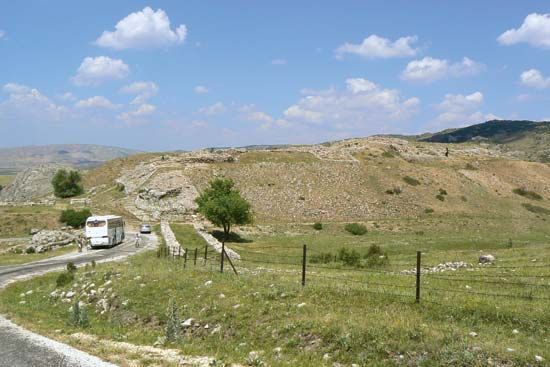
Büyükkale, which translates to "Great Fortress," is a high hill that served as the acropolis for the ancient Hittite capital of Hattusas. Located on the east…
What is Büyükkale?
Büyükkale, which translates to “Great Fortress,” is a high hill that served as the acropolis for the ancient Hittite capital of Hattusas. Located on the east side of the site in present-day Boğazkale, Turkey, it functioned as the seat of power for Hittite kings during the 2nd millennium BCE.12
Archaeological evidence indicates that Büyükkale was inhabited as early as the 3rd millennium BCE. By the time of the Hittite Empire, it had become a fortified royal center, and it was completely rebuilt in a monumental style during the New Kingdom period (c. 1400–c. 1190 BCE). The site has been a primary focus of excavations since the early 20th century, yielding significant discoveries, including thousands of cuneiform tablets that provided scholars with essential insights into Hittite history and administration. Following the collapse of the Hittite Empire, the hill saw later, more modest settlements associated with the Phrygians and, eventually, the Galatians.2
What was the significance of the cuneiform tablets found at Büyükkale?
The cuneiform tablets discovered at Büyükkale and throughout the ancient capital of Hattusas are of immense historical significance, as they serve as the primary “central storehouse” of records for the Hittite Empire. Unlike other ancient cultures known largely through external accounts, the Hittites are documented almost entirely through these internal archives.3
The significance of these findings includes:
- Historical Identification: The discovery of tablets at Büyükkale in 1906 confirmed that the site was the capital of the Hittite kings. These texts, including Akkadian documents, allowed scholars to identify the location and reconstruct the history of the Hittite state.2
- Linguistic Insight: The archives provide the primary evidence for the Hittite language, the earliest discovered Indo-European language. They also preserve texts in other regional languages, such as Hattian, Hurrian, and Luwian.43
- Cultural and Administrative Record: The collection covers a vast array of subjects, including legal codes, property rights, diplomatic treaties, and administrative correspondence. They also offer deep insight into religious life, featuring hymns, prayers, myths, and complex ritual procedures.43
- Scholarly Training: The archives reveal an “encyclopaedic approach” to education, containing word lists and omens used to train scribes in both Sumerian and Akkadian, the latter serving as the era’s diplomatic language.4
How did the Hittites defend their capital city of Hattusa?
The Hittites defended their capital, Hattusa, by utilizing the natural advantages of its rugged terrain and constructing a sophisticated, multi-layered system of fortifications.52
Key defensive features included:
- Strategic Location: The city was built astride a rocky gorge, providing natural protection. The acropolis, known as Büyükkale, was situated on a high, easily defensible citadel rock.52
- Massive Walls: During the New Kingdom, the city was expanded to include southern hills, protected by a four-mile circuit of double walls. These walls were built using cyclopean masonry—large, irregular stone blocks placed without mortar—and featured defensive towers.52
- Earth Ramparts and Glacis: The walls were constructed upon stone-faced earth ramparts, which were further protected by stone apron walls. A paved glacis (a defensive slope) was also employed to hinder attackers.52
- Advanced Engineering: The southern section, which was most vulnerable, was protected by a deep moat (fosse). Defenders also utilized a corbelled tunnel known as Yerkapu, which allowed for movement beneath the fortifications.2
- Fortified Gates: The city’s gates were designed for defense and were flanked by monumental portal sculptures, such as lions or sphinxes, which served as both symbolic and structural elements.52
Who were the Hittites and what was their role in ancient Anatolia?
The Hittites were an ancient Indo-European people who emerged in Anatolia at the beginning of the 2nd millennium BCE. By 1340 BCE, they had established themselves as a dominant power in the Middle East, with their capital located at Hattusa.6
Their role in ancient Anatolia and the broader region was defined by several key factors:
- Imperial Expansion: Through military campaigns, early kings like Hattusilis I consolidated control over much of Anatolia and northern Syria. Later, under Suppiluliumas I, the empire reached its height, engaging in significant geopolitical struggles with the kingdom of Mitanni and Egypt.6
- Technological Innovation: The Hittites were instrumental in developing iron-working technology, which helped initiate the Iron Age.6
- Political and Social Structure: Their society was essentially feudal and agrarian. The king held supreme authority as a military leader, judge, and the earthly deputy of the storm god.6
- Diplomacy: They were key players in international relations, famously concluding a peace treaty and mutual defense pact with Egypt following the Battle of Kadesh.6
Sources
- Büyükkale — Encyclopædia Britannica
- Boğazköy — Encyclopædia Britannica
- Anatolian languages - Hittite — Encyclopædia Britannica
- epigraphy - The Hittite Empire — Encyclopædia Britannica
- Anatolian art and architecture - Hittite period — Encyclopædia Britannica
- Hittite — Encyclopædia Britannica
Published on · 3 min read