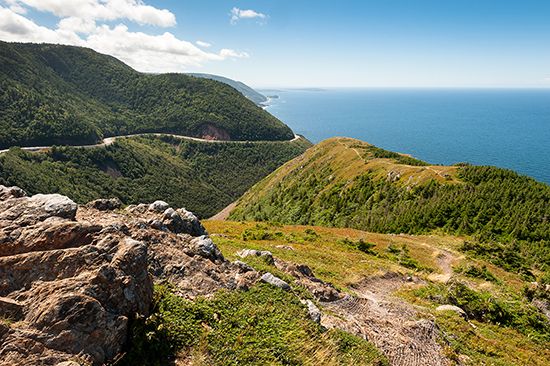
Cabot Strait
Cabot Strait is a 60-mile (97 km) wide channel located in eastern Canada that separates southwestern Newfoundland from Cape Breton Island, Nova Scotia.
What is Cabot Strait?
Cabot Strait is a 60-mile (97 km) wide channel located in eastern Canada that separates southwestern Newfoundland from Cape Breton Island, Nova Scotia.1
Serving as a vital international shipping lane, the strait connects the Gulf of Saint Lawrence with the Atlantic Ocean. It acts as the most significant of the gulf’s three “gateways,” functioning as the primary passage through which Atlantic and Arctic waters enter the gulf, and the main route by which water and ice exit it. The strait is named after the Italian navigator John Cabot, who explored the region in the late 15th century while under the sponsorship of King Henry VII of England.123
How does the Gulf of Saint Lawrence connect to the interior of North America?
The Gulf of Saint Lawrence serves as a critical gateway to the interior of the North American continent, acting as the marine entry point for the St. Lawrence River system.
This connection is facilitated primarily through the St. Lawrence Seaway, a massive navigational project that allows deep-draft ocean vessels to travel from the Atlantic Ocean into the industrial and agricultural heartlands of North America. The route functions as follows:45
- The Gateway: The Gulf of Saint Lawrence receives Atlantic waters through three main entries, most notably the Cabot Strait, before funneling traffic into the St. Lawrence River estuary.42
- The River System: From the estuary, the system transitions into the St. Lawrence River, which serves as the primary watercourse leading toward the Great Lakes.4
- Navigational Infrastructure: To overcome natural obstacles like the Lachine Rapids, the St. Lawrence Seaway utilizes a series of locks and canals. This system lifts vessels from sea level to the elevation of the Great Lakes, extending approximately 3,766 km (2,340 miles) from the Atlantic to Lake Superior.45
What were the main goals of John Cabot’s voyages in the 15th century?
John Cabot’s primary goal during his 15th-century voyages was to discover a westward route to Asia, which he believed he could reach by sailing across the North Atlantic. Independently of Christopher Columbus, Cabot envisioned this path as a way to access the lucrative markets of the East.3
Following his initial 1497 voyage, during which he mistakenly believed he had reached the northeast coast of Asia, Cabot’s objectives expanded to include:
- Establishing Trade: He sought to secure a monopoly on trade for England in the lands he encountered, as authorized by letters patent from King Henry VII.3
- Resource Acquisition: Cabot reported that the newly discovered regions were rich in fish, which he hoped would end England’s dependence on Iceland for its supply.3
- Reaching Japan: In his second expedition, he planned to return to his original landing site and sail westward until he reached Japan, which he considered the source of valuable spices and gems.3
Why are fog and ice considered major hazards for ships in this region?
Fog and ice are considered major hazards for ships in the Gulf of Saint Lawrence due to the region’s complex maritime environment and challenging navigation conditions.
- Ice Hazards: The gulf is characterized by the presence of ice floes, which are a prominent feature of the area. During winter months, the gulf receives a formidable quantity of ice from the St. Lawrence River and other gateways. This ice can obstruct shipping lanes and pose significant risks to vessels navigating the area, particularly before the spring thaw.2
- Navigation and Reefs: The gulf’s floor is not uniform; it contains various submarine platforms and depressions. The presence of reefs on these shallow surfaces, combined with the reduced visibility caused by frequent fog and the physical presence of ice, has historically resulted in a large number of shipwrecks.2
These environmental factors necessitate careful maritime management, as the gulf serves as a vital gateway to the interior of the North American continent.2
Sources
- Cabot Strait — Encyclopædia Britannica
- Gulf of Saint Lawrence — Encyclopædia Britannica
- John Cabot — Encyclopædia Britannica
- St. Lawrence River — Encyclopædia Britannica
- St. Lawrence River - The economy — Encyclopædia Britannica
- canals and inland waterways - Major inland waterways of North America — Encyclopædia Britannica
- John Cabot: Top Questions — Encyclopædia Britannica
- Sebastian Cabot — Encyclopædia Britannica
- St. Lawrence River - Physiography — Encyclopædia Britannica
- sea ice - The emerging impacts of recent changes to sea ice — Encyclopædia Britannica
- iceberg - Impact on ocean structure — Encyclopædia Britannica
Published on · 3 min read