Pennsylvanian Subperiod
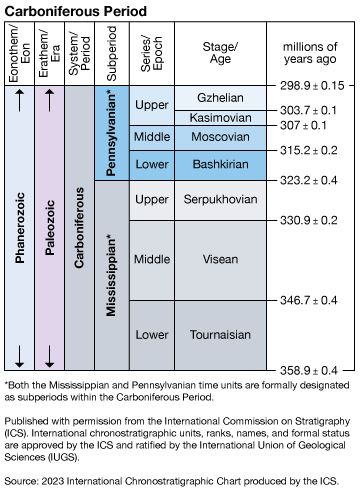
The Pennsylvanian Subperiod is the second major interval of the Carboniferous Period, spanning from 323.2 million to 298.9 million years ago. It is…
What is Pennsylvanian Subperiod?
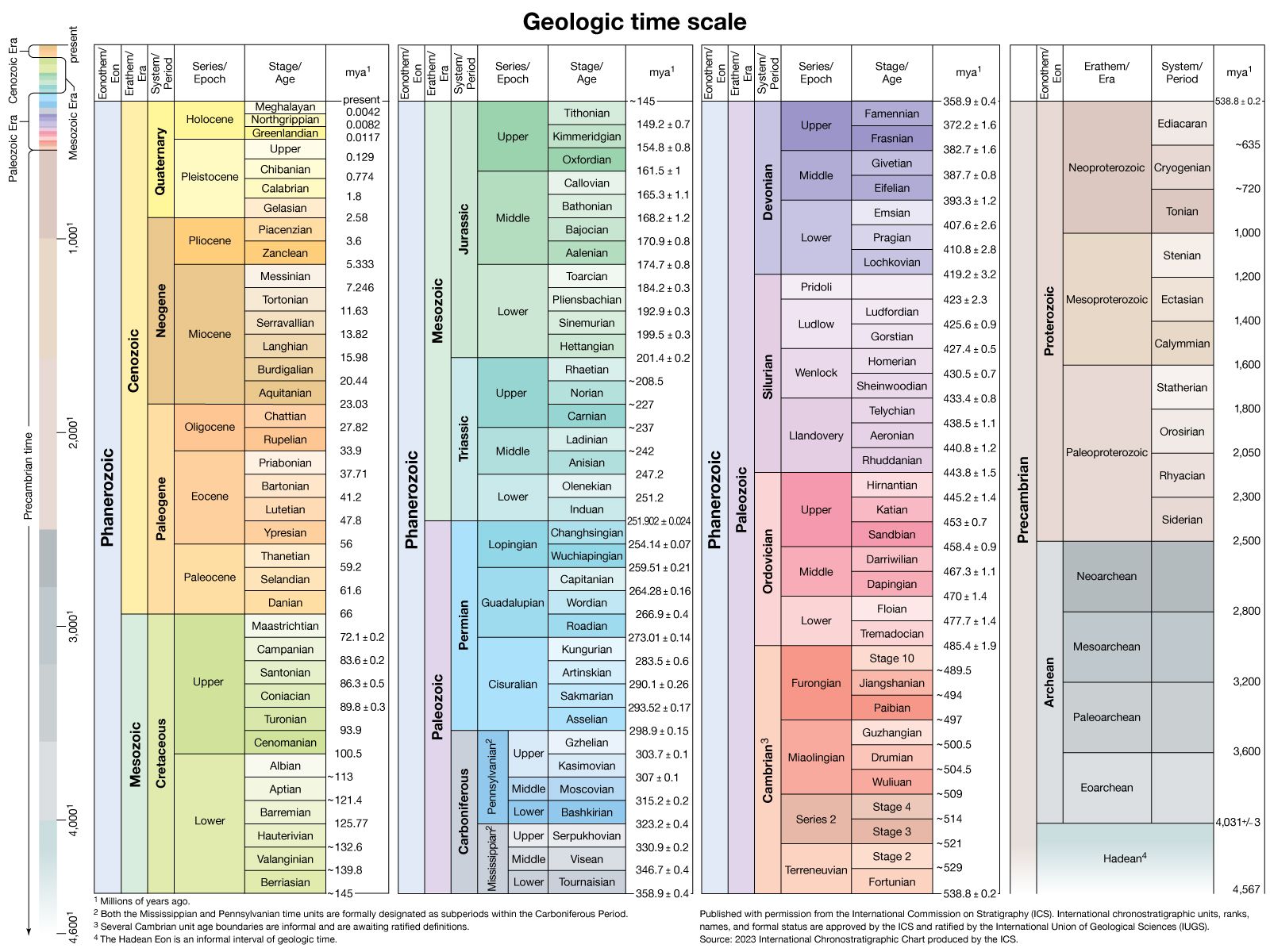
The Pennsylvanian Subperiod is the second major interval of the Carboniferous Period, spanning from 323.2 million to 298.9 million years ago. It is characterized by cyclical sedimentary deposits that reflect an alternation between marine and nonmarine conditions.12
During this time, many nonmarine equatorial areas became extensive coal swamps, leading to the formation of more coal than at any other time in the geologic record. These environments supported diverse vascular plants, such as lycopods and seed ferns. The subperiod also saw significant biological developments, including the appearance of the first reptiles and the diversification of insects, such as large dragonflies.123
Geologically, the era featured pronounced sea-level changes and significant orogenic activity, or mountain building, across various continents. While equatorial regions hosted lush swamps, the Southern Hemisphere experienced widespread continental glaciations.24
How did the high oxygen levels in the atmosphere affect the size of insects?
During the Carboniferous Period, atmospheric oxygen levels were significantly higher than they are today—reaching approximately 30 percent compared to the modern 21 percent. Many scientists believe these elevated oxygen concentrations played a critical role in enabling insects and other arthropods to reach massive sizes.563
This relationship is linked to the insect respiratory system, which relies on a network of branching tubes called tracheae to deliver oxygen directly to tissues. Because gases diffuse slowly through these narrow tubes, the length of the tracheae imposes a natural limit on how large an insect can grow. Higher atmospheric oxygen levels likely helped overcome this limitation by facilitating more efficient gas exchange, thereby providing the energy required to fuel the growth of giant forms, such as the ancestors of modern dragonflies with 70-cm wingspans.7563
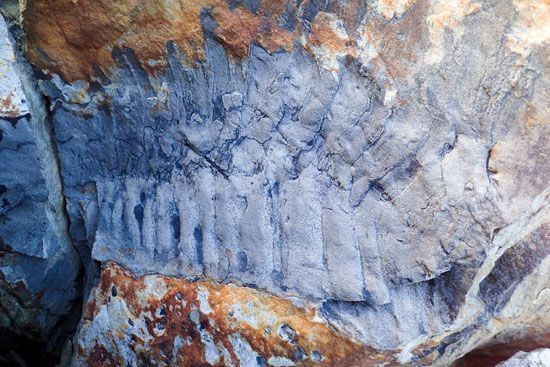
However, some evidence suggests that oxygen levels alone may not be the only factor. For instance, the giant millipede-like Arthropleura achieved massive proportions even during periods when oxygen levels were only slightly higher than present-day levels, indicating that other environmental or biological factors also contributed to their size.3
What are some of the most common plants found in Pennsylvanian coal swamps?
The Pennsylvanian coal swamps were dominated by a diverse array of vascular land plants that thrived in warm, humid, equatorial environments. These lush ecosystems were the primary source of the vast coal deposits found in the geologic record today.8910
The most common plant groups found in these swamps included:
- Lycopods (Lycopsids): These were among the most prominent trees in the swamp forests, sometimes reaching heights of 30 meters (about 100 feet). Dominant genera included Lepidodendron, characterized by diamond-shaped leaf bases, and Sigillaria, which featured ribs and round leaf bases.81
- Sphenopsids: These plants were characterized by jointed stems and leaves arranged in spirals. The genus Calamites was a common tree-sized sphenopsid that grew in profusion within these swampy environments.81
- Seed Ferns (Pteridosperms): Often referred to as “fernlike” plants, these were gymnosperms that reproduced via seeds rather than spores. While they are only distantly related to true ferns, they formed a significant portion of the underfoliage in coal swamps. Common taxa included Neuropteris and Pecopteris.81112
- True Ferns: Along with seed ferns, true ferns were a major component of the dense undergrowth beneath the taller lycopod trees.81
What distinguishes the Mississippian subperiod from the Pennsylvanian subperiod?
The Carboniferous Period is divided into two major subperiods: the Mississippian (358.9 to 323.2 million years ago) and the Pennsylvanian (323.2 to 298.9 million years ago). They are distinguished primarily by their geological deposits, climate, and biological environments.113
Geological and Environmental Differences
- Depositional Patterns: The Mississippian is characterized by widespread shallow-water limestone deposits across continental interiors. In contrast, the Pennsylvanian is defined by cyclothems—repeating sequences of marine and nonmarine strata—which contain the majority of the world’s coal reserves.14515
- Climate: A significant cooling event occurred near the boundary of the two subperiods. While the Mississippian generally featured warmer conditions, the Pennsylvanian saw the development of extensive glacial deposits in the Southern Hemisphere (Gondwana), reflecting a shift toward colder climates.155
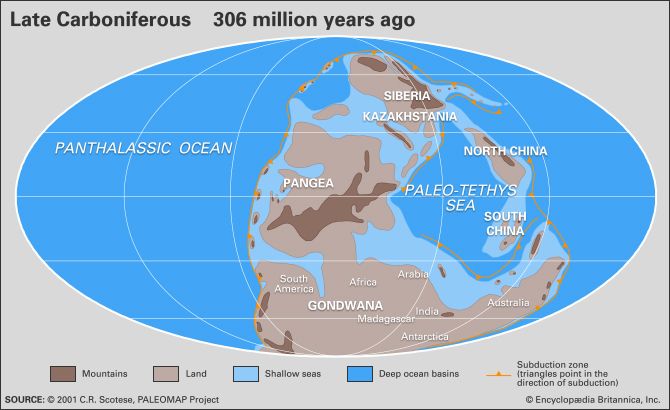
- Tectonics: By the Pennsylvanian, most of the landmass of Laurussia had fused with Gondwana, closing the Tethys Sea, whereas the Mississippian world was characterized by these landmasses being separated.13
Biological Shifts
- Insects: While insects existed earlier, the Pennsylvanian is noted for the diversification of advanced forms, including the emergence of large dragonflies and mayflies, as well as the first terrestrial scorpions and wing-folding insects like cockroaches.13
- Marine Life: The Mississippian marked a period where armored fishes, which were abundant in the Devonian Period, went largely extinct.14
Sources
- Pennsylvanian Subperiod — Encyclopædia Britannica
- Carboniferous Period - Distinctive features — Encyclopædia Britannica
- Carboniferous Period - Invertebrates — Encyclopædia Britannica
- Carboniferous Period - Paleoclimate — Encyclopædia Britannica
- A Journey Through Time Since the Precambrian - Carboniferous Period: 358.9 million to about 298.9 million years ago — Encyclopædia Britannica
- Respiratory system - Trachea — Encyclopædia Britannica
- Arthropleura — Encyclopædia Britannica
- Carboniferous Period - Plants — Encyclopædia Britannica
- coal - The fossil record — Encyclopædia Britannica
- seed fern — Encyclopædia Britannica
- cycadophyte - Seed ferns — Encyclopædia Britannica
- coal - Plant matter — Encyclopædia Britannica
- Carboniferous Period — Encyclopædia Britannica
- Carboniferous Period - Occurrence and distribution of Carboniferous deposits — Encyclopædia Britannica
- Carboniferous Period - Major subdivisions of the Carboniferous System — Encyclopædia Britannica
- Mississippian Subperiod — Encyclopædia Britannica
- Carboniferous Period - Pennsylvanian cyclothems , tillites , and turbidites — Encyclopædia Britannica
Published on · 4 min read