Caledon River
The Caledon River is a significant tributary of the Orange River located in southeastern Africa. It originates in the Drakensberg mountains along the border…
What is Caledon River?
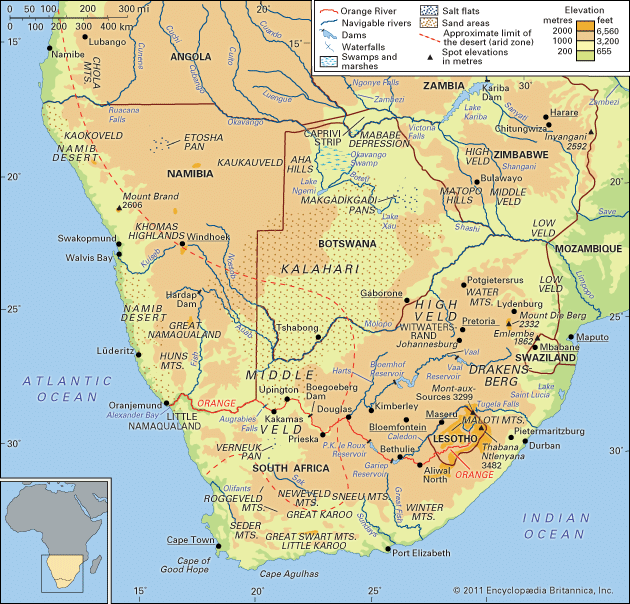
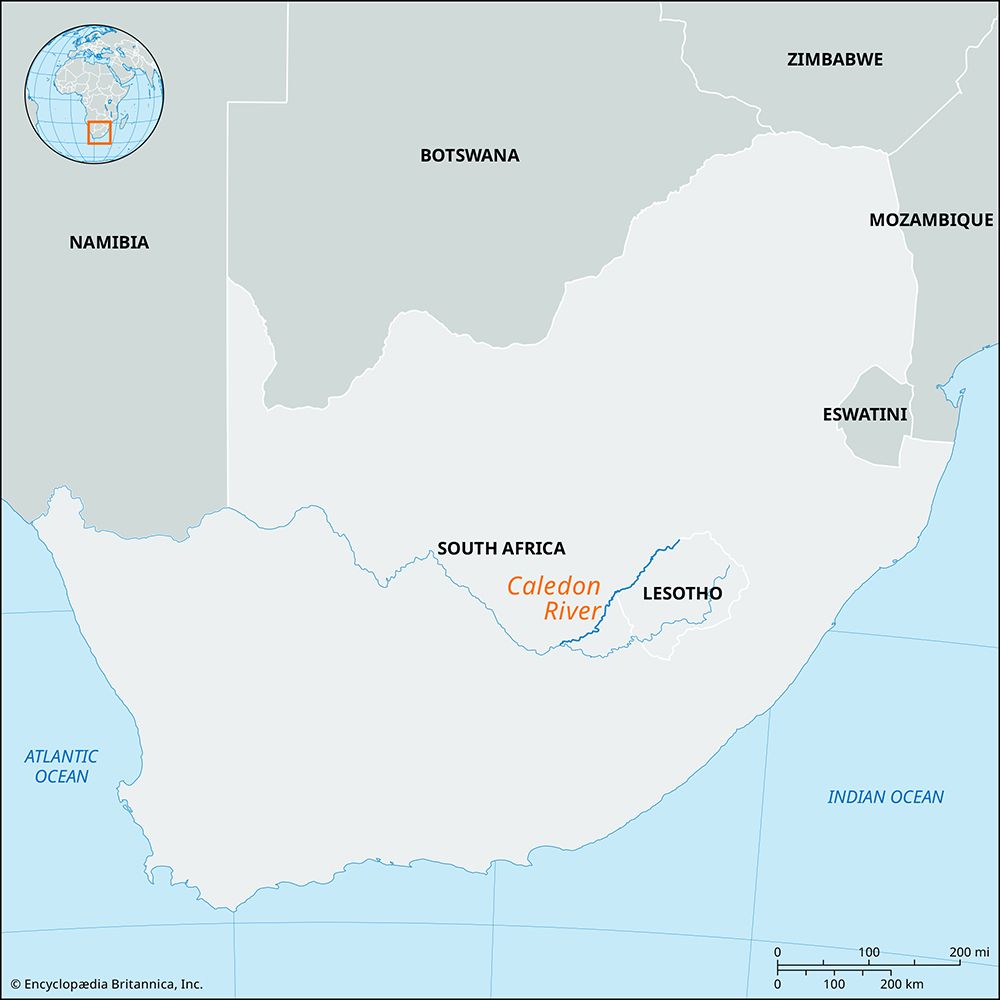
The Caledon River is a significant tributary of the Orange River located in southeastern Africa. It originates in the Drakensberg mountains along the border of Lesotho and South Africa.1
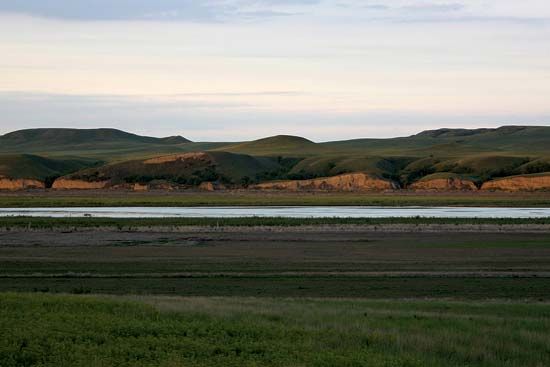
Flowing southwest for approximately 300 miles (480 km), the river serves as the primary boundary between Lesotho and the Free State province of South Africa. Maseru, the capital of Lesotho, is situated along its banks. After exiting Lesotho near Wepener, the river continues through the Free State before joining the Orange River near the town of Bethulie.1
The river’s valley is notable for having one of the most extreme temperature ranges in South Africa and serves as a highly productive region for corn (maize) cultivation.1
What is the significance of the Orange River?
The Orange River is of vital economic and historical importance to southern Africa. As one of the continent’s longest rivers, it serves as a critical water source for irrigation, urbanization, and economic development in South Africa’s central industrial areas.2
Economic Significance
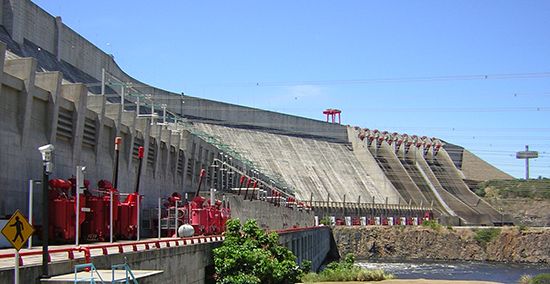
The river’s utility is maximized through major infrastructure, most notably the Orange River Project and the Lesotho Highlands Water Project. These initiatives utilize dams like the Gariep Dam and the Van der Kloof Dam to provide hydroelectric power and manage water distribution across arid regions that would otherwise be unamenable to cultivation.23
Historical Significance
Historically, the river has functioned as a major geopolitical boundary:
- Colonial Era: It marked the northern limit of British power in the 19th century.4
- Political Identity: In the 1830s, Boers crossed the river seeking independence, eventually naming their republic, the Orange Free State, after it.4
- Exploration: It served as a focal point for 18th and 19th-century explorers, including Robert Jacob Gordon, who named the river in honor of the Dutch House of Orange.4
How does the Drakensberg mountain range influence the region?
The Drakensberg mountain range is a defining feature of Southern Africa, exerting a profound influence on the region’s geography, climate, and hydrology.
Geographic and Climatic Barrier
As part of the Great Escarpment, the range acts as a massive physical barrier that separates the high plateaus of the South African interior from the lower-lying coastal lands of KwaZulu-Natal and Eswatini. This rugged terrain, characterized by steep scarps and high-altitude basalt peaks, creates distinct environmental zones, including the scenic sandstone terraces and deep valleys that support numerous game reserves and national parks.5
Hydrological Significance
The Drakensberg is the primary watershed of South Africa. It serves as the vital source for major river systems, including the Orange River and the Caledon River. By capturing precipitation—often in the form of snow during winter—the range functions as a critical water tower for much of Southern Africa.561
Cultural and Economic Impact
Beyond its physical influence, the range is a site of significant cultural heritage, containing ancient cave art and the uKhahlamba/Drakensberg Park, a UNESCO World Heritage site. While the challenging terrain has limited some forms of development, it has fostered a unique tourism industry centered on mountaineering and mountain resorts.51
What is the climate like in the Caledon River valley?
The Caledon River valley is characterized by one of the greatest temperature ranges in South Africa. As part of the broader veld region, the climate follows a pattern of mild, dry winters (May to September) and hot summers (November to March).17
The area experiences significant daily temperature fluctuations and abundant sunshine, which is typical for the region. Precipitation in this part of the interior primarily occurs during the summer months, often arriving in the form of high-energy thunderstorms. This climate, while variable, supports the valley’s status as a prolific agricultural zone, particularly for the production of corn (maize).71
Sources
- Caledon River — Encyclopædia Britannica
- Orange River — Encyclopædia Britannica
- Orange River - Study and exploration — Encyclopædia Britannica
- Orange River - Irrigation — Encyclopædia Britannica
- Drakensberg — Encyclopædia Britannica
- Maloti Mountains — Encyclopædia Britannica
- veld - Climate — Encyclopædia Britannica
- Orange River - Climate and hydrology — Encyclopædia Britannica
Published on · 3 min read