Callaeidae
The provided search results do not contain specific information regarding the unique breeding habits of the Callaeidae family that would distinguish them…
How do the breeding habits of Callaeidae birds differ from other bird families?
The provided search results do not contain specific information regarding the unique breeding habits of the Callaeidae family that would distinguish them from other bird families, other than noting that they build loose, shallow nests lined with ferns on ledges or in hollows.1
While general avian reproductive behaviors—such as nesting, incubation, and courtship strategies—are well-documented across the class Aves, the specific comparative data required to contrast Callaeidae breeding habits against other families is not available in the provided text.2
Where are Callaeidae birds primarily found, and what type of habitats do they prefer?
Callaeidae birds, commonly known as wattlebirds, are endemic to New Zealand. They are found exclusively within the country’s deep forest habitats.1
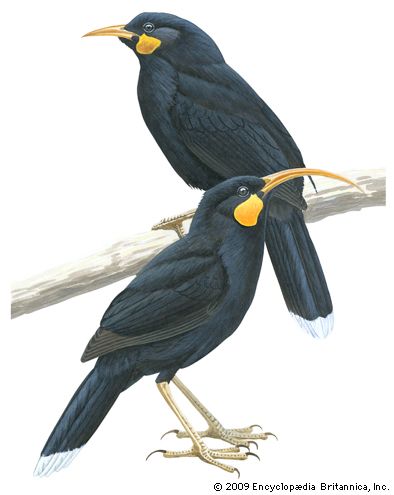
These birds are characterized by their long tails, strong feet, and weak wings, and they possess distinctive fleshy wattles at the corners of their mouths. Their diet consists primarily of fruits, supplemented occasionally by insects foraged from the ground. The family includes three species: the kokako, the saddleback, and the huia, the latter of which has been extinct since the early 20th century.1
What role do Callaeidae birds play in their ecosystem and in Maori culture?
The Callaeidae family, or wattlebirds, plays a specific role in the New Zealand ecosystem primarily as frugivores. By consuming fruits, these birds contribute to the dispersal of seeds within their deep forest habitats, a common ecological function among fruit-eating birds. Additionally, the huia exhibited unique cooperative feeding behaviors, where the male would chisel into wood while the female probed for grubs, potentially influencing the distribution of wood-boring insects.14
In Maori culture, the huia held significant cultural importance. The bird’s black, white-tipped tail feathers were highly prized and worn by Maori chiefs as an insignia of rank. Due to this cultural value and the bird’s limited range, the huia became a symbol of prestige, though it has been extinct since the early 20th century.15
The provided search results do not contain further information regarding the specific cultural roles of the other two extant species, the kokako and the saddleback.
How do Callaeidae birds communicate and what are their social behaviors?
Information regarding the specific social behaviors and communication methods of Callaeidae birds is limited in the provided search results.
Regarding communication, the kokako is noted for having a “mellow, deliberate song,” which has earned it local names such as “organbird” and “bellbird.” While general passeriform behavior often involves song and posturing for territoriality and courtship, the specific social structures or communicative displays of the other wattlebird species—the saddleback and the extinct huia—are not detailed in the available data.67
The only specific social behavior mentioned for the family is the potential for cooperative feeding in the huia, where the male and female may have worked together to access food sources by chiseling wood and probing for grubs. Beyond these points, the provided search results do not contain further information on the complex social interactions or communication systems of these birds.1
Sources
- Callaeidae — Encyclopædia Britannica
- Reproductive behaviour - Birds — Encyclopædia Britannica
- biogeographic region - New Zealand region — Encyclopædia Britannica
- seed - Dispersal by birds — Encyclopædia Britannica
- huia — Merriam-Webster
- Kokako — Encyclopædia Britannica
- Passeriform - Territoriality and courtship — Encyclopædia Britannica
- mammal - Territoriality — Encyclopædia Britannica
Published on · 2 min read