Calopogon
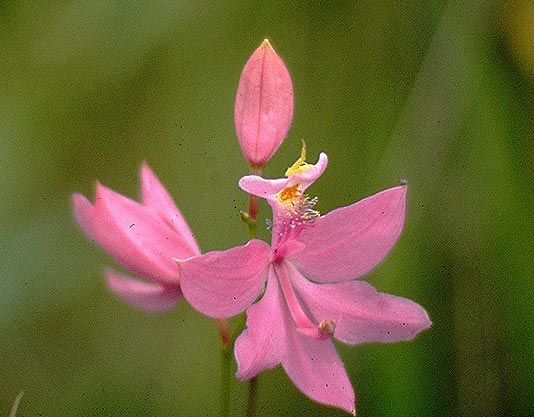
Calopogon is a genus comprising five species of terrestrial orchids native to North America and the West Indies. These perennial plants are typically found…
What is Calopogon?
Calopogon is a genus comprising five species of terrestrial orchids native to North America and the West Indies. These perennial plants are typically found in bogs, swamps, and occasionally prairie habitats.1
Key characteristics of the genus include:
- Structure: Each corm (a swollen stem base) produces one or two ribbed leaves and a spike of several flowers.1
- Appearance: The flowers, which measure about 2.5 cm (1 inch) wide, range in color from white to lavender and deep pink.1
- Unique Morphology: Unlike most orchids, Calopogon flowers typically feature the labellum (lip) at the top, which is characteristically covered in hairs.12
While they are sometimes cultivated as ornamentals, they are also known by the common name “grass pink” due to their grasslike foliage and spikelike racemes of bearded flowers.12
How do orchids adapt to living in bogs and swamps?
Orchids that inhabit bogs and swamps have evolved specialized strategies to survive in environments characterized by high acidity, low nutrient availability, and waterlogged, oxygen-poor soil.3
A primary adaptation for all orchids, including those in wetland habitats, is their reliance on mycorrhizal symbiosis. Because orchid seeds are dustlike and lack the endosperm necessary to fuel germination, they depend on fungal partners to provide essential nutrients during their initial development. This relationship often continues throughout the plant’s life cycle; many terrestrial orchids function as partial mycoheterotrophs, supplementing their own photosynthetic energy by leaching nutrients from fungal networks.4
In the nutrient-poor, acidic conditions of a bog, this fungal association is critical for acquiring nitrogen and other minerals that are otherwise difficult to obtain. While some orchids in these environments are photosynthetic, their ability to tap into underground fungal networks allows them to thrive where other plants might struggle. Furthermore, species such as those in the genus Calopogon have adapted to these wet conditions by utilizing specialized structures like corms to store energy, enabling them to persist in habitats that range from swamps to prairies.341
What is the function of the labellum in orchid pollination?
The labellum, or lip, is a specialized petal that serves as a critical component in the pollination of orchids. Its primary functions include:
- Landing Platform: In many species, the labellum acts as a landing stage for insect pollinators, positioning them precisely to interact with the flower’s reproductive structures, known as the column.78
- Attraction: The labellum often features nectaries or grooves that secrete nectar to entice visitors. Some species produce “pseudopollen”—starchy, hair-like outgrowths—to deceive insects into visiting the flower.78
- Sexual Deception: Certain orchids, such as those in the genus Ophrys, use the labellum to manipulate pollinators through mimicry. By imitating the scent, shape, and tactile stimuli of female insects, the labellum induces males to attempt pseudocopulation. This behavior ensures the insect contacts the flower’s pollinia, facilitating the transfer of pollen to other plants.9
The labellum’s role is essential to the orchid’s highly evolved, precise mechanical approach to reproduction.8
What are some other types of native North American orchids?
North America is home to a diverse array of native orchids, many of which are terrestrial and adapted to temperate climates. Beyond the bog-dwelling Calopogon mentioned previously, several other notable groups exist:101
- Lady’s Slippers (Cypripedium): These are perhaps the most recognizable North American orchids, characterized by a slipper-shaped lip that traps insects to facilitate pollination. Well-known species include the yellow lady’s slipper (C. calceolus) and the pink lady’s slipper (C. acaule), also known as the moccasin flower.5
- Ladies’ Tresses (Spiranthes): These orchids are frequently found in wet, boggy areas and roadside ditches. They are known for their spiraling spikes of small, often fragrant flowers.10
- Rein Orchids (Habenaria and Platanthera): These genera include various species adapted to diverse habitats, ranging from wet, boggy situations to more standard soil environments. For instance, Platanthera ciliaris is so common in some parts of the United States that it is occasionally considered a weed, while certain Habenaria species in the Florida Everglades are nearly aquatic.10
- Greenfly Orchid (Epidendrum conopseum): While the Epidendrum genus is primarily tropical, this specific species is native to southeastern North America and is the only member of its genus found in nontropical regions of the continent.11
Sources
- Calopogon — Encyclopædia Britannica
- Calopogon — Merriam-Webster
- Bog - Flora — Encyclopædia Britannica
- mycoheterotroph — Encyclopædia Britannica
- orchid - Ecology — Encyclopædia Britannica
- orchid - Mycorrhizal associations — Encyclopædia Britannica
- orchid - Floral structure — Encyclopædia Britannica
- orchid - Pollination — Encyclopædia Britannica
- orchid - Sexual deception — Encyclopædia Britannica
- lady’s slipper — Encyclopædia Britannica
- orchid: Top Questions — Encyclopædia Britannica
- The Orchid and the Fungus - Learn more — Encyclopædia Britannica
- Epidendrum — Encyclopædia Britannica
Published on · 3 min read