Rockhopper Penguin
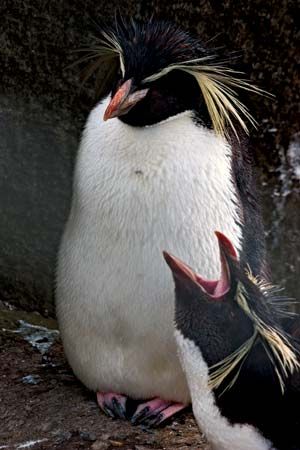
Rockhopper penguins, like most penguin species, rely on a combination of visual and vocal displays to communicate with one another, particularly within their…
How do rockhopper penguins communicate with each other?
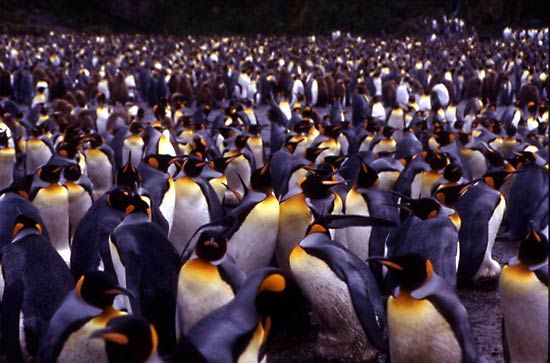
Rockhopper penguins, like most penguin species, rely on a combination of visual and vocal displays to communicate with one another, particularly within their large, dense breeding colonies.12
These interactions are most frequent between the time the birds arrive at their nesting sites and when they depart. Key methods of communication include:
- Vocalizations: Penguins use a variety of sounds, such as trumpeting, croaking, cackling, and cooing, to interact with mates and other colony members. These vocalizations are essential for finding mates and for parents to distinguish their own chicks from others within a crèche—a nursery group where young birds gather for protection.12
- Visual Displays: Physical displays are used during courtship and when re-establishing bonds with mates upon returning to the colony each year. These displays help birds navigate the social complexities of the colony and coordinate breeding activities.1
While vocalizations are diverse across species, the specific behavioral patterns of rockhopper penguins are generally consistent with the broader social strategies observed in other penguins.12
Where are rockhopper penguins typically found in the wild?
Rockhopper penguins are found across various subantarctic and cool-temperate islands, as well as on islands within the Tierra del Fuego archipelago. The two distinct species have different primary ranges:
- Northern rockhopper penguins (E. moseleyi): These populations are found on the Tristan da Cunha island group in the South Atlantic Ocean, as well as St. Paul Island and Nouvelle Amsterdam in the Indian Ocean.2
- Southern rockhopper penguins (E. chrysocome): These are most concentrated in the Falkland Islands and on islands near Cape Horn off the southern coast of South America. Additional colonies exist on the Crozet Islands, the Kerguelen Islands, Prince Edward and Marion islands, as well as Macquarie Island and Campbell Island in the Southern Ocean.2
How do rockhopper penguins care for their young?
Rockhopper penguins exhibit a high level of parental cooperation, with both males and females playing active roles in raising their offspring.32
The process of caring for their young involves several key stages:
- Incubation: After laying two eggs, both parents take turns incubating them for approximately 32–33 days.2
- Guarding and Feeding: Once the chicks hatch, the parents continue their alternating strategy to guard and feed the young. This shared responsibility lasts until the chicks are about 25 days old.2
- Crèche Formation: Once the chicks reach approximately 25 days of age, they join a crèche—a group of young penguins gathered together for protection. This allows both parents to forage for food in the ocean simultaneously, which is vital for the survival of the growing chicks.24
- Independence: The young remain in the colony until they are old enough to be fully independent, which occurs after about 66 days for northern rockhopper penguins and up to 70 days for southern rockhopper penguins.2
What are the distinguishing physical features of rockhopper penguins?
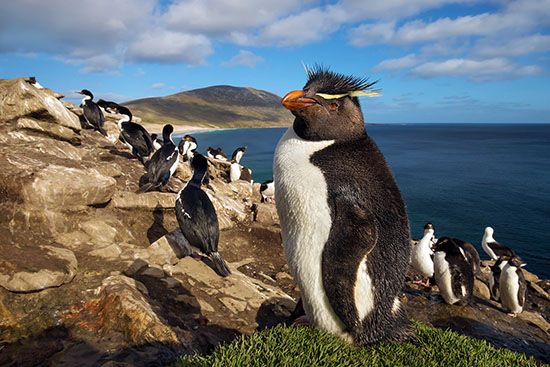
Rockhopper penguins are small, crested penguins characterized by several distinct physical traits. Adults typically stand under 52–55 cm (20–22 inches) tall and weigh between 2.5 and 3 kg (5.5–6.6 pounds).2
Key physical features include:
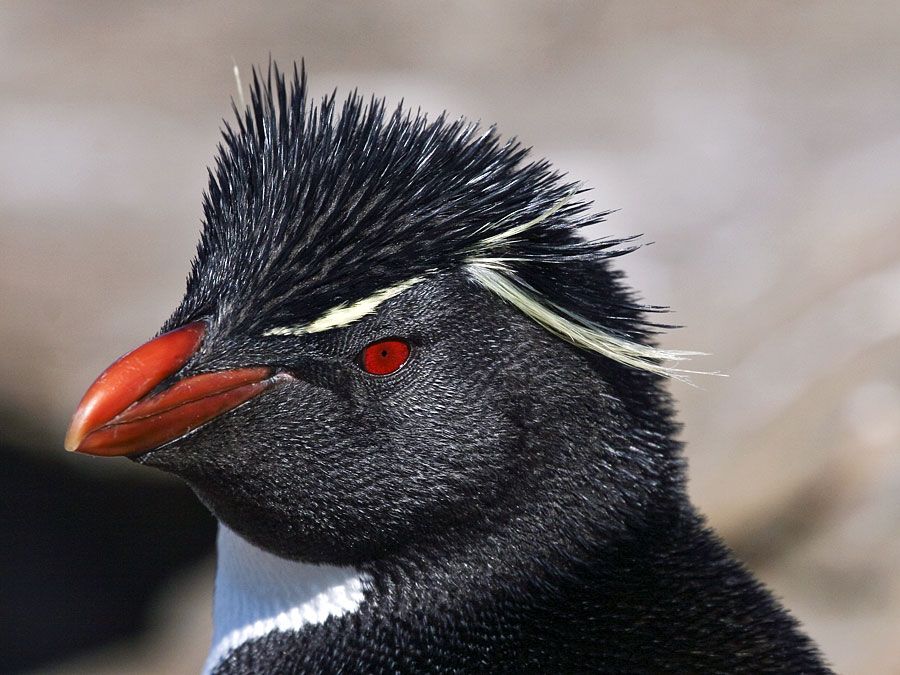
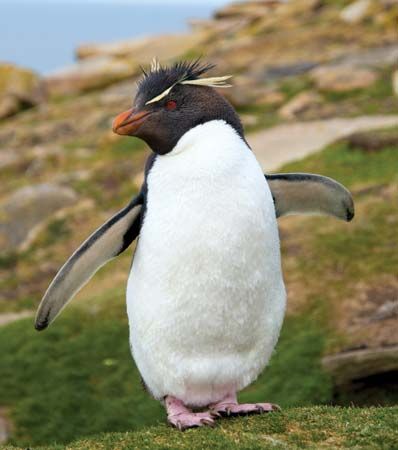
- Head and Face: They possess striking red eyes, a red-brown beak, and a crest of black feathers that stands upright on the top of the head.2
- Superciliary Stripes: A thin, prominent stripe of upright yellow feathers extends from the bill to the back of the head above each eye. The northern rockhopper penguin is distinguished from the southern species by having a slightly thicker version of this stripe.2
- Coloration: They feature black feathers on the head, throat, and back, which contrast sharply with their white underside.2
Juveniles generally resemble adults but may have lighter or absent superciliary stripes and possess mottled gray plumage under the chin. Chicks are easily identified by their black bills, gray head and back plumage, and white undersides.2
Sources
- penguin - Reproduction — Encyclopædia Britannica
- Rockhopper penguin — Encyclopædia Britannica
- Are penguins monogamous? — Encyclopædia Britannica
- crèche — Merriam-Webster
- Erect-crested penguin — Encyclopædia Britannica
Published on · 3 min read