Canary Islands
The Canary Islands are physically divided into two distinct groups, each offering unique landscapes shaped by their volcanic origins.
How do the different Canary Islands vary in terms of landscape and attractions?
The Canary Islands are physically divided into two distinct groups, each offering unique landscapes shaped by their volcanic origins.1
Eastern Islands
The eastern group, including Lanzarote and Fuerteventura, sits on a submarine plateau.1
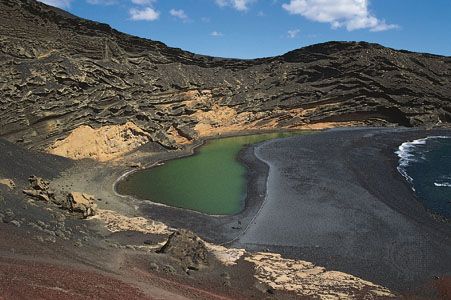
- Lanzarote: Known for its arid, mountainous terrain, it features numerous craters and lava flows. Key attractions include the Timanfaya National Park, where volcanic heat is still palpable, and its distinctive black-sand beaches.2
- Fuerteventura: This island is largely barren with eroded beaches. It is popular for its warm, dry climate and expansive coastal scenery.3
Western Islands
The western islands, such as Tenerife and La Palma, are characterized by high mountain peaks rising from the deep ocean floor.1
- La Palma: Features the massive La Caldera de Taburiente national park and the Cumbre Vieja volcanic ridge. Its slopes are well-watered and densely wooded, offering a lush contrast to the eastern islands.4
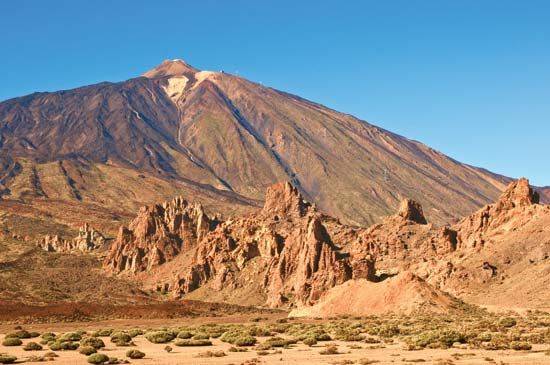
- Tenerife: Home to Teide Peak, the highest point in Spain, which dominates the island’s dramatic topography.1
What is the geographical location of the Canary Islands and how many main islands are there?
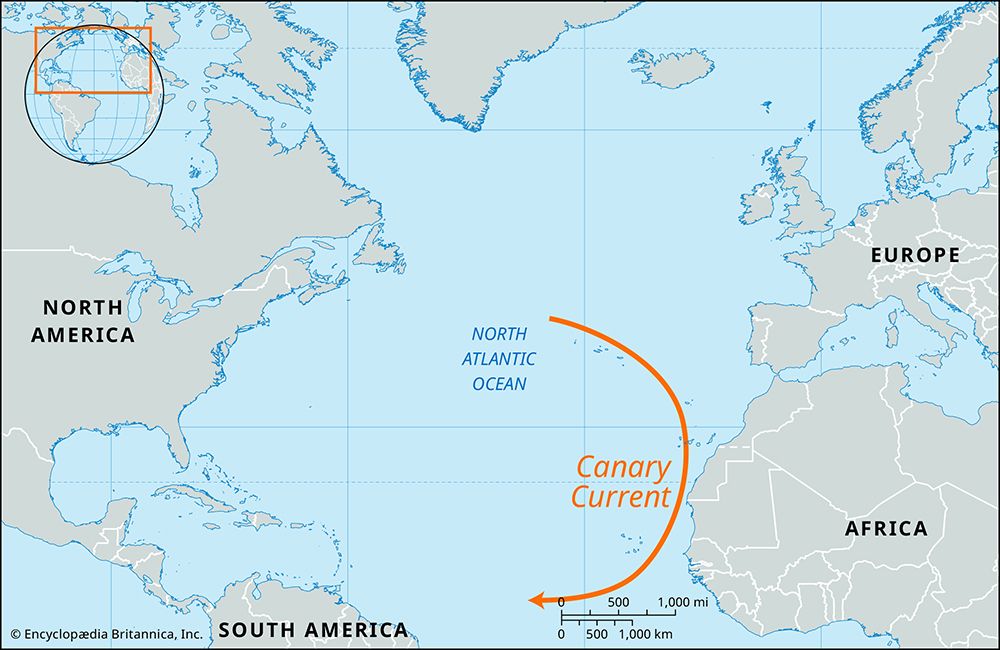
The Canary Islands are an autonomous community of Spain located in the Atlantic Ocean, situated approximately 67 miles (108 km) off the northwestern coast of Africa.6
The archipelago consists of seven main islands:
- Tenerife
- Gran Canaria
- Lanzarote
- Fuerteventura
- La Palma
- La Gomera
- Ferro6
What is the climate like in the Canary Islands, and how does it differ from mainland Spain?
The Canary Islands experience a subtropical Atlantic climate, characterized by warm temperatures and minimal seasonal variation. For instance, in Las Palmas, average afternoon temperatures remain consistent, typically ranging from about 70 °F (21 °C) in January to the high 70s F (about 26 °C) in August. Annual precipitation is generally low, rarely exceeding 10 inches (250 mm), though windward northeastern areas can receive up to 30 inches (750 mm).7
In contrast, mainland Spain features a more complex climate defined by maritime, continental, and mountain influences. While northern Spain is temperate and humid, the rest of the peninsula experiences a Mediterranean climate with continental tendencies—meaning it is hot toward the coast but relatively cold in the interior. Unlike the stable warmth of the Canaries, mainland regions often see significant temperature fluctuations; for example, inland areas like Albacete can range from 40 °F (4 °C) in winter to 75 °F (24 °C) in summer.2
What is the unique geological history of the Canary Islands, and how were they formed?
The Canary Islands were formed by volcanic eruptions that occurred millions of years ago. Geologically, the archipelago is divided into two distinct groups based on their formation and structure:2
- The Western Group: Comprising Tenerife, Gran Canaria, La Palma, La Gomera, and Ferro, these islands consist of mountain peaks that rise directly from the deep ocean floor.2
- The Eastern Group: Comprising Lanzarote, Fuerteventura, and several islets, these landmasses sit atop a single submarine plateau known as the Canary Ridge, which rises approximately 4,500 feet (1,400 meters) from the ocean floor.2
While volcanic activity is often associated with hotspots—where mantle plumes create chains of islands as tectonic plates move over them—the exact mechanisms behind various island chains remain a subject of scientific debate. Some geologists suggest that certain volcanic features may result from shallow processes, such as magma injection into crustal fractures or instabilities at the interface between continental and oceanic crust, rather than deep-rooted mantle plumes.8
Sources
- Lanzarote — Encyclopædia Britannica
- Canary Islands — Encyclopædia Britannica
- Fuerteventura Island — Encyclopædia Britannica
- La Palma — Encyclopædia Britannica
- list of cities and towns in Spain - Canary Islands — Encyclopædia Britannica
- Canary Islands — Merriam-Webster
- Spain - Climate of Spain — Encyclopædia Britannica
- plate tectonics - Hotspots — Encyclopædia Britannica
Published on · 3 min read