Sheep’s Bit
Sheep’s bit (Jasione montana) is an annual or biennial herb belonging to the bellflower family. It is characterized by its clustered, blue, star-shaped…
What is Sheep’s bit?
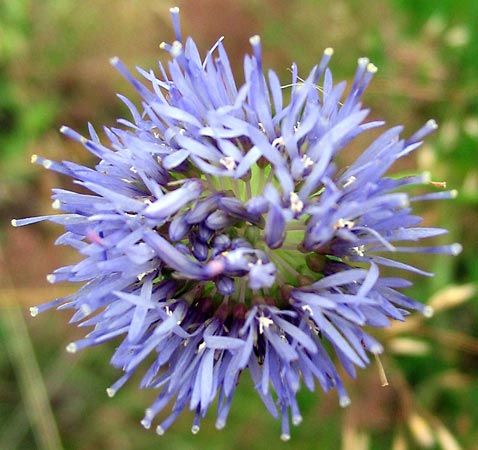
Sheep’s bit (Jasione montana) is an annual or biennial herb belonging to the bellflower family. It is characterized by its clustered, blue, star-shaped flowers that form globes approximately 2.5 cm (1 inch) in diameter. These plants typically thrive in sandy or acidic environments, such as meadows, fields, or cliffsides.1
Native to Europe, the species has been introduced to eastern North America. A closely related perennial species, J. perennis, is found in southern Europe and is distinguished by its broader leaves and larger flower heads, which can reach 5 cm (2 inches) in diameter.1
What defines a plant as an annual or biennial?
Plants are categorized by the duration of their life cycles, which are defined by how many growing seasons they require to complete their development from seed to reproduction.
Annuals
An annual is a plant that completes its entire life cycle—germination, growth, flowering, and seed production—within a single growing season. Once the plant produces seeds, it dies, and the dormant seed is the only part that survives to the next season. While many annuals follow the traditional spring-to-autumn cycle, some desert species can complete this process in just a few weeks following rainfall.23
Biennials
A biennial is a plant that requires two growing seasons to complete its life cycle.4
- First Season: The plant focuses on vegetative growth, developing its roots, stems, and leaves.43
- Second Season: The plant utilizes stored energy to produce flowers, fruits, and seeds, after which it dies.43
Many biennials, such as carrots, are often harvested during their first year before they can expend their stored energy on reproductive structures.4
What other plants belong to the bellflower family?
The Campanulaceae family, commonly known as the bellflower family, encompasses approximately 84 genera and 2,400 species of mostly herbaceous plants. While the genus Campanula is the most well-known, the family includes a diverse array of other plants:
- Ladybell (Adenophora): Similar to Campanula, these plants feature blue, bell-shaped flowers in spikes or clusters and are native to cool regions of Europe and Asia.6
- Canarian bellflower (Canarina): Notable for producing berries rather than capsules, these plants from Africa and the Canary Islands have tuberous roots and dull-yellow, bell-shaped flowers.6
- Bonnet bellflower (Codonopsis): These are weak-stemmed, sprawling perennials from Asia that produce pendent, bell-shaped flowers.6
- Trailing bellflower (Cyananthus): Himalayan mat-forming perennials with wide-open, blue bell tubes.6
- Grassy bellflower (Edraianthus): Low-growing perennials from the Balkans that often bear clustered, upward-facing bells.6
- Dart bellflower (Michauxia): Distinguished by 7 to 10 deep-parted lobes and a conspicuous, dartlike central column.6
- Giant bellflower (Ostrowskia): A fleshy-rooted perennial native to Central Asia that can reach up to 2.5 metres in height.6
- Ring bellflower (Symphyandra): Named for its joined ring of anthers, this genus includes perennials and biennials with nodding bells.6
- Lobelioids: Formerly the family Lobeliaceae, this group includes the large genus Lobelia, as well as hummingbird-pollinated genera like Siphocampylus, Centropogon, and Burmeistera.6
How do plants adapt to living in sandy or acidic soil?
Plants have evolved various strategies to survive in challenging environments like sandy or acidic soils.
Adapting to Sandy Soil
Sandy soils are often characterized by high drainage and low nutrient retention, as essential nutrients like calcium and magnesium are easily leached away. Plants in these environments often develop extensive root systems—either deep or broad—to maximize their ability to access water and nutrients. Some plants, such as succulents, store water in fleshy stems or leaves to survive periods of drought common in well-draining, arid soils. Additionally, many plants in dry or physiologically dry habitats are xerophytes, which utilize mechanisms like waxy leaf coatings or the ability to fold leaves to minimize water loss.91011
Adapting to Acidic Soil
Acidic soil (pH < 7) often presents challenges such as the increased solubility of toxic metals like aluminum and manganese, which can inhibit growth. While many agricultural crops struggle in these conditions, certain plants have adapted to thrive in acidity. For example, conifers and members of the Ericaceae family, such as blueberries, are well-suited to acidic environments and often perform poorly in alkaline soil. In some cases, soil acidity is managed by adding lime to neutralize the pH, a practice used to control specific plant diseases like clubroot.12913
Sources
- Sheep’s bit — Encyclopædia Britannica
- Biennial — Encyclopædia Britannica
- Reproduction - Life cycles of plants — Encyclopædia Britannica
- Annual — Encyclopædia Britannica
- Angiosperm - General features — Encyclopædia Britannica
- Campanulaceae — Encyclopædia Britannica
- Campanulaceae — Merriam-Webster
- Bellflower — Encyclopædia Britannica
- Xerophyte — Encyclopædia Britannica
- Succulent — Encyclopædia Britannica
- Plant disease - Soil pH — Encyclopædia Britannica
- pH — Encyclopædia Britannica
- soil - Mineral content — Encyclopædia Britannica
- soil - Biological phenomena — Encyclopædia Britannica
Published on · 3 min read