Cape Verde Peninsula
The Cape Verde Peninsula does not independently dictate the climate of Senegal; rather, it serves as a geographic marker within the country's broader…
How does the Cape Verde Peninsula affect the climate and weather patterns of Senegal?
The Cape Verde Peninsula does not independently dictate the climate of Senegal; rather, it serves as a geographic marker within the country’s broader climatic zones. Senegal’s climate is primarily conditioned by its tropical latitude and the seasonal migration of the intertropical convergence zone (ITCZ), which governs the movement of moist maritime winds and dry continental winds like the harmattan.1
The peninsula acts as a boundary point for these climatic regions. The coastal zone, which includes the peninsula and the city of Dakar, experiences a distinct maritime climate characterized by cool winters and moderate temperatures. Conversely, the Sahelian zone is bounded to the south by a line running through Thiès, a town located on the Cape Verde Peninsula, marking the transition toward the hotter, more arid conditions of the interior. While the peninsula’s projection into the Atlantic Ocean exposes it to southwesterly winds that contribute to its seasonal verdant appearance, it functions as a coastal feature rather than a primary driver of regional weather patterns.12
What is the geographical location of the Cape Verde Peninsula?
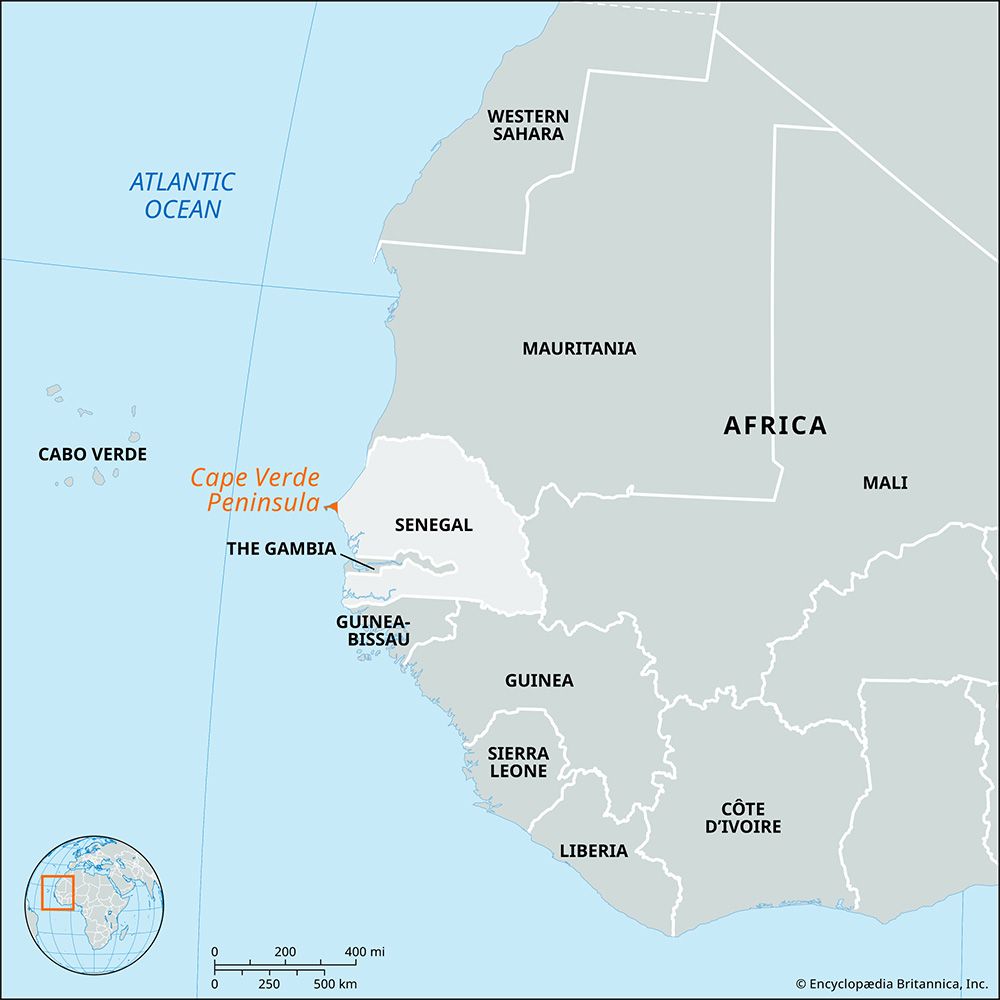
The Cape Verde Peninsula is located in west-central Senegal and serves as the westernmost point of the African continent.2
The peninsula projects into the Atlantic Ocean and is shaped like a triangle, measuring approximately 9 miles (15 km) per side. Its geography is defined by several key features:2
- Topography: It was formed by a combination of volcanic offshore islands and a land bridge created by coastal currents.2
- Landmarks: The landscape is dominated by the “Deux Mamelles” (twin volcanic cones) located northwest of Dakar, the nation’s capital, which occupies the peninsula.2
- Tips and Harbors: The northwestern tip is marked by Pointe des Almadies, while the southwest side features a natural harbor and bay.2
How did the Cape Verde Peninsula get its name?
The Cape Verde Peninsula, located in present-day Senegal, received its name following its initial sighting by Portuguese explorers around 1444.25
The name, which translates to “Green Cape” (Portuguese: Cabo Verde; French: Cap Vert), was inspired by the peninsula’s appearance. Unlike the surrounding arid, yellow dunes of the region, the peninsula often exhibits a lush, verdant landscape due to its exposure to moisture-bearing southwesterly winds.26
This geographic feature is historically significant as the westernmost point of the African continent. It later served as the namesake for the Cabo Verde Islands, an archipelago located approximately 385 miles off the coast that was named after this prominent mainland cape.26
What economic activities are important in the Cape Verde Peninsula region?
The Cape Verde Peninsula is a significant industrial and commercial hub in Senegal, benefiting from its strategic location as a major seaport on the western African coast.910
Key Economic Activities
- Manufacturing and Processing: The region is highly developed industrially. Major activities include peanut oil refining, which has historically been a cornerstone of the local economy, alongside fish canning, flour milling, and sugar refining.910
- Heavy Industry: The peninsula hosts diverse industrial facilities, including an oil refinery, chemical plants, a cement-manufacturing plant in Rufisque, and various assembly plants for trucks, bicycles, and automobiles.910
- Maritime and Logistics: As the site of Dakar, the peninsula serves as a vital transit point. Its harbor is one of the best in western Africa, supporting extensive trade and shipping operations. The region also features a naval shipyard and serves as a critical node for international air travel.109
- Traditional Crafts: Skilled artisans in the area produce traditional handicrafts, including wood carvings, jewelry, glass paintings, and textiles, which remain an important part of the local economic landscape.9
Historically, the indigenous Lebu people sustained themselves through fishing and farming, activities that continue to influence the region’s economic identity today.2
Sources
- Senegal - Climate of Senegal — Encyclopædia Britannica
- Cape Verde Peninsula — Encyclopædia Britannica
- Cabo Verde - Climate — Encyclopædia Britannica
- Namib - Climate — Encyclopædia Britannica
- Cabo Verde — Merriam-Webster
- Cabo Verde Islands — Merriam-Webster
- Cabo Verde — Encyclopædia Britannica
- Portugal - Conquest and exploration — Encyclopædia Britannica
- Senegal - Manufacturing of Senegal — Encyclopædia Britannica
- Dakar — Encyclopædia Britannica
- Cabo Verde - Early and colonial history — Encyclopædia Britannica
Published on · 3 min read