Caprimulgidae
Caprimulgidae is a family of birds within the order Caprimulgiformes, commonly known as nightjars or "goatsuckers". The latter name stems from an ancient…
What is Caprimulgidae?
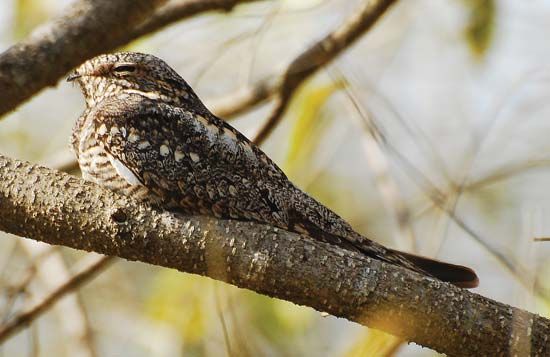
Caprimulgidae is a family of birds within the order Caprimulgiformes, commonly known as nightjars or “goatsuckers”. The latter name stems from an ancient, inaccurate superstition that these birds used their exceptionally wide mouths to milk goats; in reality, they are insectivorous birds that hunt flying insects on the wing, often attracted to the livestock.123
These birds are typically sparrow- to pigeon-sized, featuring protective gray and brown plumage that provides excellent natural camouflage while they rest during the day. They are primarily nocturnal, possessing large eyes and soft feathers that allow for silent flight. Most of the more than 80 species belong to the subfamily Caprimulginae (true nightjars), while the subfamily Chordeilinae includes the nighthawks ordeilinae includes the nighthawks. They are found nearly worldwide, with the notable exception of New Zealand and certain oceanic islands.143
Why are they sometimes called goatsuckers?
The term “goatsucker” is a historical misnomer for birds in the Caprimulgidae family, originating from an ancient, unfounded superstition that these birds would suck milk from goats.6
While it is difficult to imagine birds like the whip-poor-will or nighthawk engaging in such behavior, the name has persisted in the lexicon since at least 1611. In reality, these birds are insectivores that catch flies, moths, and beetles on the wing. Because they are often found near livestock—where they hunt the insects attracted to the animals—early observers likely misinterpreted their presence as an attempt to feed on the goats’ milk.67
The more common name, nightjar, refers to the birds’ nocturnal habits and their characteristic, often haunting, churring songs that were said to “jar” people from their sleep.68
How does their camouflage help them survive?
The camouflage of birds in the order Caprimulgiformes is a primary survival strategy that allows them to remain undetected by predators while they rest during the day. Their plumage features intricate patterns of rufescent to ochreous browns, grays, white, and black, which are specifically evolved to match their typical daytime environments.3
This background matching is highly specialized:
- Forest dwellers: Species that roost in woodlands possess streaked and spotted plumage that mimics fallen leaves and forest floor detritus.3
- Gravel dwellers: Those that rest on rocky or gravelly terrain often feature speckled patterns that allow them to blend in with stones.3
- Arboreal species: Potoos and frogmouths have plumage mottled like tree bark, enabling them to appear as dead stubs or branches when they adopt a stiff, “alarm” posture.39
By combining this protective coloration with specific behaviors—such as flattening their plumage, closing their eyes, and stretching their bodies to mimic their surroundings—these birds effectively hide from potential threats, ensuring their safety while they are inactive during daylight hours.329
What are the main differences between nightjars and nighthawks?
While nightjars and nighthawks are closely related members of the family Caprimulgidae, they are distinguished by their classification, geographic distribution, and foraging behaviors.
Classification and Distribution
- Nightjars: These belong to the subfamily Caprimulginae, often referred to as “true nightjars.” They are found globally in temperate and tropical regions, with the notable exception of New Zealand and some oceanic islands.21
- Nighthawks: These comprise the subfamily Chordeilinae. Unlike the widespread true nightjars, nighthawks are exclusively New World birds, found throughout the Americas.15
Foraging and Behavior
While both groups are insectivorous and catch prey on the wing, their hunting styles differ:
- Aerial Foraging: Nighthawks are specialized for continuous aerial foraging, spending much of their active time in sustained, erratic flight to catch insects.155
- Hunting Methods: While many nightjars also hunt on the wing, they are more versatile; some species frequently make short sallies from perches or even run along the ground to capture insects, showing greater agility on their feet than is often assumed.15
- Courtship: Nighthawks are known for dramatic courtship displays, such as the common nighthawk’s swift dives that produce audible whirring sounds. In contrast, male nightjars often use patches of white feathers, which are concealed at rest but flashed during courtship.515
Sources
- Caprimulgidae — Encyclopædia Britannica
- Nightjar — Encyclopædia Britannica
- Caprimulgiform - Form and function — Encyclopædia Britannica
- Caprimulgidae — Merriam-Webster
- Caprimulgiform — Encyclopædia Britannica
- 10 Bird Names that Sound Like Insults (and Sometimes Are) | 'Goatsucker' — Merriam-Webster
- goatsucker — Merriam-Webster
- nightjar — Merriam-Webster
- Plumage — Encyclopædia Britannica
- coloration - Background matching — Encyclopædia Britannica
- Caprimulgiform - Natural history — Encyclopædia Britannica
- coloration - Physiological functions — Encyclopædia Britannica
- coloration - Optical functions: combination of concealing and advertising coloration — Encyclopædia Britannica
- Reproductive behaviour - Birds — Encyclopædia Britannica
- Caprimulgiform - Food habits — Encyclopædia Britannica
- Nighthawk — Encyclopædia Britannica
- Caprimulgiform - Habitat — Encyclopædia Britannica
Published on · 3 min read