Cassowary
Sorry, the Britannica knowledge base does not contain information regarding the specific cultural or historical significance of cassowaries to Indigenous…
Are there any cultural or historical significance of cassowaries to indigenous peoples in their native regions?
Sorry, the Britannica knowledge base does not contain information regarding the specific cultural or historical significance of cassowaries to Indigenous peoples in their native regions.
While the provided records detail the biological characteristics, ecology, and etymology of these flightless birds, they do not document the traditional knowledge, folklore, or cultural roles associated with them in Australo-Papuan societies.
How fast can a cassowary run, and how does this compare to other flightless birds?
Cassowaries are highly agile birds capable of sprinting through dense forest environments at speeds of up to 50 km (31 miles) per hour.5
When compared to other large flightless birds, known as ratites, their speed is quite competitive:
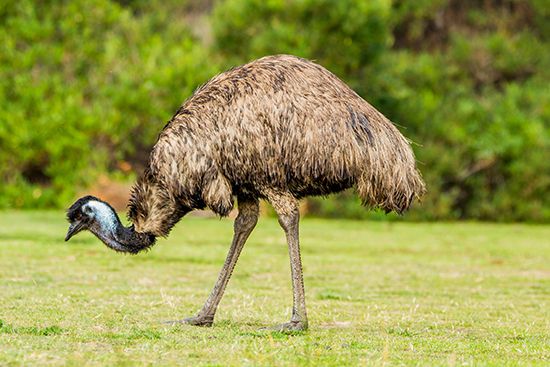
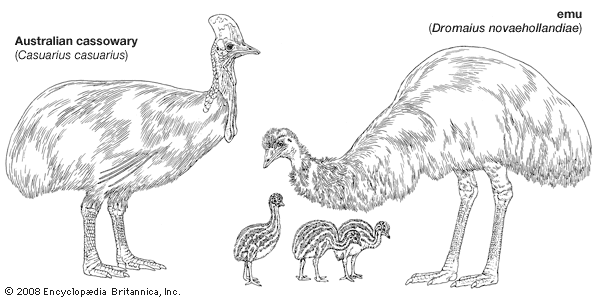
- Emus: These close relatives of the cassowary can also reach speeds of nearly 50 km (30 miles) per hour.1
- Ostriches: As the largest and fastest of the ratites, ostriches can achieve significantly higher top speeds of approximately 72.5 km (45 miles) per hour.6
While the ostrich holds the title for the fastest running speed among these birds, the cassowary remains remarkably fast, especially considering it navigates narrow, obstructed tracks in the bush rather than the open plains favored by ostriches. All three species share a reliance on powerful legs for locomotion and defense, often using their feet to deliver dangerous kicks when threatened.5671
Where are cassowaries found in the wild, and what is their natural habitat like?
Cassowaries are native to the Australo-Papuan region, specifically inhabiting New Guinea, nearby islands, and northern Australia.12
These birds are essentially creatures of the tropical rainforest, where they are notoriously difficult to observe due to the dense vegetation. Their specific habitat preferences vary by species:3
- Common (Southern) Cassowary: Inhabits New Guinea, nearby islands, and Australia.1
- Northern Cassowary: Found in the northern lowlands of New Guinea.1
- Dwarf Cassowary: Native to the higher elevations of New Guinea and the island of New Britain.1
Within these rainforest environments, cassowaries move rapidly along narrow tracks in the bush. They are primarily frugivorous, foraging for fruits on the forest floor, though they also consume small animals.13
What are the unique physical characteristics of the cassowary?
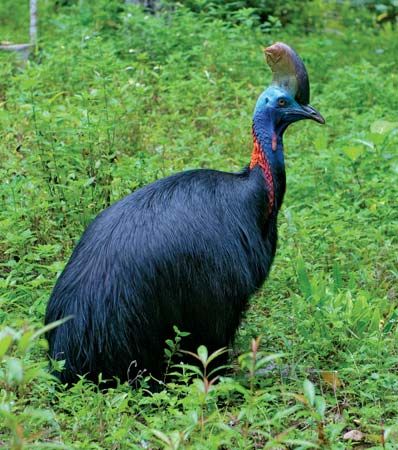
The cassowary is a highly specialized flightless bird with several distinct physical characteristics adapted for life in the dense Australo-Papuan rainforests:
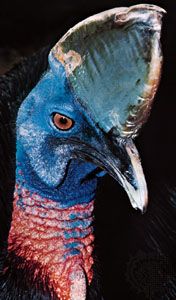
- Casque: The head is crowned with a prominent, horny helmet known as a casque. Experts believe this structure may protect the bird from injury by branches as it moves rapidly through the forest.15
- Plumage and Skin: Adults possess black, loose, and hairlike plumage, which lacks the interlocking barbules found in most birds. Their heads and necks are characterized by naked blue skin, often accompanied by fleshy, pendulous wattles of red, orange, or yellow (except in the dwarf species).15
- Defensive Feet: Cassowaries have three toes, with the innermost toe featuring an elongated, daggerlike nail. This makes their feet a formidable weapon capable of delivering lethal, slashing blows.15
- Wing Structure: Their wings are highly reduced, featuring five quills modified into hollow, unbranched spines.59
Sources
- cassowary — Encyclopædia Britannica
- casuariiform — Encyclopædia Britannica
- casuariiform - Ecology — Encyclopædia Britannica
- cassowary — Merriam-Webster
- casuariiform - Form and function — Encyclopædia Britannica
- emu — Encyclopædia Britannica
- ostrich — Encyclopædia Britannica
- The Fastest Animals on Earth — Encyclopædia Britannica
- casuariiform - Classification — Encyclopædia Britannica
Published on · 3 min read