Cardinal
The term "cardinal" refers to various species of songbirds that are native to the New World, though their specific distributions vary by genus.
In which regions of the world are cardinal birds commonly found?
The term “cardinal” refers to various species of songbirds that are native to the New World, though their specific distributions vary by genus.1
- Genus Cardinalis: The northern cardinal is widespread across the eastern United States, with a range extending west to Arizona and New Mexico, and south into Mexico, Guatemala, and Belize. Due to human activity and bird feeders, they have expanded into southeastern Canada and have been introduced to Hawaii and Bermuda1. The desert cardinal is found in the American Southwest.12
- Genus Paroaria: These birds, often grouped with tanagers, are found across South America and on several islands in the Caribbean Sea1. Species such as the red-crested cardinal are native to countries including Brazil, Argentina, Paraguay, Uruguay, and Bolivia.1

What is the significance of the cardinal’s bright red coloration in nature?
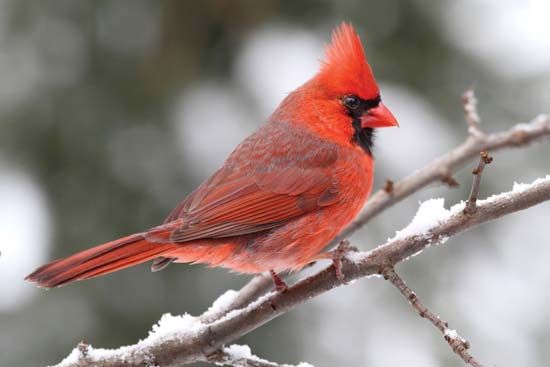
The bright red coloration of the male cardinal serves as a vital biological signal, primarily functioning as a form of advertising coloration to attract and arouse potential mates. This striking plumage is produced by carotenoids—yellow, orange, or red pigments derived from the bird’s diet of fruits and berries.213
The significance of this coloration in nature includes:
- Reproductive Signaling: Bright colors are often used in courtship displays to signal sexual maturity and fitness to females. These visual signals are frequently accompanied by specific postures or movements that enhance the display.2
- Species Recognition: Distinctive coloration aids in the reproductive isolation of species, ensuring that individuals can identify and attract appropriate mates within their own population.2
- Territorial Defense: While the red plumage is a key component of courtship, male cardinals are also highly territorial. Their vibrant appearance and aggressive behaviors, such as defending breeding territories from rivals, help establish and maintain their nesting grounds.14
In contrast to the males, females typically exhibit more subdued, brownish coloration, which may provide better camouflage while nesting.14

What are the different species of cardinals, and how do they differ from each other?
Birds referred to as “cardinals” belong to two distinct groups, primarily categorized by their genus. While they share the name, they differ significantly in their biological classification, appearance, and geographic distribution.
The Genus Cardinalis
These birds are members of the family Cardinalidae. They are generally characterized by their crested heads and thick bills.
- Northern Cardinal: The most well-known species, it is the only red North American bird with a crest. Males are bright red with a black mask, while females are a duller reddish-brown. They are highly adaptable and common across the eastern United States and parts of Mexico.
- Desert Cardinal: Also known as the pyrrhuloxia, this species is found in the thorn scrub of the American Southwest. It is less showy than the northern cardinal, appearing primarily gray with a red mask and a strongly curved, stubby bill.
- Vermilion Cardinal: Another member of this genus, sharing the characteristic family traits.
The Genus Paroaria
These birds are grouped with the tanagers (family Thraupidae) and are native to South America and the Caribbean.
- Red-crested Cardinal: Also called the Brazilian cardinal, it features a red head, a white belly, and gray wings. It has been introduced to areas like Hawaii.
- Red-capped Cardinal: Distinguished by a conspicuous red head that contrasts with a black throat and wings.
- Yellow-billed Cardinal: Primarily distinguished from other Paroaria species by the color of its beak.
While members of Cardinalis are known for their crests and specific North American ranges, Paroaria species are generally associated with South American habitats and different family lineages. All these species are currently classified as being of least concern by the IUCN.
How do male and female cardinals differ in appearance?
Male and female northern cardinals exhibit sexual dimorphism, meaning they differ significantly in their appearance. While both sexes share a distinctive crest, a black mask around the eyes, a short, thick red-orange bill, and a relatively long tail, their plumage coloration is quite distinct.271
- Males: They are well known for their striking, bright-red plumage, which is the result of carotenoids derived from their diet.71
- Females: They possess a more subdued, olive-brown coloration, though they often feature reddish highlights on their wings and tail.7
This difference in coloration is a common trait among many bird species, where the male is typically the more colorful sex.2
Sources
- Cardinal — Encyclopædia Britannica
- Northern cardinal — Encyclopædia Britannica
- coloration - Carotenoids — Encyclopædia Britannica
- coloration - Reproductive signals — Encyclopædia Britannica
- coloration - The adaptive value of biological coloration — Encyclopædia Britannica
- Integument - Birds — Encyclopædia Britannica
- Did you know? — Merriam-Webster
Published on · 3 min read