Caracal
The caracal (Caracal caracal) is primarily found across a wide geographic range that includes Africa, the Middle East, and regions of central and…
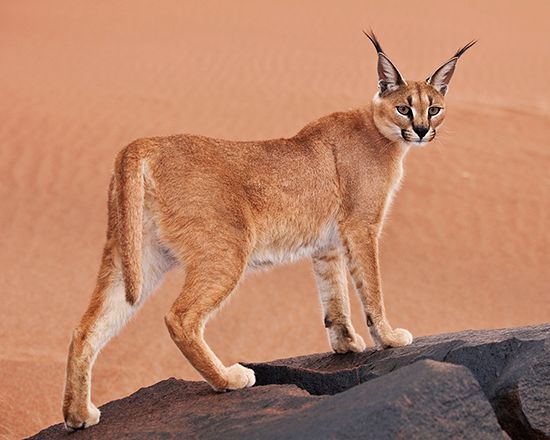
Where are caracals primarily found in the wild, and what types of habitats do they prefer?
The caracal (Caracal caracal) is primarily found across a wide geographic range that includes Africa, the Middle East, and regions of central and southwestern Asia.1
Regarding their habitat preferences, these cats are highly adaptable and are typically found in the following environments:
- Hills: They inhabit hilly terrain where they can utilize the landscape for hunting and shelter.1
- Deserts: Caracals are well-suited to desert ecosystems, demonstrating their ability to thrive in arid conditions.1
- Plains: They are also commonly found in open plains, where they hunt prey such as birds and mammals.1
While the species is considered of least concern globally, it faces significant conservation challenges and is classified as threatened or endangered in specific regions, including North Africa, Turkey, Central Asia, and India.1
How do caracals hunt, and what are their main prey animals?
The caracal is a swift, solitary, and nocturnal predator that relies on its agility to secure food. As a member of the family Felidae, it is a skilled hunter that preys on a variety of birds and mammals. Its primary diet includes animals such as gazelles, hares, and peafowl.1
Beyond its natural hunting behaviors, the caracal’s intelligence and agility have historically been recognized by humans. In parts of Asia, the species has been trained as a hunting companion, a practice facilitated by the high learning ability common among carnivorous mammals.12
What is the caracal’s conservation status, and what threats do they face in the wild?
The caracal is currently classified by the International Union for Conservation of Nature and Natural Resources (IUCN) as a species of least concern on a global scale.1
However, this broad classification masks significant regional declines. The species is considered threatened or endangered in several specific areas, including North Africa, Turkey, Central Asia, and India.1 While the provided data does not explicitly detail the specific anthropogenic or environmental threats causing these regional declines, the status indicates that local populations face pressures that jeopardize their long-term survival in those territories.1
How do caracals compare to other wild cat species in terms of size and behavior?
The caracal (Caracal caracal) is a medium-sized, feline predator distinguished by its unique physical proportions and specialized features. Standing 40–45 cm (16–18 inches) at the shoulder, it is characterized by its long legs and a relatively short tail (20–25 cm or 7.9–9.8 inches), which contrasts with the longer, more balanced tails found in many other wild cat species.1
In terms of appearance, the caracal is easily identified by its reddish-brown coat and prominent, long tufts of black hair on the tips of its pointed ears. Behaviorally, it shares the solitary and nocturnal habits common to many members of the Felidae family. While many wild cats are ambush predators, the caracal is noted for its exceptional agility and speed, which it uses to hunt birds and mammals such as gazelles and hares. Unlike many other wild cats, the caracal’s high learning ability has historically allowed it to be trained by humans for hunting purposes in parts of Asia.13
Sources
- caracal — Encyclopædia Britannica
- carnivore - Behaviour — Encyclopædia Britannica
- caracal — Merriam-Webster
Published on · 2 min read