Carangid
Carangids, which include jacks, pompanos, and greater amberjack, are swift, predatory fish found in warm and tropical marine regions. While these species are…
What are some common fishing methods used to catch carangid fish?
Carangids, which include jacks, pompanos, and greater amberjack, are swift, predatory fish found in warm and tropical marine regions. While these species are widely valued for both food and sport, the provided search results do not specify particular fishing methods exclusively used for the family Carangidae.1
However, commercial fishing generally employs several techniques for catching pelagic and schooling fish, which may be applicable to carangids depending on the species and habitat:
- Seine nets: Often used in beach seining for shoals near shorelines, or as Danish seines to herd fish toward a net bag.2
- Gill and entangling nets: These are used in long rows, either as anchored setnets or as drift nets that move with the current.3
- Lift nets: These can be stationary or operated from boats, sometimes utilizing luring lights at night to attract pelagic prey.4
What are the typical habitats and geographic distribution of carangid fish?
Carangid fish, which include jacks, pompanos, and amberjacks, are primarily found in warm and tropical marine regions across the globe. Their geographic distribution spans the temperate and tropical portions of the Atlantic, Pacific, and Indian oceans.156
Regarding their habitat, these fish are predominantly marine, though their environments can vary:
- Marine Waters: They are most commonly associated with warm seas, where they thrive as swift, predatory species.15
- Brackish and Fresh Water: While primarily saltwater dwellers, some species are known to inhabit brackish environments or occasionally invade fresh water.16
The family Carangidae is highly diverse, containing more than 200 species that have adapted to a wide range of marine conditions, from open waters to coastal areas.16
What are some unique physical features of carangid fish that help in their identification?
Carangid fish, a family that includes jacks and pompanos, exhibit several distinct physical characteristics that aid in their identification. While their body shapes vary—ranging from elongated and streamlined to deep-bodied and laterally compressed—they generally share the following features:16
Key Identification Features
- Dorsal and Anal Fins: They typically possess two dorsal fins, with the first sometimes reduced to small spines. The anal and second dorsal fins are usually high in the front, and the first two anal spines are notably separated from the third.1
- Pectoral Fins: These are generally slim and often sickle-shaped.1
- Tail Structure: The tail base is very slender, supporting a strong tail that is either forked or crescent-shaped.16
- Scales and Scutes: While many carangids have small, smooth scales, a defining feature for many species is the lateral line, which is often partially or entirely covered with large, hard, keeled scales known as scutes.16
- General Appearance: They are usually silvery, though some species display bluish-green or yellowish sheens.16
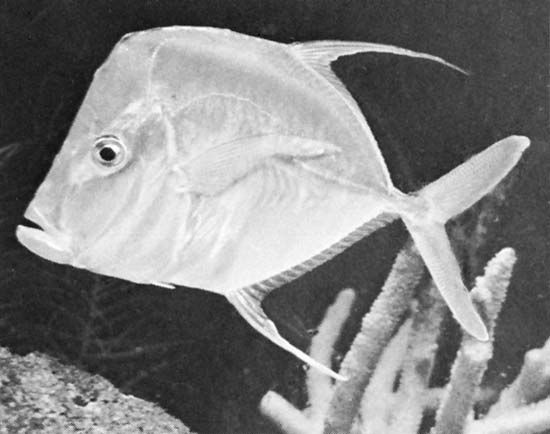
Some species, such as the lookdown, are particularly unique, featuring an exceptionally thin body, a high “forehead,” and elongated filaments extending from the second dorsal fin.1
How do carangid fish differ from other closely related fish families?
Carangids belong to the order Perciformes, which is the largest group of bony fishes in the world, encompassing over 6,000 species across 150 families, including tunas, sea basses, and sunfishes.1
While they share the general characteristics of the perciform order, carangids are distinguished by specific anatomical traits that set them apart from their relatives:
- Lateral Line Scutes: A primary identifying feature of many carangids is the presence of large, hard, keeled scales known as scutes along the lateral line, a trait not typically found in other perciform families.9
- Fin Structure: Carangids possess two dorsal fins, with the first often reduced to a few small spines. Notably, the first two anal spines are separated from the third, and the pectoral fins are typically slim and sickle-shaped.9
- Body Morphology: The family is characterized by a very slender tail base supporting a strong, forked, or crescent-shaped tail, which facilitates their nature as swift, predatory swimmers.9
Sources
- carangid — Encyclopædia Britannica
- commercial fishing - Lift nets — Encyclopædia Britannica
- commercial fishing - Seine nets — Encyclopædia Britannica
- commercial fishing - Gill and entangling nets — Encyclopædia Britannica
- Carangidae — Merriam-Webster
- jack — Encyclopædia Britannica
- carangid — Merriam-Webster
- scale — Encyclopædia Britannica
- perciform — Encyclopædia Britannica
Published on · 3 min read