Dipterus
Dipterus is a genus of very primitive lungfish that lived during the Devonian Period, approximately 416 million to 359 million years ago. Fossils of these…
What is Dipterus?
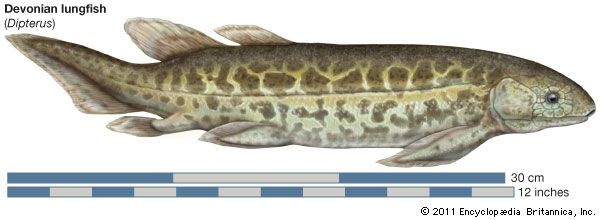
Dipterus is a genus of very primitive lungfish that lived during the Devonian Period, approximately 416 million to 359 million years ago. Fossils of these jawed vertebrates have been discovered in Europe and North America.12
As a member of the lobe-finned group, Dipterus retained several archaic characteristics, including two dorsal fins and a tail resembling that of other lobe-finned fishes. It is considered one of the earliest known lungfish and likely possessed functional lungs, suggesting a freshwater habitat. The skull of Dipterus featured a mosaic of small bones, marking the beginning of a unique bone pattern and a trend toward skeletal deossification seen in more advanced lungfish.123
Evolutionarily, Dipterus represents an early point in a lineage that can be traced to the modern Australian lungfish, Neoceratodus. Its leaflike pectoral and pelvic fins provide insight into the early development of traits that may have eventually contributed to the movement behaviors observed in tetrapods.3
What are the main differences between lobe-finned and ray-finned fish?
Lobe-finned and ray-finned fishes represent the two primary classes of bony fish, distinguished primarily by the structure of their fins and their evolutionary relationship to land vertebrates.
Key Differences
- Fin Structure:
- Lobe-finned fishes (Sarcopterygii): These fish possess fleshy, lobed fins. Structurally, these fins contain bones and muscles that are considered the evolutionary precursors to the limbs of tetrapods.456
- Ray-finned fishes (Actinopterygii): These fish have fins supported by bony or horny rays rather than fleshy, muscular lobes. This group comprises the vast majority of all living fish species, including common varieties like tuna, salmon, and trout.75
- Respiration and Biology:
- Some lobe-finned fishes, such as lungfish, are not solely dependent on gills and possess lungs that allow them to breathe air, an adaptation for living in shallow or seasonal waters.456
- Ray-finned fishes are highly diverse in their morphology and ecology, typically relying on gills for respiration and utilizing a swim bladder for buoyancy.87
- Diversity and Prevalence:
- While lobe-finned fishes were once a large and flourishing group, they are now represented by only a few living members, such as the coelacanth and lungfishes.46
- Ray-finned fishes have largely replaced them in most aquatic environments, accounting for the great majority of the world’s commercial and sport fishes.86
How do modern lungfish survive in dry conditions?
Modern lungfish have evolved remarkable physiological and behavioral adaptations to survive in environments where water levels drop or disappear entirely. Their survival strategy, known as estivation, allows them to remain viable for months or even years without food or water.1112
Survival Mechanisms
- Burrowing and Encystment: During the dry season, African lungfish burrow into the mud of riverbeds or lake beds. They secrete a mucous sheath that hardens into a protective cocoon, which remains connected to the surface via a thin tunnel for air access. South American lungfish also burrow into the mud during water shortages, though they do not form a protective sheath. Notably, the Australian lungfish does not exhibit this burrowing behavior.1112
- Metabolic Depression: Once encased, the fish enters a state of dormancy where its metabolism, respiration, and heart rate drop to very low levels. This state is induced by a proteinlike substance that inhibits normal metabolic activity.1112
- Aerial Respiration: Lungfish possess primitive lungs derived from the swim bladder, allowing them to breathe atmospheric air. When water oxygen levels are low, they surface to gulp air, a process that becomes their primary means of survival as aquatic habitats dry out.131412
- Waste Management: During prolonged periods of estivation, African lungfish may accumulate high concentrations of urea within their bodies as a byproduct of their altered metabolic state.11
What is the significance of the Devonian Period in fish evolution?
The Devonian Period (approximately 419.2 to 359 million years ago) is famously known as the “Age of Fishes” due to the extraordinary diversification and proliferation of fish species in both marine and freshwater environments. This era was a pivotal turning point in vertebrate evolution, marked by several key developments:1718
- Rise of Jawed Fishes: The period saw the dominance and subsequent decline of placoderms, an armored group of jawed fishes that served as a major evolutionary force. Their peak in diversity during the Devonian provided the foundation for the emergence of other major lineages.1920
- Emergence of Modern Groups: The Devonian witnessed the first appearance of several critical groups, including chondrichthians (cartilaginous fishes like sharks) and osteichthians (bony fishes)19. Specifically, the ancestors of modern lungfishes, coelacanths, and rhipidistians appeared during this time.2019
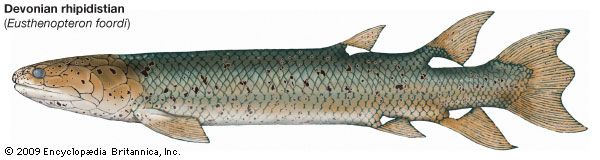
- Transition to Land: The rhipidistians are of particular significance, as they are believed to have given rise to the first tetrapods—four-legged amphibians that marked the colonization of land by vertebrates near the middle of the period.171819
While the period experienced significant extinction events that eliminated many species, the subsequent recovery and diversification laid the groundwork for the vertebrate life we recognize today.17
Sources
- Dipterus — Encyclopædia Britannica
- Dipterus — Merriam-Webster
- lungfish - Evolution — Encyclopædia Britannica
- lobe-finned — Merriam-Webster
- bony fish — Encyclopædia Britannica
- ray-finned — Merriam-Webster
- ostariophysan - Fin spines and adipose fin — Encyclopædia Britannica
- lobe-fin — Merriam-Webster
- fish - Body plan — Encyclopædia Britannica
- muscle - Origins of the tetrapod limbs — Encyclopædia Britannica
- lungfish - Physiology and biochemistry — Encyclopædia Britannica
- lungfish - Adaptations for breathing — Encyclopædia Britannica
- Respiratory system - Fishes — Encyclopædia Britannica
- lungfish — Encyclopædia Britannica
- lungfish - Reproduction and life cycle — Encyclopædia Britannica
- Circulatory system - Fishes — Encyclopædia Britannica
- A Journey Through Time Since the Precambrian - Devonian Period: 419.2 million to about 359 million years ago — Encyclopædia Britannica
- Devonian Period - Devonian life — Encyclopædia Britannica
- Devonian Period - Vertebrates — Encyclopædia Britannica
- chondrichthyan - Evolution — Encyclopædia Britannica
Published on · 4 min read