Carcharodontosaurus
Carcharodontosaurus is a genus of massive, bipedal predatory dinosaurs that lived in North Africa during the late Cretaceous Period, approximately 99–94…
What is Carcharodontosaurus?
Carcharodontosaurus is a genus of massive, bipedal predatory dinosaurs that lived in North Africa during the late Cretaceous Period, approximately 99–94 million years ago. Its name, derived from Greek, means “sharp-toothed” or “shark-toothed lizard”.1
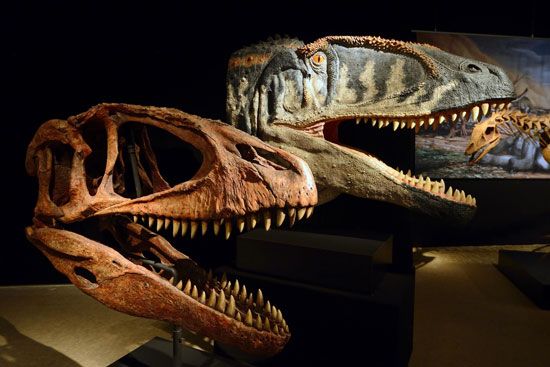
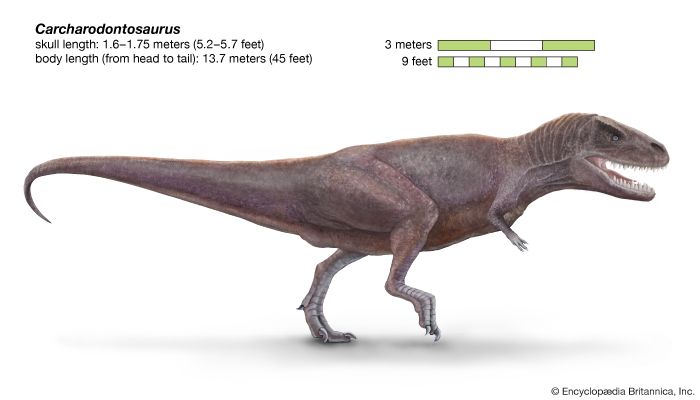
Belonging to the suborder Theropoda, this dinosaur is among the largest land-dwelling carnivores in history, with estimates suggesting it reached lengths of 13–14 meters (42–46 feet) and weighed roughly 6 metric tons. It possessed a massive skull—measuring up to 1.75 meters (5.7 feet) in some specimens—and jaws lined with approximately 60 serrated teeth, some as long as 15 cm (6 inches). Paleontologists hypothesize that it preyed upon large herbivorous sauropods large herbivorous sauropods.1
The genus includes two species: C. saharicus, found in Morocco, Algeria, and Tunisia, and C. iguidensis, discovered in Niger. Early fossil evidence was famously destroyed during a 1944 bombing raid in World War II, leaving the species a mystery until Paul Sereno and his team uncovered a new skull in 1995.1
When and where did Carcharodontosaurus live?
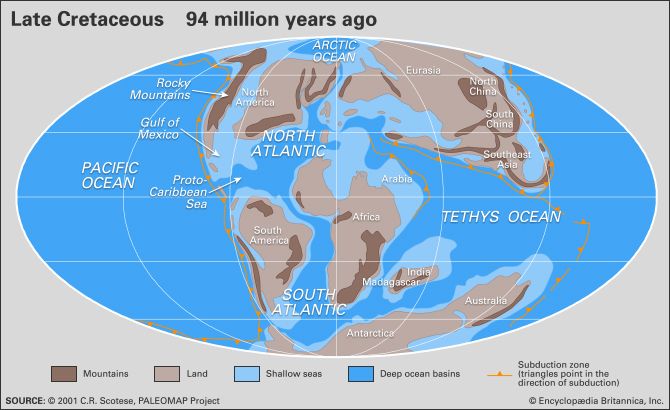
Carcharodontosaurus lived during the late Cretaceous Period, specifically within the Cenomanian Age, approximately 99–94 million years ago.1
Geographically, this genus inhabited North Africa. Fossil evidence for the two recognized species has been discovered in the following present-day countries:
- Carcharodontosaurus saharicus: Fossils have been unearthed in Morocco, Algeria, and Tunisia.1
- Carcharodontosaurus iguidensis: Fossils have been found in Niger iguidensis***: Fossils have been found in Niger.1
What did Carcharodontosaurus look like?
Carcharodontosaurus was a massive, bipedal theropod that stood upright and moved on its two powerful hind limbs. As one of the largest land-dwelling carnivores in history, it reached estimated lengths of 13 to 14 meters (42 to 46 feet) and weighed approximately 6 metric tons.1
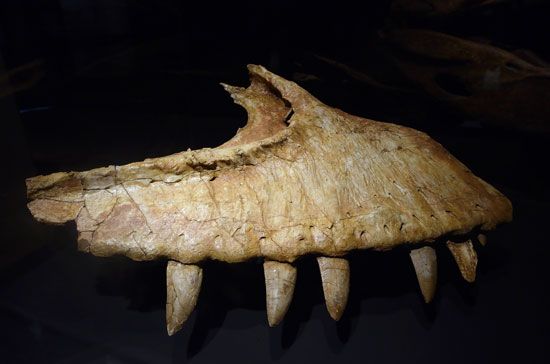
Its most striking feature was its enormous skull, which measured between 1.6 and 1.75 meters (5.2 to 5.7 feet) in length. This skull housed approximately 60 serrated teeth, many of which were as long as 15 cm (6 inches), designed for a predatory lifestyle likely focused on hunting large sauropods.1
While much of its body morphology remains speculative, paleontologists believe its forelimbs were likely small in proportion to its hind legs, similar to the evolutionary path seen in other large theropods like Tyrannosaurus rex. Although some Cretaceous dinosaurs possessed feathers, there is no definitive evidence that Carcharodontosaurus was feathered.16
What kind of food did Carcharodontosaurus eat?
Carcharodontosaurus was a specialized predator, as indicated by the morphology of its skull and dentition. Paleontologists hypothesize that it primarily fed on large herbivorous sauropod dinosaurs.1
Its jaws were well-adapted for this carnivorous diet, containing approximately 60 serrated teeth that could reach lengths of up to 15 cm (6 inches). These features allowed the dinosaur to effectively hunt and consume large prey within its North African environment during the late Cretaceous Period.1
Sources
- Carcharodontosaurus — Encyclopædia Britannica
- tyrannosaur - Classification — Encyclopædia Britannica
- How tall was T. rex? — Encyclopædia Britannica
- Cretaceous Period - Paleogeography — Encyclopædia Britannica
- A Journey Through Time Since the Precambrian - Cretaceous Period: 145 million to 66 million years ago — Encyclopædia Britannica
- Bird - The origin of feathers — Encyclopædia Britannica
- dinosaur - Ornithopoda — Encyclopædia Britannica
Published on · 2 min read