Casuariiform
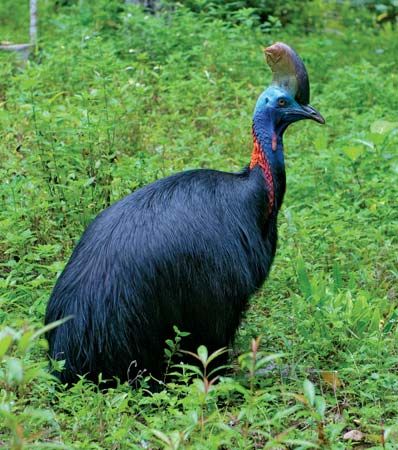
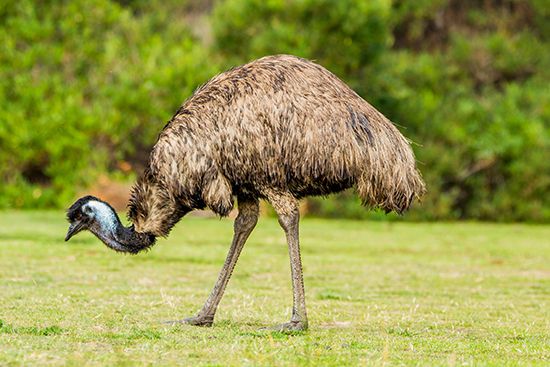
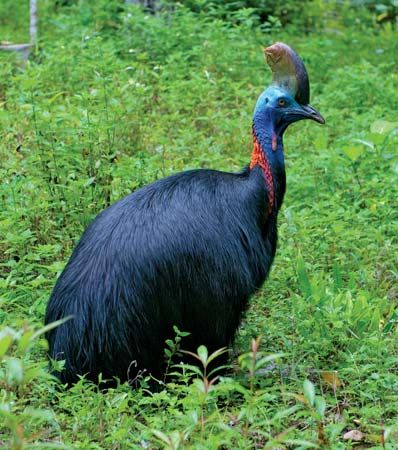
Within the order Casuariiformes, which also includes the emu, cassowaries are distinguished by several unique physical characteristics:
What are the unique physical features of cassowaries within the Casuariiform order?
Within the order Casuariiformes, which also includes the emu, cassowaries are distinguished by several unique physical characteristics:
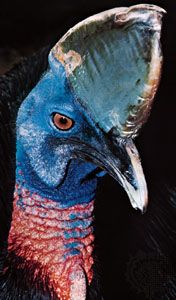
- Head and Neck: Cassowaries possess a naked blue head and neck. Unlike emus, they feature a prominent, horny casque—a helmet-like structure believed to protect the bird from injury while moving through dense forests. Most species also display fleshy, pendulous wattles in shades of red, orange, or yellow.12
- Plumage: While all casuariiforms have loose, hairlike feathers due to a lack of interlocking barbules, adult cassowaries are uniquely characterized by their black plumage.12
- Wings: They lack traditional tail feathers and possess modified wing quills that appear as five hollow, unbranched spines.2
- Feet: Like other ratites, they have only three toes. However, the innermost toe is armed with an elongated, daggerlike nail, which serves as a formidable weapon capable of delivering lethal slashing blows.12
Which bird species are included in the Casuariiform order?
The order Casuariiformes consists of large, flightless birds native to Australasia. While some authorities classify these birds within the order Struthioniformes, others group them into the order Casuariiformes, which comprises two families and four extant species:561
- Family Casuariidae (cassowaries): This family includes three living species:
- Family Dromaiidae (emu): This family consists of one living species:
Additionally, some scientific classifications recognize two extinct populations of emus—the King Island emu (Dromaius ater) and the Kangaroo Island emu (D. baudinianus)—as distinct species.6
What are the main characteristics that define the Casuariiform order of birds?
The order Casuariiformes comprises large, flightless birds—specifically the cassowaries and the emu—that are classified as ratites. These birds are defined by several key anatomical and biological characteristics:
Physical Structure
- Flightlessness: Like other ratites, they possess a smooth, raftlike sternum that lacks the keel necessary for anchoring flight muscles.2
- Limbs: They are graviportal (ponderous) birds with only three toes, having lost the hind toe. Their leg elements are enlarged to support their size.63
- Plumage: Their feathers are loose and hairlike due to a lack of interlocking barbules.6
- Skeleton: They exhibit a reduced humerus and a palaeognathous palate, characterized by large vomer bones that separate the palatines.6
Distinctive Traits
- Reproduction: They are monogamous and lay green-colored eggs.3
- Taxonomy: The order includes two families: the Casuariidae, known for their laterally compressed beaks and prominent head casques, and the Dromaiidae, which feature flattened beaks and lack casques.3
What is the evolutionary history of Casuariiform birds?
The evolutionary history of Casuariiform birds—which include cassowaries and the emu—is characterized by a long, albeit sparsely documented, development throughout the Cenozoic Era.9
Paleontological Record
Fossil evidence for this group is limited and primarily restricted to the Australian region. Most discovered remains date to the Pleistocene Epoch, with only rare, tentative findings from the Pliocene. Despite this thin fossil record, these birds are recognized as ratites, a group that evolved from flying ancestors; their flightlessness is a secondary, specialized adaptation that allowed them to reach large sizes and escape mammalian predation.92
Evolutionary Origins
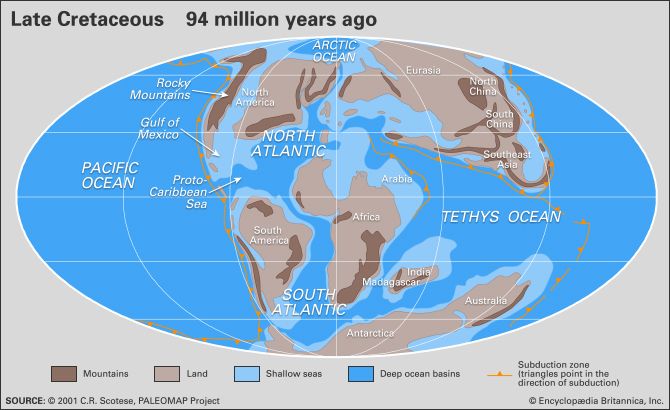
While some authorities classify them within the order Struthioniformes, DNA analysis suggests that emus and cassowaries diverged from other ratites approximately 80 million years ago during the Cretaceous Period. This separation is believed to have been driven by the final breakup of the supercontinent Gondwana, which isolated these populations and facilitated their distinct evolutionary trajectory in the Australasian region.10
Sources
- cassowary — Encyclopædia Britannica
- casuariiform - Form and function — Encyclopædia Britannica
- Casuariiformes — Merriam-Webster
- casque — Merriam-Webster
- casuariiform — Encyclopædia Britannica
- casuariiform - Classification — Encyclopædia Britannica
- Bird - Critical appraisal — Encyclopædia Britannica
- ratite — Encyclopædia Britannica
- casuariiform - Evolution and paleontology — Encyclopædia Britannica
- casuariiform - Critical appraisal — Encyclopædia Britannica
- Bird - Flightlessness — Encyclopædia Britannica
Published on · 3 min read