Carlsberg Ridge
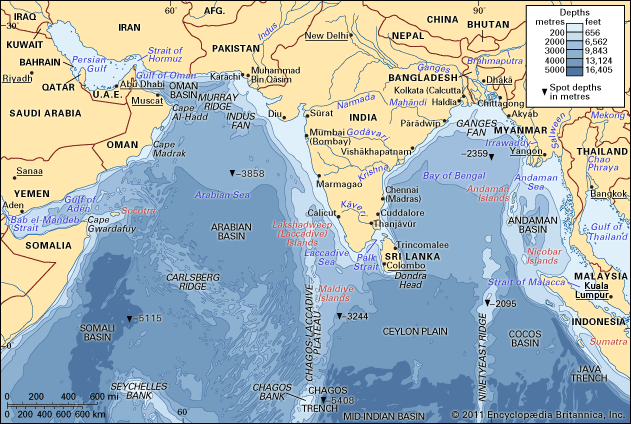
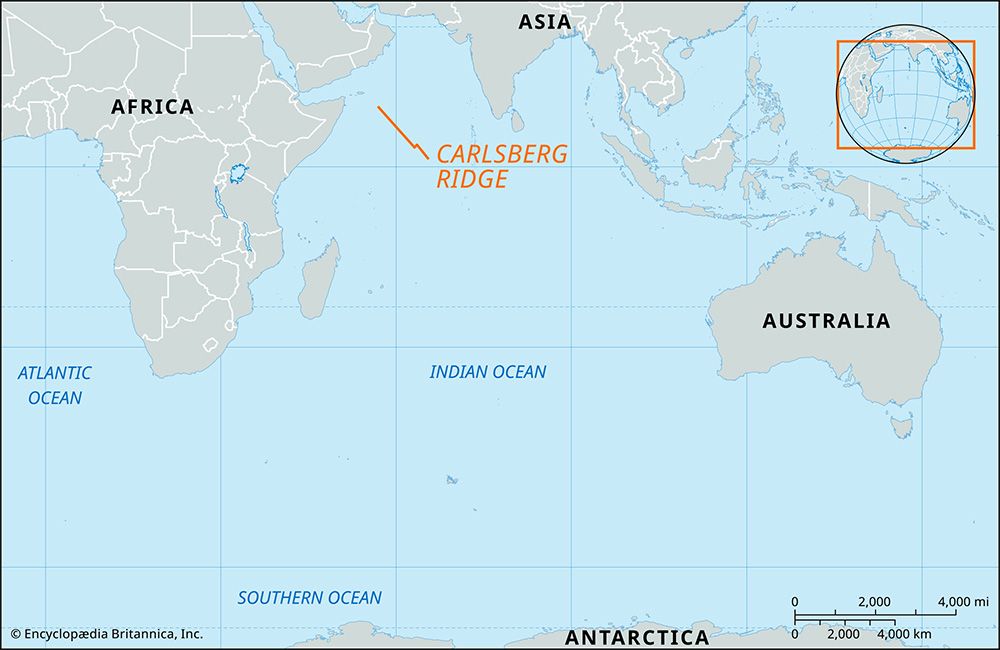
The Carlsberg Ridge is a submarine mountain range located in the Arabian Sea and the Indian Ocean. It extends northwest from a triple junction of tectonic…
What is Carlsberg Ridge?
The Carlsberg Ridge is a submarine mountain range located in the Arabian Sea and the Indian Ocean. It extends northwest from a triple junction of tectonic plates to the Gulf of Aden, effectively separating the Arabian Sea from the Somali Basin.1
While some researchers classify it as a distinct feature, others identify it as the northern segment of the Mid-Indian Ridge. The ridge sits at a mean depth of 6,000 to 12,000 feet below the surface and rises approximately 7,000 feet above the surrounding seafloor. It is a site of significant geological interest, as it coincides with a major belt of seismic activity and connects to the East African Rift System near the island of Socotra. This feature serves as a key example of an oceanic ridge shaped by plate tectonics.1
What is the theory of plate tectonics?
The theory of plate tectonics describes the Earth’s outer shell as a rigid layer, 50 to 100 km (30 to 60 miles) thick, known as the lithosphere. This layer is broken into a series of large and small plates that rest upon and slide over the asthenosphere, a denser, partially molten, and plastic-like layer of the mantle.2
Plate Interactions
As these plates move across the planet’s surface, they interact at their boundaries in three primary ways:
- Divergent margins: Plates move apart, leading to seafloor spreading and the creation of new crust at oceanic ridges.34
- Convergent margins: Plates move toward each other, often resulting in subduction zones where one plate sinks into the mantle, or orogeny (mountain building).24
- Transform faults: Plates slide laterally past one another, a process that neither creates nor destroys crust but frequently triggers earthquakes.45
Driving Mechanisms
While the exact forces are still studied, most experts believe plate movement is driven by convection currents in the mantle, fueled by the decay of radioactive elements. Additional forces include “slab pull,” where sinking plates drag the rest of the plate downward, and “ridge push,” where gravitational force pushes plates away from elevated mid-ocean ridges.21
How do mid-ocean ridges form?
Mid-ocean ridges form at divergent margins, where tectonic plates move apart from one another. This process, known as seafloor spreading, is driven by the upwelling of magma from the Earth’s mantle.5910
The Formation Process
- Magma Upwelling: As plates diverge, the reduction in pressure allows molten material to rise from the mantle to the surface.1011
- Crust Creation: This magma cools and solidifies, creating new oceanic crust along the ridge crest.96
- Thermal Elevation: The region is swollen with heat, which makes the crust more buoyant and causes it to rise 2 to 3 km above the surrounding seafloor.512
- Ridge Push: As the newly formed crust cools and moves away from the spreading center, it becomes denser and sinks, creating a gravitational force that helps push the plates apart, further sustaining the ridge’s elevated topography.5911
These ridges form an interconnected global system of underwater mountains characterized by frequent volcanic activity and shallow earthquakes resulting from the crust repeatedly rifting and healing.5912
What is the East African Rift System?
The East African Rift System is one of the most extensive rift zones on Earth, stretching approximately 4,000 miles (6,400 km) from Jordan in the north to Mozambique in the south.15
Geological Structure
The system is a prime example of continental rifting, where the lithosphere is being stretched and pulled apart by upwelling magma. This process creates a rift valley characterized by steep escarpments and deep, fjordlike lakes. The system consists of two primary branches:1516
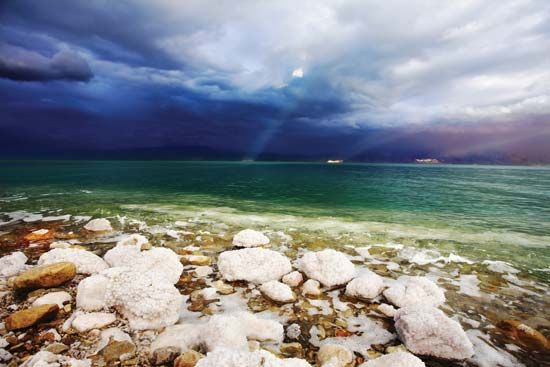
- Eastern Rift Valley: The main branch, which includes the Dead Sea, the Red Sea, and several lakes in Kenya.15
- Western Rift Valley: An arc-shaped branch containing deep lakes such as Tanganyika and Albert.15
Tectonic Significance
Forming over the last 30 million years, the rift represents an early stage of plate separation. As the crust thins, it is accompanied by significant volcanism, eventually potentially leading to the creation of a new ocean basin. The system also connects to the global midoceanic ridge system via the Gulf of Aden.151617
Sources
- Carlsberg Ridge — Encyclopædia Britannica
- plate tectonics - Principles of plate tectonics — Encyclopædia Britannica
- How do tectonic plates move? — Encyclopædia Britannica
- plate tectonics - Past plate movements — Encyclopædia Britannica
- plate tectonics - Seafloor spreading — Encyclopædia Britannica
- plate tectonics - Discovery of ocean basin features — Encyclopædia Britannica
- plate tectonics - Plate boundaries — Encyclopædia Britannica
- plate tectonics - Transform faults — Encyclopædia Britannica
- seafloor spreading — Encyclopædia Britannica
- oceanic ridge - Principal characteristics — Encyclopædia Britannica
- oceanic ridge — Encyclopædia Britannica
- mid-ocean ridge — Merriam-Webster
- plate tectonics - Mantle convection — Encyclopædia Britannica
- Mid-Atlantic Ridge — Encyclopædia Britannica
- East African Rift System — Encyclopædia Britannica
- plate tectonics - Continental rifting — Encyclopædia Britannica
- Mid-Indian Ridge — Encyclopædia Britannica
Published on · 3 min read