East Pacific Rise
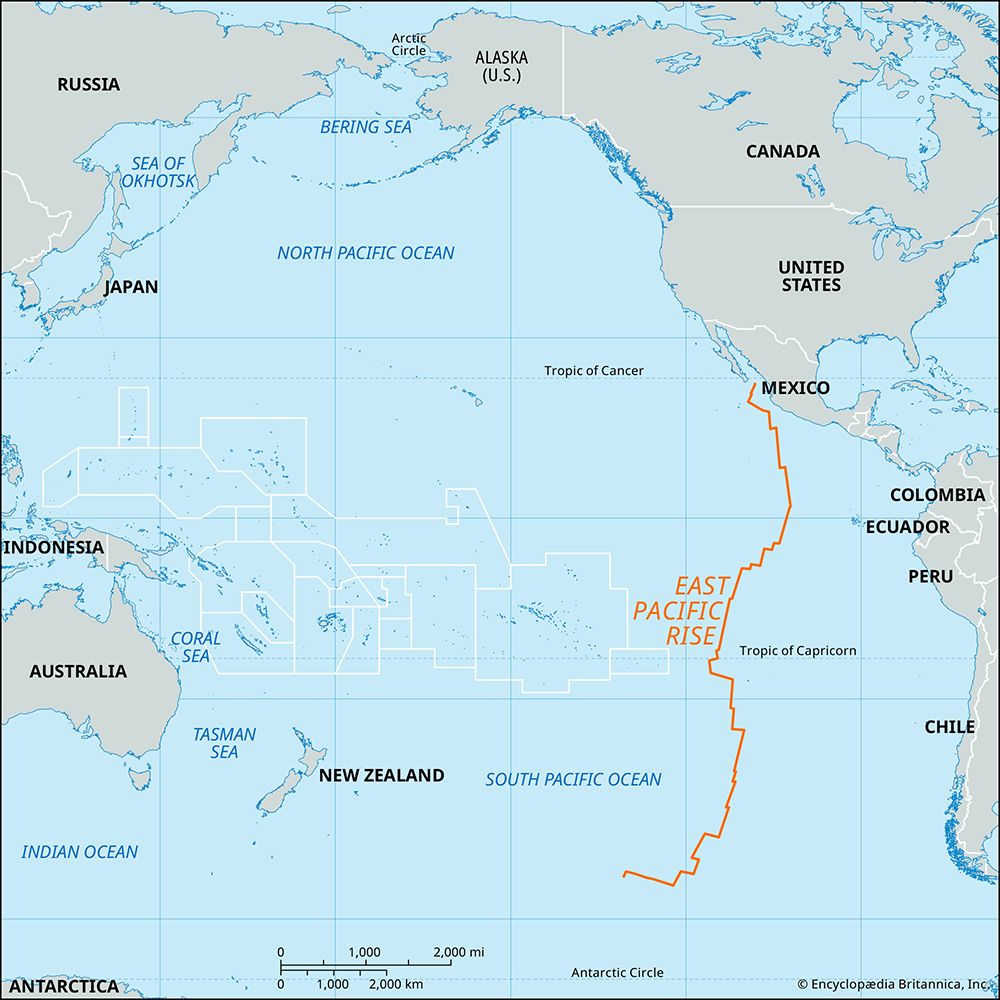
The East Pacific Rise is a linear submarine volcanic chain located on the floor of the southeastern Pacific Ocean. It was formed and is continuously…
How was the East Pacific Rise formed, and what role does it play in plate tectonics?
The East Pacific Rise is a linear submarine volcanic chain located on the floor of the southeastern Pacific Ocean. It was formed and is continuously maintained by the process of seafloor spreading, where molten basaltic lava wells up from beneath the Earth’s crust along the ridge’s crest. As this material cools, it creates new oceanic crust that moves outward in both directions from the center.12
In the context of plate tectonics, the East Pacific Rise serves as a critical divergent boundary. It defines the eastern and southern edges of the Pacific Plate, where it meets the North American, Cocos, Nazca, and Antarctic plates. It is one of the most active spreading centers on Earth, with spreading rates reaching up to 6.3 inches (16 cm) per year off the coasts of Chile and Peru. By constantly generating new crust, the rise plays a fundamental role in the movement of tectonic plates and the ongoing evolution of the ocean floor.132
How deep is the East Pacific Rise, and how does its depth vary along its length?
The East Pacific Rise is a fast-spreading ridge, and its depth is primarily determined by the thermal state of the oceanic crust as it moves away from the spreading center.1
Depth and Topography
While oceanic ridges globally rise to an average depth of approximately 2.6 km (1.6 miles) below sea level, the East Pacific Rise is characterized by its specific fast-spreading morphology. Unlike slow-spreading ridges that feature deep rift valleys, the East Pacific Rise displays an “axial high”—a broad, elevated crest—along its length.15
The rise stands roughly 6,000 to 9,000 feet (1,800 to 2,700 meters) above the surrounding seafloor. Because the ridge is a site of active seafloor spreading, the crust at the crest is warm and thermally expanded, which accounts for its significant elevation.614
Variation Along the Length
The depth and topography of the ridge vary based on the age of the crust and the rate of spreading:
- Thermal Contraction: As the crust moves away from the crest, it cools and undergoes thermal contraction, causing the seafloor to deepen over time. This depth is proportional to the square root of the crust’s age.1
- Spreading Rates: The East Pacific Rise exhibits varying spreading rates, from about 6.3 inches (16 cm) per year near Chile and Peru to approximately 2.4 inches (6 cm) per year near the Gulf of California. These differences influence the ridge’s width and overall profile.651
- Segmentation: The ridge is not uniform; it is segmented by transform faults and “overlapping spreading centres,” which are thought to result from fluctuations in magma supply along the crest.65
What is the average spreading rate of the East Pacific Rise, and how does it compare to other oceanic ridges?
The East Pacific Rise is one of the most active spreading centers on Earth, characterized by “fast” spreading rates that vary significantly along its length. Off the coasts of Chile and Peru, the ridge spreads at rates of approximately 159 mm (6.3 inches) per year or more, while these rates decrease to about 60 mm (2.4 inches) per year near the mouth of the Gulf of California.51
When compared to other oceanic ridges, the East Pacific Rise is classified as a fast-spreading ridge. Oceanic ridges are generally categorized by their spreading rates:7
- Slow-spreading ridges: Up to 50 mm (about 2 inches) per year, such as the Mid-Atlantic Ridge, which typically feature a deep rift valley at the crest.7
- Intermediate-spreading ridges: Up to 90 mm (about 3.5 inches) per year.7
- Fast-spreading ridges: Up to 160 mm per year, such as the East Pacific Rise, which lack rift valleys and instead display a broad, elevated “axial high” at the crest.71
Because of these high spreading rates, the East Pacific Rise produces new oceanic crust much more rapidly than slower systems, resulting in smoother flank topography and a distinct volcanic profile compared to its slower counterparts.74
What scientific research and discoveries have been made at the East Pacific Rise?
Scientific research at the East Pacific Rise has been instrumental in advancing our understanding of plate tectonics and deep-sea ecosystems. First detected during the Challenger Expedition in the 1870s, the ridge was later mapped in detail during the 1950s and 1960s by oceanographers such as Heezen, Ewing, and Henry W. Menard, who described its role as a major center of seafloor spreading.14
Key discoveries include:
- Overlapping Spreading Centres: In the 1980s, researchers including Kenneth C. Macdonald, Paul J. Fox, and Peter F. Lonsdale identified that the spreading center is often interrupted and offset. These “overlapping spreading centres” are now understood to be fundamental features that reflect variations in magma supply along the ridge.4
- Hydrothermal Vents: The rise is home to hydrothermal vents, where heated, mineral-rich seawater discharges into the ocean. These vents support unique biological communities that thrive through chemosynthesis by sulfur-fixing bacteria, existing entirely independently of solar energy.1312
- Geological Dynamics: Studies of the ridge have provided critical evidence for the creation of new oceanic crust and the thermal processes that govern the elevation of the seafloor.113
Sources
- East Pacific Rise — Encyclopædia Britannica
- Mid-Atlantic Ridge — Encyclopædia Britannica
- Pacific Ocean - Geology — Encyclopædia Britannica
- oceanic ridge - Pacific Ocean — Encyclopædia Britannica
- oceanic ridge - Principal characteristics — Encyclopædia Britannica
- ocean basin - General features — Encyclopædia Britannica
- seafloor spreading — Encyclopædia Britannica
- plate tectonics - Seafloor spreading — Encyclopædia Britannica
- oceanic ridge - Distribution of major ridges and spreading centres — Encyclopædia Britannica
- oceanic ridge - Spreading centre zones — Encyclopædia Britannica
- How do tectonic plates move? — Encyclopædia Britannica
- deep-sea vent — Encyclopædia Britannica
- oceanic ridge - Hydrothermal vents — Encyclopædia Britannica
Published on · 4 min read