Carpenter Ant
A carpenter ant is any of more than 1,000 species of ants belonging to the genus Camponotus. These eusocial insects are found nearly worldwide and are…
What is a carpenter ant?
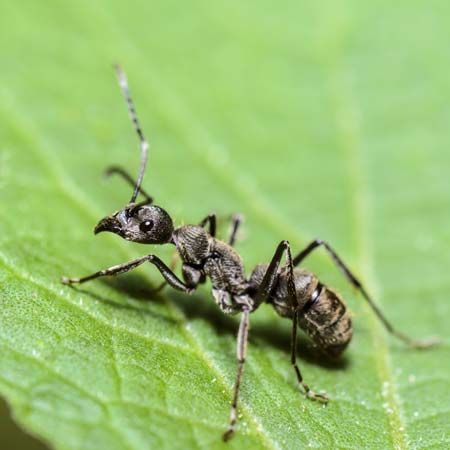
A carpenter ant is any of more than 1,000 species of ants belonging to the genus Camponotus. These eusocial insects are found nearly worldwide and are well-known for nesting in dead or decaying wood.1
Unlike termites, carpenter ants do not consume wood. Instead, they use their strong mandibles to excavate tunnels and galleries to create nests, which can cause significant damage to human-built structures. Ecologically, however, they play a vital role in ecosystems by assisting in the decomposition of dead wood and serving as a key component of food webs.1
Physically, they vary in color and size, featuring elbowed antennae and a constricted waist. They do not sting and are omnivorous, often foraging at night for nectar, honeydew, and insects. Interestingly, they are the primary hosts for the zombie-ant fungus, which can infect and manipulate their behavior.1
What does a carpenter ant look like?
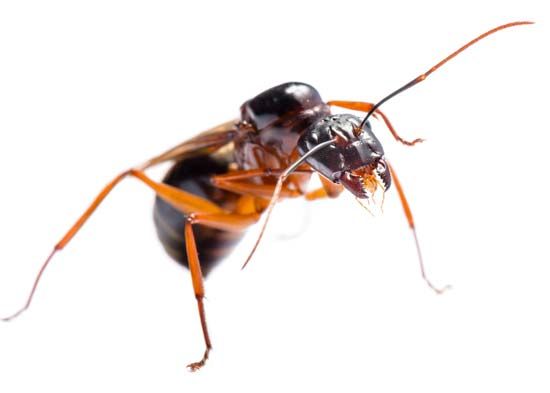
Carpenter ants (genus Camponotus) exhibit a range of physical characteristics depending on the species. Their bodies can be smooth or hairy and appear in various colors, including black, yellow, brown, tan, reddish, or a combination of black and red.3
Structurally, they possess a head with elbowed antennae, a thorax with a constricted waist, and a rounded abdomen. Unlike some other ant species, carpenter ants do not have a sting.3
Size varies significantly based on the ant’s role within the colony’s three castes:
- Queens: The largest members, reaching up to 20 mm (0.8 inch) in length.3
- Majors: The largest workers, growing up to 12 mm (0.5 inch), tasked with colony defense and foraging.3
- Minors: The smallest workers, responsible for nest excavation and tending to the brood.3
- Media: An intermediate-sized worker found in some specific species.3
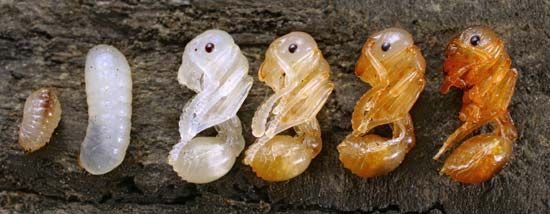
During their development, they transition from white, oval-shaped eggs to legless larvae, and then to capsule-shaped pupae that are white to tan in color.3
Where do carpenter ants usually live?
Carpenter ants (genus Camponotus) are found nearly worldwide in most terrestrial habitats, where they are particularly dominant in rainforest canopies.2
Their nesting habits are primarily focused on wood, though they do not consume it. Most species establish their nests in the following locations:
- Dead or decaying wood: This includes dead standing trees, the dead interior of living trees, and tree stumps.2
- Logs and timbers: They are commonly found in old logs and wooden structures.4
- Soil: Some species choose to build their nests directly in the ground.2
- Vegetation: Certain species may inhabit the hollow stems of weeds or other plants.4
As a colony grows, the workers often establish “satellite nests” in drier wood to house older larvae, pupae, and additional workers. Because they prefer these environments, they can sometimes cause significant damage to human-built structures when they excavate tunnels and galleries for their nests.2
How do carpenter ants build their nests?
Carpenter ants (genus Camponotus) build their nests through a systematic process that begins with a single mated queen. After shedding her wings, the queen selects a site—typically in dead or decaying wood, such as standing trees, stumps, or logs, though some species may nest in soil—and excavates a small initial chamber to raise her first brood.2
Once the first generation of workers matures, they assume the responsibility of expanding the colony. The workers use their strong mandibles to tunnel into the wood, creating intricate systems of tunnels and galleries. Unlike termites, carpenter ants do not consume the wood; instead, they remove the debris and push it outside the nest.2
As the colony grows over several years, the workers continue to enlarge the nest and often establish “satellite nests” in drier wood to accommodate older larvae, pupae, and additional workers. This expansion allows the colony to thrive and effectively manage its population.2
Sources
- carpenter ant — Merriam-Webster
- carpenter ant — Encyclopædia Britannica
- ant - Physical description — Encyclopædia Britannica
- ant - Natural history — Encyclopædia Britannica
- wood ant — Merriam-Webster
Published on · 3 min read