Carpenter Bee
A carpenter bee is any of approximately 400 species of bees belonging to the genus Xylocopa. While they are often mistaken for bumblebees, carpenter bees are…
What is a carpenter bee?
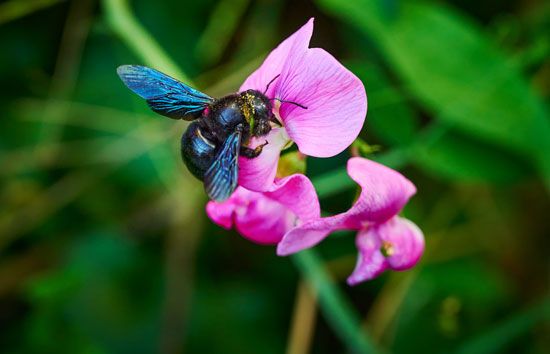
A carpenter bee is any of approximately 400 species of bees belonging to the genus Xylocopa. While they are often mistaken for bumblebees, carpenter bees are distinguished by their hairless abdomens and solitary nature.12
These bees earn their name from their habit of using strong mandibles to excavate tunnels in solid wood, such as tree branches or structural timber, to create nests for their young. Although they are sometimes viewed as pests due to this tunneling, they do not consume the wood and serve as vital native pollinators.12
Most carpenter bees are solitary, though some species may form simple social colonies. They do not produce honey, and they are generally docile. Only females possess a stinger, which they use only if provoked. A separate group known as “small carpenter bees” (genus Ceratina) also exists, which typically nests in hollowed-out plant stems.123
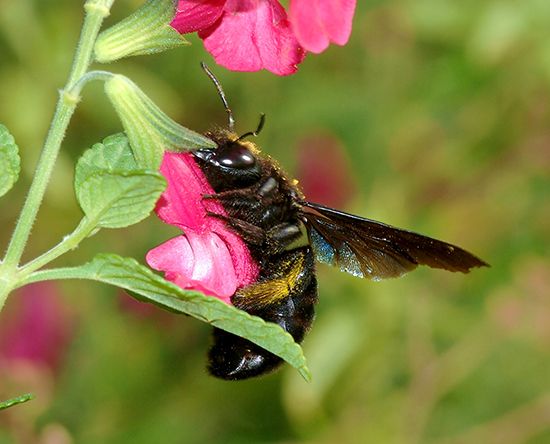
How can you tell a carpenter bee apart from other bees?
To distinguish a carpenter bee from other bees, such as the bumblebee, you can look for these key physical characteristics:
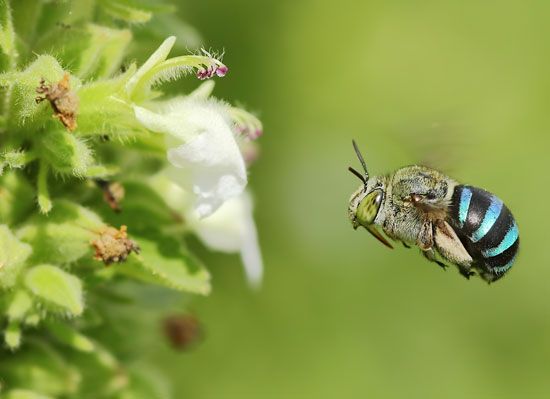
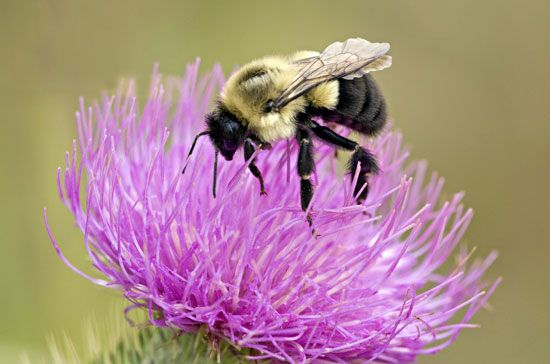
- Abdomen Texture: The most reliable way to tell them apart is by the abdomen. While bumblebees are fuzzy all over, carpenter bees have a smooth, shiny, and nonhairy abdomen.14
- Coloration: Most carpenter bees are all black or nearly black, though they may have patches of white or yellow hair on the thorax.1
- Sexual Dimorphism: Males often feature a white or yellow face and larger compound eyes than females.1
- Size: They are generally large, often comparable in size to a bumblebee.4
Additionally, their behavior provides a clue: unlike many other bees that nest in the ground or in pre-existing cavities, carpenter bees are known for excavating tunnels into solid wood, such as structural timber, tree branches, or park benches, using their strong mandibles.1
Where do carpenter bees usually live?
Carpenter bees (genus Xylocopa) are found in most areas of the world, where they have coevolved with local flowering plants to thrive in diverse habitats.1
Regarding their specific nesting sites, these bees are named for their habit of excavating tunnels in solid wood. Common locations for these nests include:
- Natural structures: Tree branches and other woody plant materials.1
- Human-made structures: Wooden beams, buildings, fences, and park benches.1
While most carpenter bees are wood-nesters, a few species are known to nest in the ground. Additionally, the unrelated “small carpenter bees” (genus Ceratina) typically nest by hollowing out plant stems. Regardless of the location, these bees do not consume the wood they tunnel into; instead, they use it as a protective environment to provision individual cells for their larvae.1
How do carpenter bees make their nests?
Carpenter bees are solitary insects that construct their nests by excavating tunnels into solid wood, such as tree branches, structural beams, or wooden furniture.1
The process involves the following steps:
- Excavation: Using her strong mandibles, the female carves a circular entrance hole that leads into a series of adjacent tunnels. Notably, the bees do not consume the wood they remove during this process.1
- Provisioning: Once the tunnels are prepared, the female creates individual cells within them. She places an egg in each cell, accompanied by a supply of food.1
- Sealing: Each cell is sealed off using a mixture of wood pulp and saliva.1
- Development: The larvae mature and pupate within these sealed cells over several weeks. The resulting adults typically hibernate inside the nest throughout the winter before emerging in the spring.1
While most species are solitary, some may form simple social colonies where mothers and daughters share nesting duties.1
Sources
- carpenter bee — Encyclopædia Britannica
- carpenter bee — Merriam-Webster
- 8 Buzzworthy Types of Bees — Encyclopædia Britannica
- great carpenter bee — Merriam-Webster
Published on · 3 min read