Carpenter Moth
Carpenter moths (family Cossidae) earn their name from the behavior of their larvae, which bore into wood or pithy stems. Much like a human carpenter who…
How do carpenter moths get their name, and what is their relationship with wood?
Carpenter moths (family Cossidae) earn their name from the behavior of their larvae, which bore into wood or pithy stems. Much like a human carpenter who works with timber, these insects spend a significant portion of their life cycle—often one to three years—tunneling through the interior of trees.12
Their relationship with wood is primarily nutritional and developmental. Because wood is a nutrient-poor food source, the larvae require an extended period to complete their growth, sometimes taking up to two years to develop. During this time, they live within the wood, using it as both a habitat and a food source before eventually pupating within their larval burrows. While this behavior makes them destructive pests to various ornamental and crop plants, they remain vital components of their local food webs, serving as a food source for woodpeckers and other birds.21
What is the life cycle of a carpenter moth, from egg to adult?
The life cycle of a carpenter moth (family Cossidae) follows the process of complete metamorphosis, consisting of four distinct stages: egg, larva, pupa, and adult.
- Egg: While specific details on the egg stage are limited, the cycle begins when eggs are laid on or near host plants, typically deciduous trees or pithy stems.
- Larva: This is the primary feeding and growth stage. Carpenter moth larvae are pale and nearly hairless. Unlike many other insects, they spend an extended period—ranging from one to three years—boring into wood. Because wood is a nutrient-poor food source, their development is slow. During this time, they molt their exoskeleton multiple times as they grow within their tunnels.
- Pupa: Before transforming into an adult, the larva pupates within its larval burrow. During this stage, the insect undergoes a dramatic internal reorganization, breaking down larval structures and developing adult features such as wings.
- Adult: The adult moth emerges from the pupa. Adults are characterized by long, thick bodies and mottled or spotted wings. Notably, they possess vestigial mouthparts and do not feed; they rely entirely on the energy reserves accumulated during their long larval stage to survive and reproduce.
What are some of the largest species of carpenter moths, and how big can they grow?
The size of carpenter moths (family Cossidae) varies significantly across the family, ranging from small species in temperate zones to some of the largest moths in the world.
- Largest Species: The species Xyleutes boisduvali, native to Australia, is notable for its massive size. It can reach a wingspan of approximately 25 cm (10 inches).1
- Other Notable Sizes: In contrast, many other species are much smaller. For example, the carpenterworm moth (Prionoxystus robiniae), which is the most common North American representative of the family, typically has a wingspan of about 5 cm (2 inches). Generally, species found in temperate zones may have a wingspan of under 2.5 cm (1 inch).1
These moths are characterized by their long, thick bodies, which support their substantial size, though they do not feed as adults due to their vestigial mouthparts.1
What are the distinguishing features of carpenter moths?
Carpenter moths, belonging to the family Cossidae, are distinguished by several key physical and behavioral characteristics:
- Larval Features: The larvae are pale, nearly hairless, and are known for their wood-boring habits. They spend one to three years tunneling through wood or pithy stems, which can cause significant damage to trees.1
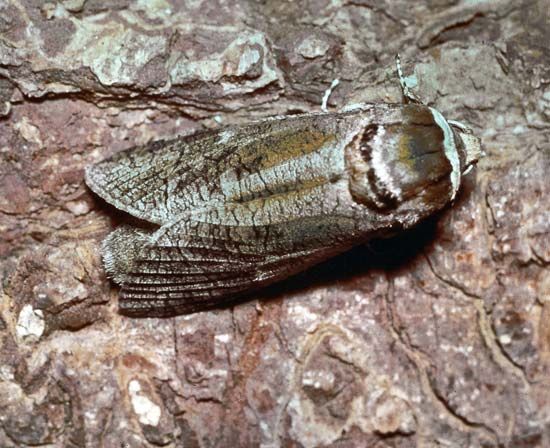
- Adult Morphology: Adult carpenter moths possess long, thick bodies and vestigial mouthparts, meaning they do not feed during their adult stage. Their wings are typically gray to brown and are frequently marked with mottled or spotted patterns.1
- Size Variation: There is a vast range in size across the family. Temperate species may have a wingspan of less than 2.5 cm (1 inch), while the Australian species Xyleutes boisduvali can reach a wingspan of approximately 25 cm (10 inches).1
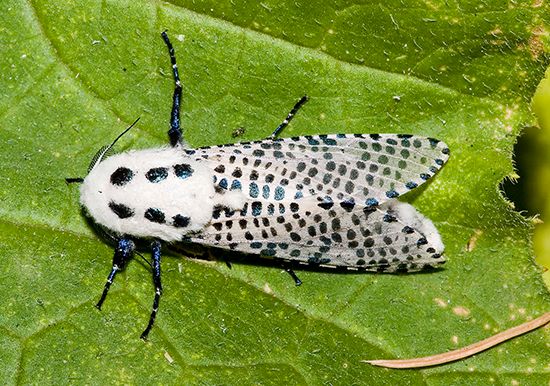
- Species Diversity: The family includes various notable species, such as the leopard moth, which features white wings with dark blotches, and the goat moth, whose larvae are known for exuding a strong, goatlike odor.1
Sources
- carpenter moth — Encyclopædia Britannica
- Lepidoptera - Larva, or caterpillar — Encyclopædia Britannica
- pupa — Encyclopædia Britannica
- Lepidoptera - The adult — Encyclopædia Britannica
- Lepidoptera - Thorax — Encyclopædia Britannica
- geometrid moth — Encyclopædia Britannica
- carpenter bee — Encyclopædia Britannica
Published on · 3 min read