Cashew
The cashew tree (Anacardium occidentale) produces a complex structure consisting of several distinct parts, each with specific uses.
What are the different parts of the cashew fruit, and how are they used?
The cashew tree (Anacardium occidentale) produces a complex structure consisting of several distinct parts, each with specific uses.1
The Cashew Apple
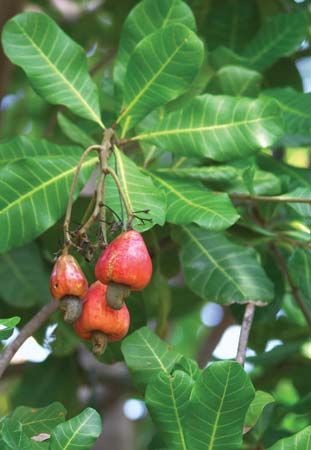
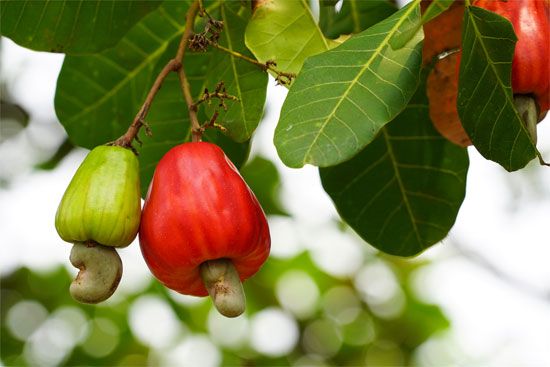
The pear-shaped, reddish or yellow structure is an accessory fruit known as the cashew apple. It is used locally to produce beverages, jams, and jellies.1
The True Fruit and Seed
The curved, bean-shaped structure attached to the apple is the true fruit, which contains the edible seed commonly called a cashew “nut”. These seeds are widely consumed as a protein-rich snack or as an ingredient in various cuisines.1
The Shells and Resin
The true fruit is protected by two shells containing a caustic, oily [resin]. This liquid is highly versatile in industrial applications, including:1
- Manufacturing: Used to create resins for varnishes, plastics, and as a laminating agent for paper, cloth, and glass fibers.12
- Industrial/Automotive: Utilized in brake linings, clutch facings, and to treat synthetic rubber and cement floors.2
- Preservation: Applied as a wood preservative against insects and as an insecticide to kill mosquito larvae.12
- Medicine: Employed in traditional medicinal practices.1
Because the plant is related to poison ivy, the resin must be handled with extreme care as it can blister human skin.12
How does the cashew tree grow, and what are its unique physical characteristics?
The cashew tree (Anacardium occidentale) is an evergreen member of the sumac family (Anacardiaceae). It thrives in fertile soil with high humidity, where it can reach heights of up to 12 meters (40 feet).1
Physical Characteristics
The tree is defined by several unique structural features:
- Leaves: It bears leathery, elliptical leaves that are arranged in a spiral pattern.1
- The “Fruit”: The cashew produces a complex structure consisting of a true fruit and an accessory fruit. The true fruit is a curved, bean-shaped structure (often over 2.5 cm long) that appears to be embedded in a swollen, pear-shaped stem called the cashew apple. The apple is an accessory fruit, typically reddish or yellow and about three times the size of the true fruit.1
- Shells and Resin: The true fruit is protected by two shells. A caustic, brown oily resin is found between these layers, which can cause severe blistering on human skin due to the plant’s relationship to poison ivy.1
How is the cashew plant cultivated commercially, and which countries are the main producers?
Commercial cultivation of the cashew (Anacardium occidentale) is primarily focused on the production of its valuable seeds. While the tree is native to northeastern Brazil, it is now cultivated extensively in Brazil and India.1
Cultivation and Processing
The cashew tree thrives in fertile soil with high humidity, reaching heights of up to 12 meters. The harvesting and processing of the seeds involve several steps:
- Harvesting: Cashew apples are picked by hand, and the attached true fruits are detached and sun-dried.1
- Roasting: To remove the caustic resin found between the two shells of the fruit, the seeds are roasted. Traditional methods involve roasting them amid burning logs, though modern, improved methods use roasting cylinders to safely dispel the poisonous properties.1
- Extraction: Once roasted, the inner shells are broken open by hand, and the kernels are heated to remove the seed coat.1
Because the plant is related to poison ivy, extreme care is required during processing to avoid skin irritation and eye injury from the resin fumes.1
What is the origin and native habitat of the cashew plant?
The cashew (Anacardium occidentale) is native to northeastern Brazil. While it originated in the New World, it was introduced to East Africa and India by Portuguese missionaries during the late 16th century.1
In its native and introduced ranges, the tree thrives in areas with fertile soil and high humidity, often becoming abundant at low altitudes near the seacoast. It is a member of the Anacardiaceae family, which is distributed primarily across tropical and subtropical regions of the world.13
Sources
- Cashew — Encyclopædia Britannica
- Fruit farming - Waste materials, other uses — Encyclopædia Britannica
- Wild cashew — Encyclopædia Britannica
- list of plants in the family Anacardiaceae — Encyclopædia Britannica
Published on · 3 min read