Catawba River
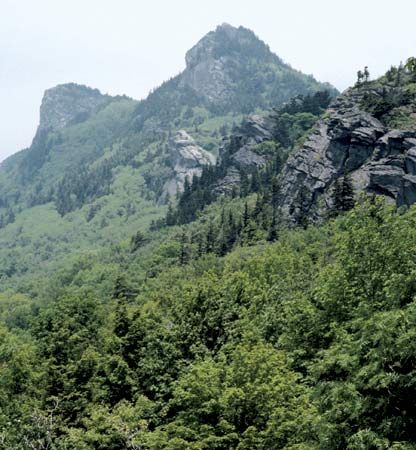
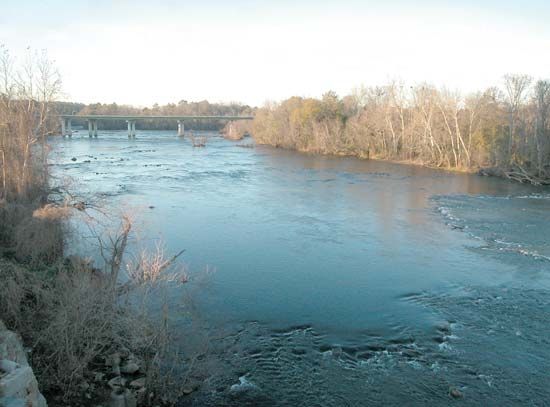
The Catawba River is a 220-mile (350-km) waterway in the southeastern United States that originates in the Blue Ridge Mountains of western North Carolina.…
What is Catawba River?
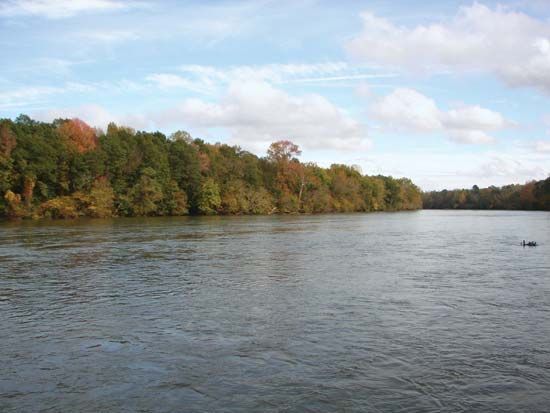
The Catawba River is a 220-mile (350-km) waterway in the southeastern United States that originates in the Blue Ridge Mountains of western North Carolina. Flowing south into South Carolina, the river reaches Great Falls, where it becomes the Wateree River. Together with the Wateree and the Santee, it forms a major river system that serves as a vital source of hydroelectric power for South Carolina.12
The river is also historically significant as the ancestral territory of the Catawba, a Siouan-speaking North American Indian tribe. The Catawba people traditionally relied on the river for resources and established their principal village along its banks in north-central South Carolina.3
How is hydroelectric power generated from river systems?
Hydroelectric power is generated by converting the potential energy of water into mechanical energy and, ultimately, into electricity.4
The process typically involves the following steps:
- Water Storage: A dam is used to impound a river, creating a reservoir at a higher elevation. This elevation difference between the reservoir and the turbine exit is known as the head.4
- Conveyance: Water is directed downward through large pipes or tunnels called penstocks. The pressure generated by this falling water is what drives the system.54
- Energy Conversion: At the end of the penstock, the water flows through a turbine. The force of the water causes the turbine blades to rotate, converting the water’s energy into mechanical energy.64
- Generation: The rotating turbine is connected to a generator, which converts the mechanical energy into electricity. Finally, transformers increase the voltage for efficient long-distance transmission.4
While this process provides a renewable energy source, it is important to acknowledge that the construction of dams can cause significant environmental disruption, including the displacement of human communities and the destruction of natural habitats.541
What are the key differences between the Catawba and Wateree rivers?
The Catawba and Wateree rivers are not distinct, separate waterways; rather, they are the same river system identified by different names based on its geographic location.
The primary difference lies in their nomenclature and the specific segments they represent within the Santee-Wateree-Catawba river system:
- Catawba River: This name refers to the upper 220-mile (350-km) portion of the river. It originates in the Blue Ridge Mountains of western North Carolina and flows south into South Carolina until it reaches Great Falls.81
- Wateree River: At Great Falls, the river transitions into the Wateree. This segment flows through central South Carolina, characterized by a series of lakes and reservoirs—most notably Wateree Lake—before joining the Congaree River to form the Santee River.21
While the names change at the Great Falls transition point, the entire system functions as a unified, vital source of hydroelectric power and navigation for the region.81
What was the daily life of the Catawba people like?
The Catawba people, a Siouan-speaking tribe, traditionally lived in villages composed of bark-covered cabins and a central temple used for religious ceremonies and public gatherings. Each village operated under the governance of a council led by a chief.3
Daily life was defined by several key practices:
- Agriculture: Unlike many other Southeast Indian cultures where women performed agricultural labor, Catawba men were the primary farmers. They grew beans, squash, gourds, and multiple annual crops of corn (maize).3
- Subsistence: The diet was supplemented by fishing for sturgeon and herring using weirs, snares, and long poles. During the winter, they relied on a plentiful supply of passenger pigeons.3
- Crafts and Trade: The Catawba produced baskets, mats, and bowls, which they traded with Europeans and other tribes in exchange for skins and meat.3
- Cultural Customs: They were known to English traders as “Flatheads” due to the ritual practice of head flattening performed on male infants.3
Sources
- Catawba River — Encyclopædia Britannica
- Santee-Wateree-Catawba river system — Encyclopædia Britannica
- Catawba — Encyclopædia Britannica
- Did you know? — Merriam-Webster
- turbine — Encyclopædia Britannica
- hydroelectric power — Encyclopædia Britannica
- dam - Rise of environmental and economic concerns — Encyclopædia Britannica
- Wateree River — Encyclopædia Britannica
Published on · 3 min read