Passenger Pigeon
The passenger pigeon (Ectopistes migratorius) was driven to extinction primarily through human activity, including mass slaughter and commercial hunting.
When was the last known passenger pigeon seen in the wild, and when did the species go extinct?
The passenger pigeon (Ectopistes migratorius) was driven to extinction primarily through human activity, including mass slaughter and commercial hunting.1
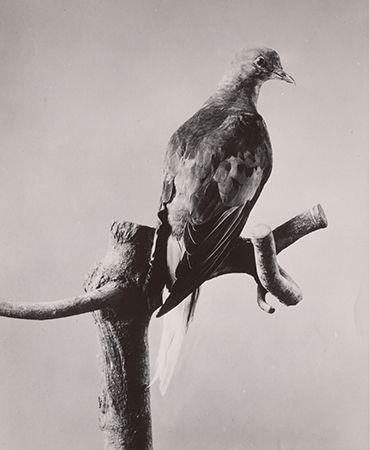
While the species experienced a precipitous decline starting in 1870, the last known individual, a bird named Martha, died in captivity at the Cincinnati Zoo on September 1, 1914. This date marks the official extinction of the species. Although the exact date of the last confirmed sighting in the wild is often debated, the rapid collapse of the population in the late 19th century effectively ended their presence in nature shortly before the death of the final captive bird.1
The tragic loss of this once-abundant species serves as a stark reminder of the consequences of human avarice and remains a foundational event that helped catalyze the modern conservation movement.1
What were the main factors that led to the rapid extinction of the passenger pigeon?
The rapid extinction of the passenger pigeon was primarily driven by the relentless and unthinking exploitation of the species by human settlers as they expanded westward across North America.12
The main factors contributing to their collapse included:
- Massive Commercial Hunting: The birds were slaughtered by the millions annually to satisfy a high demand for their meat. They were harvested on a massive scale and shipped in railway carloads to be sold in city markets.12
- Destruction of Nesting Grounds: Hunters frequently targeted the birds’ breeding colonies, often annihilating entire nesting populations in a single season. This prevented the species from successfully reproducing and sustaining its numbers.2
- Lack of Self-Moderation: The sheer abundance of the birds—which once numbered in the billions—led to a false sense of inexhaustibility. This “avarice and thoughtlessness,” as noted on a monument to the species, fueled an unsustainable rate of extraction that the population could not withstand.12
By 1870, these pressures caused a precipitous decline, leading to the species’ total extinction by 1914.12
How did the passenger pigeon’s social behavior contribute to its vulnerability to extinction?
The passenger pigeon possessed highly developed social behaviors that, while evolutionarily successful in the wild, rendered the species exceptionally vulnerable to human exploitation.
Their reliance on flocking behavior was a primary factor in their demise. While this behavior helped the birds locate food sources efficiently, it also meant that they congregated in massive, dense groups. Because these flocks were so concentrated, they were easily located and targeted by commercial hunters, who could slaughter thousands of birds in a single event.
Furthermore, the species practiced colonial nesting, with as many as 100 nests occupying a single tree. This social nesting structure meant that entire breeding populations were often concentrated in relatively small areas. When hunters discovered these nesting grounds, they could destroy the reproductive capacity of an entire region in one season. By exploiting the birds’ tendency to gather in predictable, high-density groups for both feeding and breeding, humans were able to systematically dismantle the population until it could no longer sustain itself.
What were the physical characteristics and behaviors of the passenger pigeon?
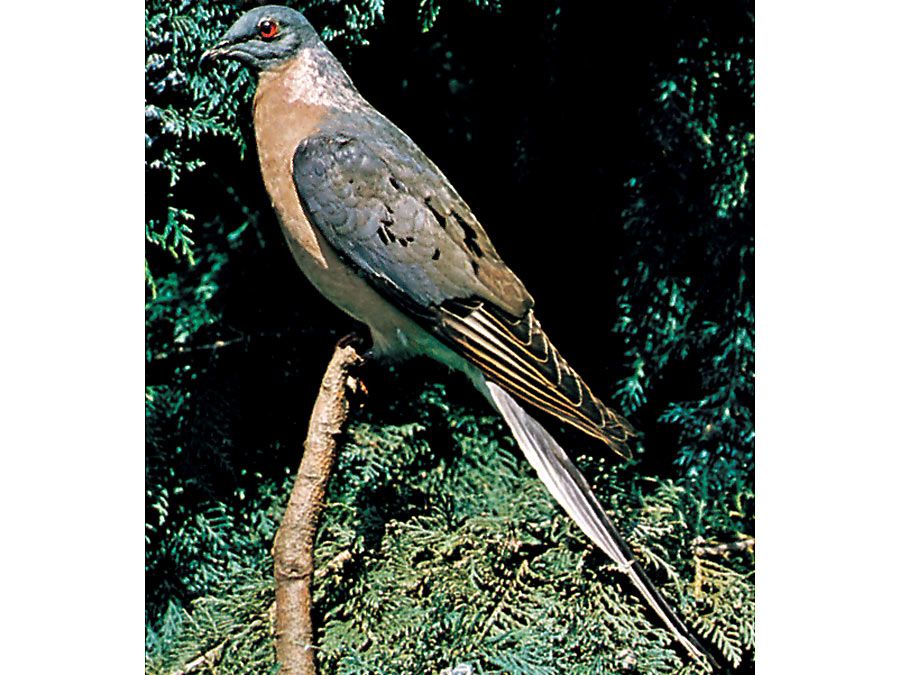
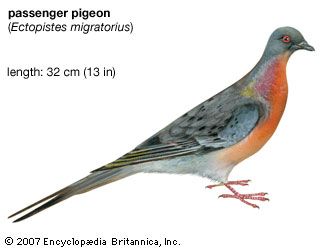
The passenger pigeon (Ectopistes migratorius) was a highly migratory bird characterized by its compact, plump body and a long, pointed tail, which provided the high degree of maneuverability needed for rapid escape in woodland environments. Measuring approximately 32 cm (13 inches) in length, the species exhibited sexual dimorphism: males featured a blue-gray head and a pinkish body, while females were generally duller in appearance.14
Regarding their behavior, passenger pigeons were defined by extreme gregariousness. They lived in massive flocks that were so large they could darken the sky for days during migration. This social nature extended to their reproductive habits; they practiced colonial nesting, with as many as 100 nests—each containing a single white egg—often crowded into a single tree. While they occasionally foraged in grainfields, they generally did little damage to crops. Their natural predators included hawks, owls, weasels, skunks, and arboreal snakes.51
Sources
- Passenger pigeon — Encyclopædia Britannica
- 6 Animals We Ate Into Extinction — Encyclopædia Britannica
- Pigeon: Top Questions — Encyclopædia Britannica
- Columbiform - Behaviour — Encyclopædia Britannica
- Columbiform - General features — Encyclopædia Britannica
- Columbiform - Distinguishing characteristics — Encyclopædia Britannica
Published on · 3 min read