Ceanothus
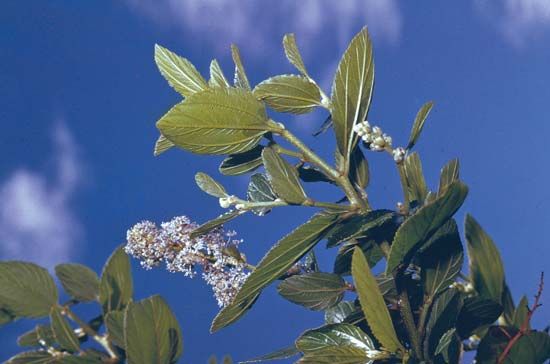
Ceanothus is a genus of approximately 55 species of North American shrubs, vines, and small trees belonging to the buckthorn family (Rhamnaceae). These…
What is Ceanothus?
Ceanothus is a genus of approximately 55 species of North American shrubs, vines, and small trees belonging to the buckthorn family (Rhamnaceae)1. These plants are characterized by their small blue or white flowers, which typically grow in profuse, erect clusters.12
Notable species include:
- Ceanothus americanus: Commonly known as New Jersey tea, this deciduous shrub grows to about 1 meter (3 feet) tall. Its leaves were historically used as a tea substitute during the American Revolutionary War.2
- C. arboreus: Also called Catalina or felt-leaf ceanothus, this evergreen tree is native to the islands off the coast of California. It can reach heights of 5–8 meters and produces fragrant blue flowers in early spring.2
The name is derived from the Greek word keanōthos, meaning “thistle,” and the genus has been recognized in botanical contexts since at least 1785.1
Why was New Jersey tea used during the American Revolutionary War?
New Jersey tea (Ceanothus americanus) was used as a substitute for imported tea during the American Revolutionary War because of the widespread colonial boycotts against British goods.34
These boycotts were fueled by intense opposition to British taxation policies, such as the Townshend Acts and the Tea Act, which granted the East India Company a monopoly on tea exports to the colonies. Following events like the Boston Tea Party, where colonists destroyed British tea shipments to protest “taxation without representation,” many Americans refused to consume imported tea as a form of political resistance. Consequently, the leaves of the native Ceanothus americanus shrub became a popular, patriotic alternative for those seeking to avoid British products.134
What are the differences between evergreen and deciduous plants?
The primary difference between evergreen and deciduous plants lies in their leaf-retention strategies, which are evolutionary adaptations to their specific environments.56
Evergreen Plants
Evergreen plants retain their leaves throughout the year and into the following growing season. Their leaves are often thicker and more leathery than those of deciduous plants, frequently featuring protective waxes and resins that help them survive cold temperatures, prevent water loss, and resist freezing. Because these leaves are costly to produce, evergreens keep them for two or more years, allowing the plant to perform photosynthesis whenever conditions—such as moisture and temperature—are favorable.578
Deciduous Plants
Deciduous plants shed their leaves annually at the end of each growing season. This is a protective mechanism; because deciduous leaves are typically thin and delicate, they would be susceptible to freezing and fracturing during harsh winters. By dropping their leaves, these plants avoid the risk of cell damage from freezing water and prevent physical breakage from wind or the weight of snow. The process is highly controlled: the plant closes off vessels to the leaf and forms an abscission layer to detach it, often recycling nutrients before the leaf falls.687
How do plants in the buckthorn family differ from other shrubs?
Plants in the Rhamnaceae family, commonly known as the buckthorn family, are distinguished from other shrubs by a specific set of morphological characteristics.1213
Key Morphological Features
Members of this family are typically woody plants that exhibit the following traits:
- Floral Structure: They possess a prominent hypanthium—a cup-shaped structure formed by the joined bases of flower parts—that surrounds the ovary.1413
- Stamen Arrangement: A defining characteristic is the presence of stamens that are positioned opposite the petals.121413
- Ovary: They feature a two- to five-chambered ovary, often with a disk of tissue developing underneath or around it.121413
- Leaves: The family is characterized by simple, undivided leaves.1214
Adaptations and Habit
Many members of the Rhamnaceae family have evolved specific adaptations to thrive in dry climates. These include a low, shrubby, and intricately branched habit, often accompanied by shortened branches and the presence of thorns or spines. While some species are used as ornamentals or for their medicinal properties—such as the bark of the cascara buckthorn—others have become invasive, outcompeting native vegetation in forest understories.14131516
Sources
- Ceanothus — Encyclopædia Britannica
- ceanothus — Merriam-Webster
- New Jersey tea — Merriam-Webster
- Boston Tea Party — Encyclopædia Britannica
- evergreen — Encyclopædia Britannica
- Temperate forest - Environment — Encyclopædia Britannica
- Temperate forest - Flora — Encyclopædia Britannica
- Why Do Leaves Fall in Autumn? — Encyclopædia Britannica
- plant - Classification of angiosperms — Encyclopædia Britannica
- Deciduous forest: Top Questions — Encyclopædia Britannica
- deciduous — Merriam-Webster
- Rhamnaceae — Merriam-Webster
- buckthorn — Encyclopædia Britannica
- Rosales - Characteristic morphological features — Encyclopædia Britannica
- alder buckthorn — Encyclopædia Britannica
- buckthorn — Merriam-Webster
- Rosales - Rhamnaceae — Encyclopædia Britannica
Published on · 3 min read