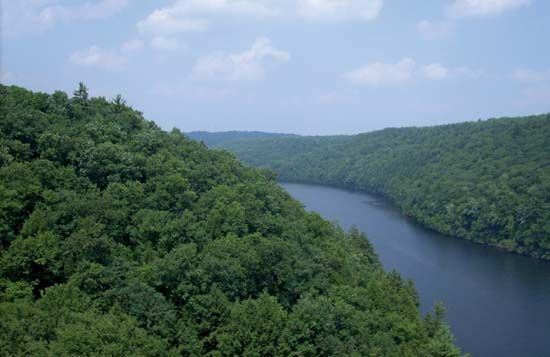
Cedar River
The Cedar River is a 329-mile-long (529-km) nonnavigable stream located in the north-central United States. It originates in southeastern Minnesota and flows…
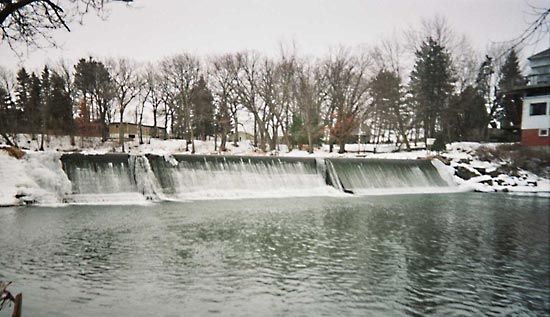
What is Cedar River?
The Cedar River is a 329-mile-long (529-km) nonnavigable stream located in the north-central United States. It originates in southeastern Minnesota and flows southeasterly across Iowa, eventually joining the Iowa River approximately 20 miles (32 km) before that river reaches the Mississippi River.12
The river’s 7,819-square-mile drainage basin consists primarily of fertile farmland. Along its course, the river passes through several cities, including Austin, Charles City, Cedar Falls, Waterloo, and Cedar Rapids. It is named for the stands of red cedar found along its lower reaches and features several small hydroelectric dams.1
How do rivers contribute to the formation of fertile farmland?
Rivers contribute to the formation of fertile farmland primarily through the deposition of alluvium, a mixture of silt, sand, clay, and gravel that often contains significant organic matter.4
This process occurs through two main mechanisms:
- Lateral Accretion: As a river meanders, it erodes its outer banks and deposits sediment on the inside of bends, creating features like point bars. These deposits expand across the valley bottom over time.5
- Vertical Accretion: During periods of flooding, a river overflows its banks, spreading sediment across the floodplain surface. This overbank deposition gradually increases the elevation and nutrient content of the soil.65
Because these deposits are rich in minerals and organic material, they create highly productive agricultural land. Historically, this fertility supported the rise of “hydraulic civilizations” in river valleys such as the Nile, the Tigris-Euphrates, and the Ganges, where early societies developed irrigation and engineering practices to manage these dynamic environments.47
What is the difference between a river and its tributaries?
The primary difference between a river and its tributaries lies in their relationship within a drainage basin. A river—often referred to as the trunk stream—is the main channel that collects water and sediment from a specific area. In contrast, a tributary is a smaller stream or river that flows into this larger body of water.91011
The distinction is functional rather than strictly based on size. While tributaries are often smaller than the rivers they feed, some can be immense; for example, the Missouri River is a tributary to the Mississippi River, despite being thousands of miles long itself. Together, a river and its network of tributaries form a complex system that drains all precipitation from a defined landscape into a single outlet.1012
It is also important to distinguish these from distributaries. While a tributary contributes water to a main river, a distributary is a branch that flows away from the main channel, typically occurring in areas like deltas or alluvial fans where the river splits as it deposits sediment.91113
How do hydroelectric dams generate electricity?
Hydroelectric dams generate electricity by converting the potential energy of stored water into mechanical energy and finally into electricity.17
The process functions through the following steps:
- Storage and Head: Water is collected in a reservoir at a high elevation. The vertical distance between the water surface and the turbines below is known as the head. A higher head allows for greater power generation from a smaller volume of water.15
- Conveyance: Water is directed downward through large pipes or tunnels called penstocks toward the powerhouse.15
- Generation: As the water exits the penstocks, its pressure and flow cause turbines to rotate. These turbines are connected to generators, which convert the mechanical rotation into electrical energy.1615
- Transmission: Transformers increase the voltage of the generated electricity to make it suitable for efficient long-distance transmission across the power grid.15
While this process provides a renewable energy source, it often involves significant environmental trade-offs, including the disruption of fish migration and the displacement of human communities.1715
Sources
- Cedar River — Encyclopædia Britannica
- Iowa River — Encyclopædia Britannica
- Cedar Rapids — Encyclopædia Britannica
- alluvium — Encyclopædia Britannica
- river - Significance in early human settlements — Encyclopædia Britannica
- river - Environments of deposition — Encyclopædia Britannica
- river - Floodplains — Encyclopædia Britannica
- river - Floodplain deposits, origins, and features — Encyclopædia Britannica
- tributary — Merriam-Webster
- drainage basin — Encyclopædia Britannica
- Did you know? — Merriam-Webster
- river — Merriam-Webster
- tributaries — Merriam-Webster
- river - Braided channels — Encyclopædia Britannica
- Did you know? — Merriam-Webster
- dam - Rise of environmental and economic concerns — Encyclopædia Britannica
- hydroelectric power — Encyclopædia Britannica
Published on · 3 min read