Celastraceae
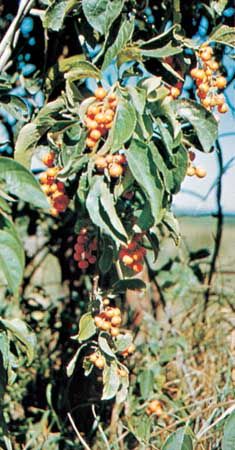
Celastraceae, commonly known as the staff-tree or bittersweet family, is a diverse group of flowering plants within the order Celastrales. This family…
What is Celastraceae?
Celastraceae, commonly known as the staff-tree or bittersweet family, is a diverse group of flowering plants within the order Celastrales. This family comprises approximately 90 genera and 1,300 species of woody vines, shrubs, trees, and herbs, which are distributed throughout temperate and tropical regions worldwide.12
Key characteristics of the family include:
- Morphology: Plants often feature simple, leathery leaves that may be arranged spirally or oppositely. Many species secrete latex, which can be observed as thin strands when a leaf is torn.12
- Flowers: The flowers are typically small, featuring a prominent nectar disk from which stamens arise.12
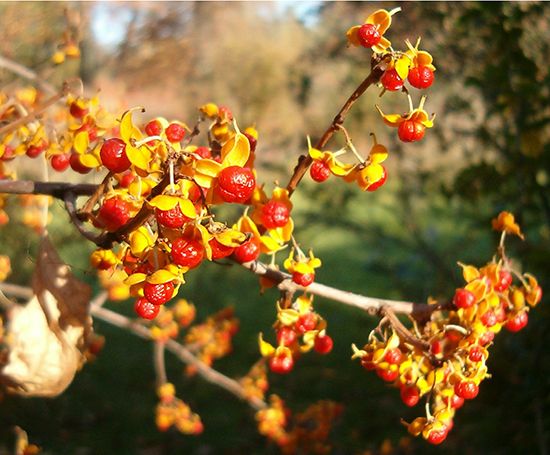
- Fruit: The family is noted for its often colorful fruit, which may be fleshy or dry, and seeds that sometimes possess a fleshy appendage known as an aril.132
Well-known members include ornamental genera such as Euonymus and Celastrus, as well as Catha edulis, or khat, a tree whose leaves are chewed for their stimulant properties.12
What are some common ornamental plants in the Celastraceae family?
The Celastraceae family, commonly known as the staff-tree family, includes several popular ornamental plants valued for their foliage and colorful fruit. The most prominent genera used in landscaping are Euonymus and Celastrus (bittersweet).45
Popular Ornamental Genera
- Euonymus: This genus includes about 130 species of shrubs, woody climbers, and small trees.4
- Winter creeper euonymus (E. fortunei): A versatile evergreen climber with many cultivated varieties used as ground covers or landscape shrubs.4
- Winged spindle tree (E. alatus): Also known as the burning bush, it is prized for its corky winged stems and vibrant fall foliage.4
- Wahoo (E. atropurpureus): A shrub native to North America known for its reddish fruits.4
- Strawberry bush (E. americanus): A lower-growing shrub featuring pinkish fruits.4
- Celastrus: These are primarily twining woody vines.62
- American bittersweet (C. scandens) and Oriental bittersweet (C. orbiculatus) are widely grown for their decorative capsules, which split to reveal colorful arils.2
- Paxistima: This genus consists of low, often creeping North American shrubs, such as P. canbyi, which are valued for their evergreen foliage.5
How does the khat plant function as a stimulant?
The khat plant (Catha edulis) functions as a stimulant primarily through the chemical compounds found in its leaves and young buds. When these plant parts are chewed, they release two specific alkaloids: cathinone and cathine.7
These substances act on the central nervous system to produce a state of mild euphoria. Individuals who consume khat typically experience feelings of excitement and increased talkativeness.7
While the plant is deeply integrated into the social fabric of certain regions in the Horn of Africa and the Arabian Peninsula, it is important to note that both the plant and its active component, cathinone, are classified as controlled substances in many parts of the world, including the United States, China, and much of Europe, due to their stimulant effects and potential for misuse.7
What is the purpose of the aril found on many Celastraceae seeds?
The primary purpose of the aril found on seeds, including those of many members of the Celastraceae family, is to facilitate seed dispersal.8
These structures typically develop as a fleshy, often brightly colored envelope surrounding the seed. This appearance serves as an evolutionary strategy to attract animals, particularly birds, which consume the aril along with the seed. Because the seeds are often resistant to digestion, they are later excreted by the animals in new locations, effectively spreading the plant to different areas. In some cases, such as with the fatty arils known as elaiosomes, the structure is specifically designed to entice ants to carry the seeds away.89
In the genus Euonymus, which belongs to the Celastraceae family, the presence of these attractive, bird-dispersed seeds is a key factor in the plant’s ability to spread and colonize new environments.9
Sources
- Celastraceae — Encyclopædia Britannica
- Celastraceae — Merriam-Webster
- Celastrales — Encyclopædia Britannica
- Euonymus — Encyclopædia Britannica
- staff tree — Merriam-Webster
- bittersweet — Encyclopædia Britannica
- khat — Encyclopædia Britannica
- aril — Encyclopædia Britannica
- aril — Merriam-Webster
- seed - Dispersal by birds — Encyclopædia Britannica
Published on · 3 min read