Cerro Mercedario
Cerro Mercedario is a prominent mountain peak located in the San Juan province of western Argentina, situated near the border with Chile. It reaches an…
What is Cerro Mercedario?
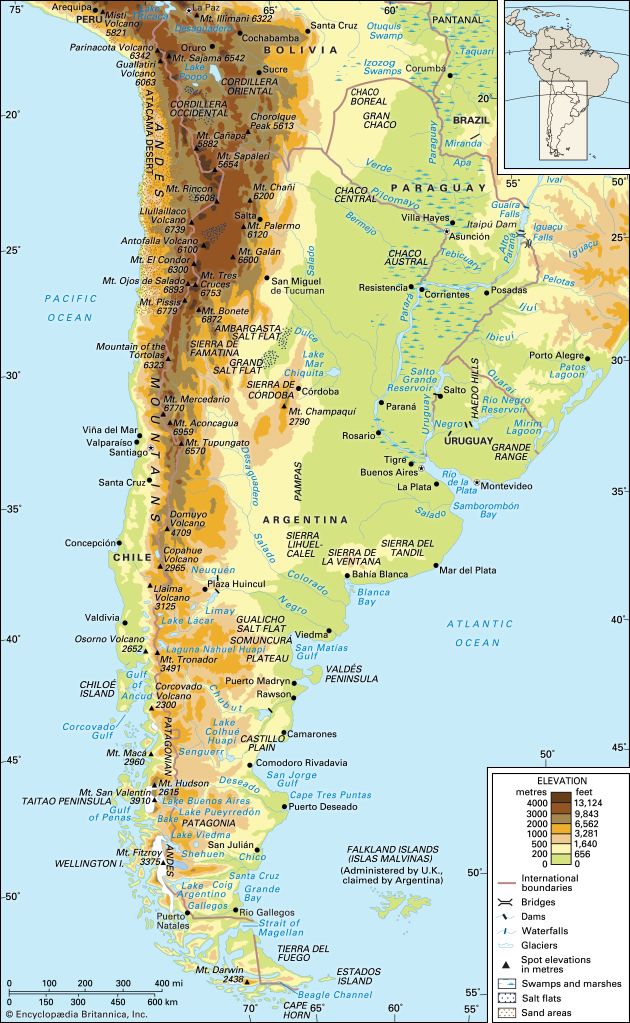
Cerro Mercedario is a prominent mountain peak located in the San Juan province of western Argentina, situated near the border with Chile. It reaches an elevation of 22,211 feet (6,770 metres) and is part of the Andes mountain range.1
What is the Andes mountain range?
The Andes Mountains are a vast, continuous mountain system in South America that form an unbroken rampart stretching approximately 5,500 miles (8,900 kilometers) from the continent’s southern tip to its northern coast on the Caribbean Sea. As one of the world’s great natural features, they contain the highest peaks in the Western Hemisphere, including Mount Aconcagua at 22,831 feet (6,959 meters).234
Rather than a single line of peaks, the Andes consist of parallel and transverse ranges, or cordilleras, interspersed with high plateaus and depressions, such as the Altiplano. Geologically, the system was formed by the subduction of the oceanic Nazca Plate beneath the continental South American Plate, a process that began roughly 25 million years ago and continues today. This tectonic activity makes the region part of the Ring of Fire, characterized by frequent volcanoes and earthquakes.354
The range deeply influences the climate and biodiversity of the continent, with life zones varying significantly by altitude.63
How do mountains form in Argentina?
Mountains in Argentina, specifically those within the Andes, were primarily formed through plate tectonics and the process of subduction.78
The Mechanism of Formation
The mountain-building process, or orogeny, is driven by the convergence of two major tectonic plates:
- Nazca Plate: An oceanic plate that moves eastward.8
- South American Plate: A continental plate that moves westward.78
As the denser Nazca Plate is forced beneath the lighter South American Plate, it creates a subduction zone. This ongoing process, which began approximately 170 million years ago, has resulted in significant crustal compression and uplift.879
Key Geological Factors
- Magmatism: The subduction process triggers the intrusion of magma from the mantle, leading to extensive volcanism along the cordillera.798
- Crustal Compression: During the Cretaceous period, tectonic activity shifted from crustal extension to compression, which helped form the sub-Andean foreland basins where many natural resources are now concentrated.9
- Episodic Uplift: While subduction is continuous, the actual rise of the mountains often occurs in discrete, rapid episodes of uplift, such as the significant elevation increase that occurred roughly 25 million years ago.710
What are the highest peaks in the Andes?
The Andes Mountains contain the highest peaks in the Western Hemisphere, with many summits exceeding 20,000 feet (6,100 meters).211
The most prominent peaks include:
- Mount Aconcagua: Located in Argentina, it is the highest point in the Western Hemisphere at 22,831 feet (6,959 meters).121314
- Ojos del Salado: Situated on the border of Argentina and Chile, this peak reaches 22,615 feet (6,893 meters).14
- Mount Bonete: Located in Argentina, it stands at 22,546 feet (6,872 meters).14
- Mount Mercedario: Found north of Aconcagua, it reaches 22,211 feet (6,770 meters).5
- Mount Huascarán: The highest peak in Peru, rising to 22,205 feet (6,768 meters).511
- Tres Cruces: Located at 27° S latitude, this peak reaches 22,156 feet (6,753 meters).5
These mountains are characterized by a succession of parallel ranges and high plateaus, with significant volcanic activity throughout the system.211
Sources
- Cerro Mercedario — Encyclopædia Britannica
- Andes Mountains: Top Questions — Encyclopædia Britannica
- Andean Geosyncline — Encyclopædia Britannica
- Andes Mountains - Plant and animal life — Encyclopædia Britannica
- South America - The Andes Mountains — Encyclopædia Britannica
- Andes Mountains — Encyclopædia Britannica
- Andes Mountains - Geology — Encyclopædia Britannica
- South America - The Central Andes — Encyclopædia Britannica
- plate tectonics - Mountains by subduction — Encyclopædia Britannica
- Nazca Plate — Encyclopædia Britannica
- Mount Aconcagua — Encyclopædia Britannica
- Andes Mountains - Physiography of the Central Andes — Encyclopædia Britannica
- mountain - Selected world mountains — Encyclopædia Britannica
- Exploring 7 of Earth’s Great Mountain Ranges - Andes — Encyclopædia Britannica
Published on · 3 min read