Cordillera Central
The term Cordillera Central refers to several distinct mountain ranges across the globe. Because the name is a common geographical descriptor, it is used to…
What is Cordillera Central?
The term Cordillera Central refers to several distinct mountain ranges across the globe. Because the name is a common geographical descriptor, it is used to identify major highland systems in multiple countries:
- Dominican Republic: A structurally complex range in the western part of the country. It contains Duarte Peak, which at 10,417 feet (3,175 m) is the highest point in the West Indies.12
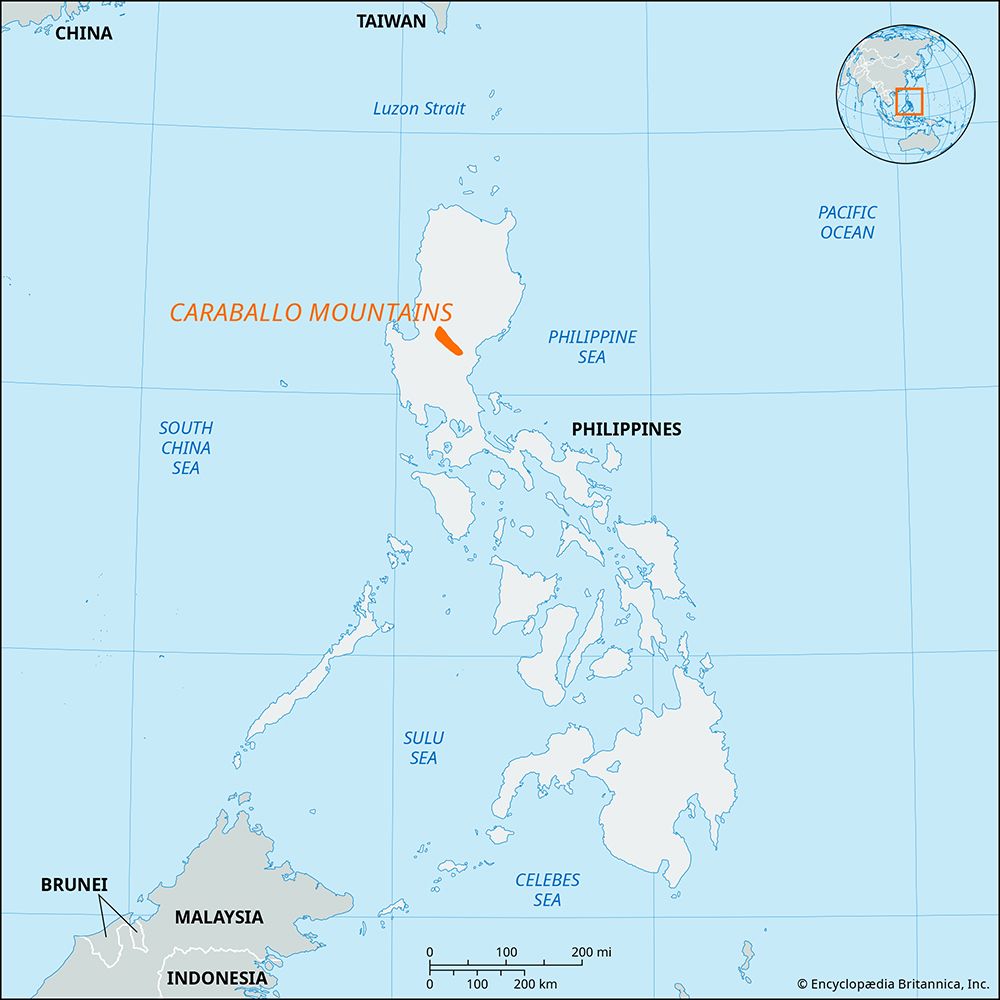
- Philippines: The central mountain chain of Luzon. It consists of parallel ranges that merge with the Sierra Madre to form the Caraballo Mountains.32
- Colombia and Peru: The name is also applied to specific ranges within the Andes Mountains in both countries.2
- Puerto Rico: A mountain range located in the south-central region of the island.2
What is the difference between a mountain range and a cordillera?
While the terms are sometimes used interchangeably in casual conversation, they describe different scales of geological features.
A mountain range (or chain) is a series of mountains connected by ridges and separated by valleys, typically extending tens to hundreds of kilometers in length. Mountains rarely occur individually; they generally form these elongated ranges or chains. When multiple mountain ranges are linked together, they form a larger mountain belt.4
A cordillera (from the Spanish word for “little rope”) is a more extensive system of mountain ranges, often consisting of several more or less parallel chains. While a mountain range is a single, linear feature, a cordillera represents a broader, complex system of multiple ranges. For example, the Andes Mountains constitute a massive mountain belt that includes various individual ranges, such as the Cordillera Blanca, which are referred to by the term cordillera to differentiate the specific chains within the larger system.564
How do mountain ranges influence the climate of the surrounding regions?
Mountain ranges significantly influence the climate of surrounding regions through their impact on temperature, atmospheric flow, and precipitation patterns.
Temperature and Altitude
As elevation increases, atmospheric pressure decreases, causing air to expand and cool—a process known as adiabatic cooling. Consequently, mountain environments are generally cooler than nearby lowlands. This altitude-driven temperature drop creates distinct mesoclimates and microclimates that vary significantly over short distances.91011
Precipitation and Barriers
Mountains act as physical barriers to moving air masses. When moist air is forced to rise over a range, it cools and releases moisture, a phenomenon called orographic precipitation. This results in heavy rainfall or snowfall on the windward slopes. Conversely, as the air descends the leeward side, it warms and dries, creating a rain shadow—a region of significantly reduced precipitation.9121113
Atmospheric Flow
Large mountain barriers, such as the Rockies and Andes, can redirect regional wind patterns and prevent cold continental air from moving across them. This can lead to milder weather on one side of a range compared to the other.13
What are some of the highest peaks found in the Andes mountain system?
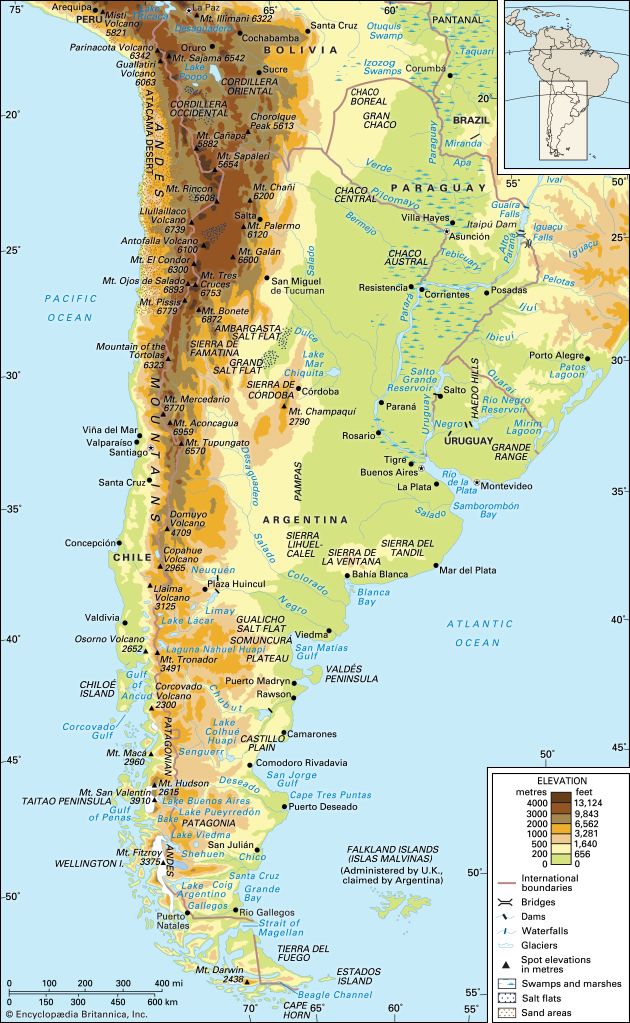
The Andes Mountains contain the highest peaks in the Western Hemisphere, forming a vast system of parallel and transverse ranges. Some of the most notable high peaks include:15
- Mount Aconcagua: Located in Argentina, it is the highest point in the Western Hemisphere, reaching an elevation of 22,831 feet (6,959 meters).161715
- Mount Huascarán: Situated in Peru’s Cordillera Blanca, this peak reaches 22,205 feet (6,768 meters).18
- Cerro Mercedario: Located in Argentina, this peak stands at 22,211 feet (6,770 meters).18
- Tres Cruces: Reaching 22,156 feet (6,753 meters), it marks a significant culmination point in the cordillera.18
- Mount Tupungato: A prominent volcanic peak near the border of Chile and Argentina, rising to 21,555 feet (6,570 meters).18
- Nevado Illimani: A major peak in Bolivia’s Cordillera Real, exceeding 21,000 feet.18
Other significant peaks throughout the system include Ojos del Salado, Llullaillaco, and Chimborazo.1819
Sources
- Cordillera Central — Encyclopædia Britannica
- Philippines - Relief — Encyclopædia Britannica
- Cordillera Central — Merriam-Webster
- cordillera — Encyclopædia Britannica
- mountain — Encyclopædia Britannica
- mountain range — Merriam-Webster
- continental landform - Orogenic geomorphic systems — Encyclopædia Britannica
- cordillera — Merriam-Webster
- Highland climate — Encyclopædia Britannica
- Orographic precipitation — Encyclopædia Britannica
- Why are higher elevations colder? — Encyclopædia Britannica
- Mountain ecosystem - Environment — Encyclopædia Britannica
- Atmosphere - Mountain barriers — Encyclopædia Britannica
- rain shadow — Merriam-Webster
- Andes Mountains: Top Questions — Encyclopædia Britannica
- Mount Aconcagua — Encyclopædia Britannica
- Andes Mountains - Physiography of the Central Andes — Encyclopædia Britannica
- list of mountains - South America — Encyclopædia Britannica
- Andes Mountains — Encyclopædia Britannica
Published on · 3 min read