Ceyhan River
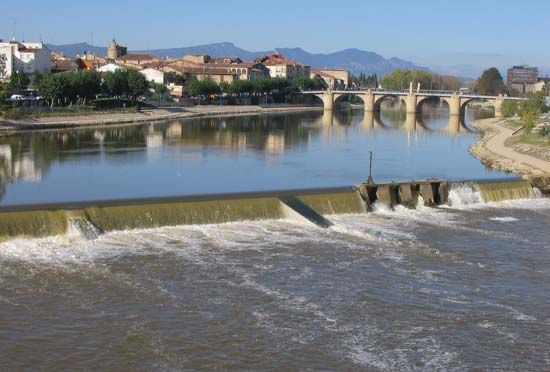
The Ceyhan River is a significant waterway located in southern Turkey. It originates in the Nurhak Mountains of the Eastern Taurus range, northeast of…
What is Ceyhan River?
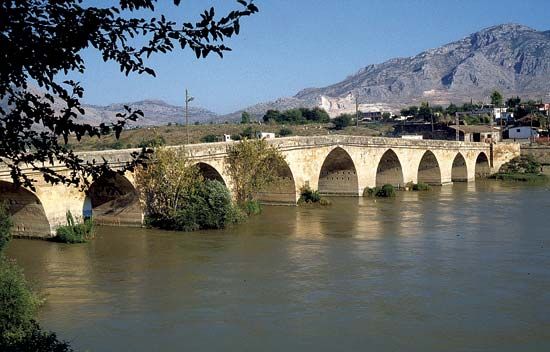
The Ceyhan River is a significant waterway located in southern Turkey. It originates in the Nurhak Mountains of the Eastern Taurus range, northeast of Elbistan.
The river follows a course of approximately 316 miles (509 km). After flowing southeast past Elbistan, where it is fed by the Harman Deresi and various small streams, it turns south to join the Aksu near Kahramanmaraş. From there, it shifts southwest before emptying into the Mediterranean Sea. Historically, the region surrounding the river was part of the Byzantine Empire, and its name is the Turkish derivative of the Arabic term Jayḥān.1
What are the major mountain ranges in Turkey?
Turkey is a predominantly mountainous country, characterized by a complex geological structure within the young folded-mountain zone of Eurasia. The landscape is dominated by two primary mountain systems that trend east to west.2
Major Mountain Ranges
- Taurus Mountains: Located in the south, this massive system runs parallel to the Mediterranean coast. It extends from Lake Egridir in the west to the upper reaches of the Euphrates River in the east. Crest lines often exceed 8,000 feet (2,400 meters), with several peaks surpassing 11,000 feet (3,400 meters).34
- Pontic Mountains: Situated in the north, this range rises along the southern shore of the Black Sea. The mountains follow a gentle double bend and reach heights of up to 12,900 feet (3,932 meters), featuring dense pine forests.5
Eastern Highlands
In the eastern third of Turkey, the northern and southern fold systems converge, creating an extensive area of rugged, mountainous terrain. This region contains the country’s highest elevations, including Mount Ararat, which reaches 16,945 feet (5,165 meters).24
How do rivers shape the geography of the Mediterranean region?
Rivers have played a fundamental role in shaping the geography and history of the Mediterranean region through both physical landscape evolution and the development of human civilization.
Landscape Evolution and Deltas
Rivers act as primary agents of landscape change by transporting sediment from drainage basins to the coast. Where these rivers meet the sea, they form deltas, which are depositional plains that alter the shoreline. Notable examples include the deltas of the Nile, Rhône, Po, and Ebro rivers, which have significantly expanded coastal landforms through silt deposition. The morphology of these deltas—ranging from broad plains to complex channel networks—is determined by a balance between riverine sediment discharge and marine processes like wave energy and tidal range.678
Hydrological Impact
Rivers influence the Mediterranean’s internal hydrology. Because the sea loses more water to evaporation than it receives from rivers, it relies on a continuous inflow of surface water from the Atlantic Ocean. Large-scale human interventions, such as the construction of the Aswan High Dam on the Nile, have altered these dynamics by reducing freshwater flow, which in turn modifies salinity levels and circulation patterns within the sea.910
Historical Significance
The Mediterranean’s early civilizations were deeply tied to riverine environments. The Tigris-Euphrates and Nile valleys provided the fertile conditions necessary for the rise of “hydraulic civilizations,” where irrigation and flood management fostered permanent settlements and urban growth. These rivers served as vital conduits for communication, trade, and conquest, anchoring the development of major cities and political structures throughout history.1112
What was the historical significance of the Byzantine Empire in this area?
The Byzantine Empire, or Eastern Roman Empire, served as a vital bridge between the ancient and medieval worlds for nearly 1,000 years after the fall of the Western Roman Empire. Centered in Constantinople, its historical significance is defined by several key roles:1415
- Preservation of Culture: The empire acted as a bastion for the traditions and literature of Hellenic civilization, preserving knowledge that eventually became available to the West through trade and diplomatic contact.16
- Geopolitical Buffer: For centuries, the empire served as a shield for Europe, holding firm against various invasions from the east, including Goths, Huns, Slavs, and Arabs. Its military and administrative structures, such as the theme system, were essential for managing these frontiers.151718
- Religious Influence: As the center of Eastern Orthodoxy, the empire shaped the religious and cultural landscape of the Balkans and Eastern Europe. The East-West Schism remains a watershed moment in church history.1419
- Cultural Mediation: Byzantium functioned as a mediator between the West and other civilizations, including the Islamic world, India, and China, facilitating the exchange of ideas and goods.16
Sources
- Ceyhan River — Encyclopædia Britannica
- Taurus Mountains — Encyclopædia Britannica
- Pontic Mountains — Encyclopædia Britannica
- Turkey - Relief — Encyclopædia Britannica
- Turkey - The southern folded zone — Encyclopædia Britannica
- Mediterranean Sea - Hydrology — Encyclopædia Britannica
- Mediterranean Sea - Impact of human activity — Encyclopædia Britannica
- river - Deltas — Encyclopædia Britannica
- river - Morphology of deltas — Encyclopædia Britannica
- ancient Middle East - Evolution of Middle Eastern civilizations — Encyclopædia Britannica
- Mediterranean Sea - Physiography — Encyclopædia Britannica
- river - Significance in early human settlements — Encyclopædia Britannica
- drainage basin — Encyclopædia Britannica
- Timeline of the Roman Empire - Byzantine, or Eastern Roman, Empire — Encyclopædia Britannica
- Byzantine Empire — Encyclopædia Britannica
- Greece - The evolution of Byzantine institutions — Encyclopædia Britannica
- Byzantine Empire: Top Questions — Encyclopædia Britannica
- Greece - Economy and society — Encyclopædia Britannica
- Mediterranean Sea - Transportation and tourism — Encyclopædia Britannica
- History of Albania - Medieval culture — Encyclopædia Britannica
- history of technology - Byzantium — Encyclopædia Britannica
- Byzantine Empire - Military revival — Encyclopædia Britannica
Published on · 3 min read