Chaffinch
The chaffinch (Fringilla coelebs) is a common songbird belonging to the family Fringillidae. It is recognized as the most prevalent finch found in western…
What is Chaffinch?
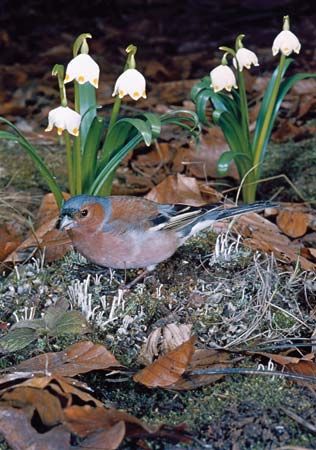
The chaffinch (Fringilla coelebs) is a common songbird belonging to the family Fringillidae. It is recognized as the most prevalent finch found in western Europe.1
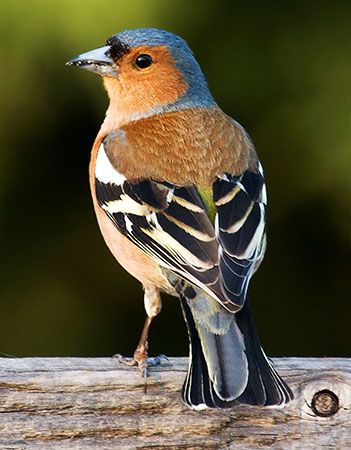
These birds typically breed in farmlands and gardens across a range extending from Europe and northern Africa to central Asia, and they have also been introduced to South Africa. Measuring approximately 15 cm (6 inches) in length, the species exhibits sexual dimorphism: the male is characterized by a bluish crown, a rust-brown back, a greenish rump, and a pinkish to rust-colored face and breast, while the female displays a more muted greenish-brown plumage. A related species, the blue chaffinch (F. teydea), is found in the Canary Islands.12
What other types of birds belong to the finch family?
The family Fringillidae, often referred to as “true finches,” comprises approximately 230 to 240 species of songbirds found on every continent except Antarctica3.3
While the term “finch” is colloquially applied to various birds across different families, the true finches of the Fringillidae family include several distinct groups:
- Grosbeaks: Known for their heavy, powerful bills.43
- Euphonias: Small, often brightly colored birds.43
- Cardueline finches: A diverse group that includes well-known species such as goldfinches and crossbills.43
- Chaffinches: A common group of songbirds found across Europe, Asia, and Africa.43
It is important to note that many other birds commonly called “finches”—such as buntings, cardinals, sparrows, and weavers—are classified in separate families, including Emberizidae, Thraupidae, and Estrildidae.43
How do chaffinches communicate through song?
Chaffinches communicate through birdsong, which serves as a vital tool for attracting mates and defending territory during the breeding season. These vocalizations allow other males to identify the singer’s species, mood, and individual identity.5
The development of this song is a combination of hereditary instinct and social learning. While a chaffinch is born with the innate ability to produce a simple, juvenile “subsong,” it must hear the mature, true song from adult males to learn the full, complex sequence of notes characteristic of the species.5
What do chaffinches typically eat in their natural habitat?
As members of the finch family, chaffinches are primarily seed-eaters. They utilize their heavy, conical bills to crack open the seeds of various grasses and weeds found in their natural habitats, such as gardens and farmlands.1
In addition to seeds, many finches supplement their diet with insects. This is particularly important during the breeding season, as nestlings are unable to crack seeds and are therefore fed a diet consisting of insects by their parents.1
Sources
- Chaffinch — Encyclopædia Britannica
- chaffinch — Merriam-Webster
- Fringillidae — Encyclopædia Britannica
- Finch — Encyclopædia Britannica
- Birdsong — Encyclopædia Britannica
Published on · 2 min read