Chalcid Wasp
A chalcid wasp is any of more than 22,000 species of small, solitary wasps belonging to the superfamily Chalcidoidea. These insects typically measure 2 to 3…
What is chalcid wasp?
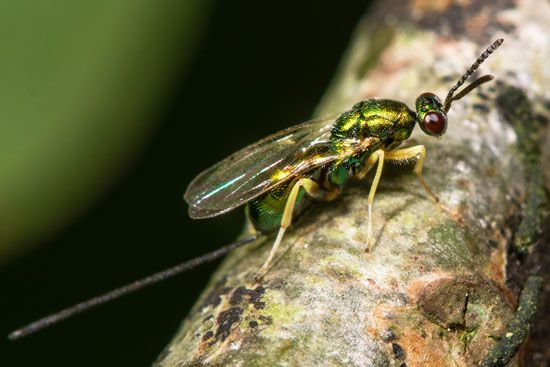
A chalcid wasp is any of more than 22,000 species of small, solitary wasps belonging to the superfamily Chalcidoidea. These insects typically measure 2 to 3 mm in length and often feature metallic colorations or black and yellow patterns.1
Most chalcid wasps are parasitoids, meaning their larvae develop on or within other arthropods, including various insects, spiders, and mites. Because many of these species parasitize agricultural pests, they are considered beneficial to humans. However, some species, such as certain seed chalcids, are categorized as economic pests.12
Not all chalcids are parasitic; for example, fig wasps (family Agaonidae) are essential for the pollination of figs. The group is highly diverse, comprising approximately 19 families, including the Mymaridae (fairyfly) and Trichogrammatidae.12
How do fig wasps help pollinate plants?
The relationship between fig wasps and figs is a remarkable example of coevolution, where each species of fig relies on a specific wasp species for pollination.
The process occurs within the syconium, an enclosed flowering structure. After mating inside a fig, a female wasp emerges from her gall and passes by male flowers, becoming covered in pollen. She then leaves the fig to find another to deposit her eggs. As she enters a new fig, she inadvertently transfers the pollen to the female flowers inside, fertilizing them.
In some cases, such as with Smyrna figs, the wasp cannot lay her eggs because the flower’s pistils are too long for her ovipositor. However, she still performs the essential role of pollination, which triggers the fruit to ripen. This cycle is vital for tropical forest ecosystems, as it ensures a year-round food supply for many birds and mammals.3
What is the difference between a parasite and a parasitoid?
The primary difference between a parasite and a parasitoid lies in the ultimate impact on the host.
- Parasites are organisms that live on or within another species (the host), benefiting at the host’s expense. While they may cause harm or disease, they do not necessarily kill the host organism.4
- Parasitoids are organisms whose larvae develop on or within a single host individual, and this relationship always results in the death of the host.45
Most parasitoids are wasps, though the strategy has also evolved in some flies, beetles, and moths. In contrast, parasitism is a broader category that includes diverse interactions such as ectoparasites (like fleas or ticks) that live on the body surface, and endoparasites that inhabit the host’s body or cells.45
How are chalcid wasps used in biological pest control?
Chalcid wasps (superfamily Chalcidoidea) are highly effective agents in biological control because the majority of species are parasitoids. In this role, their larvae develop on or within the bodies of other arthropods, effectively killing the host and regulating pest populations in agricultural settings.1
Specific applications include:
- Targeting Agricultural Pests: Many chalcid species parasitize insects that damage food crops, making them natural allies in pest management.1
- Egg Parasitism: Members of the family Trichogrammatidae, such as the genus Trichogramma, are particularly notable. These tiny wasps lay their eggs directly into the eggs of host insects. The developing wasp larvae consume the host’s nutrients and embryo, preventing the pest from ever reaching a damaging life stage.9
- Integrated Pest Management: Because broad-spectrum chemical insecticides can inadvertently kill beneficial insects and lead to pest resistance, chalcid wasps are often utilized as part of integrated control strategies. This approach minimizes chemical use by relying on the natural predatory and parasitic behaviors of these wasps to keep pest populations in check.10
Sources
- chalcid wasp — Encyclopædia Britannica
- Hymenoptera - Economic importance — Encyclopædia Britannica
- fig wasp — Encyclopædia Britannica
- parasitism — Encyclopædia Britannica
- parasitoid — Encyclopædia Britannica
- parasites — Merriam-Webster
- parasitic plant — Encyclopædia Britannica
- community ecology - Parasite - host interactions — Encyclopædia Britannica
- ichneumon wasp — Encyclopædia Britannica
- trichogrammatid wasp — Encyclopædia Britannica
- insecticide - Environmental contamination and resistance — Encyclopædia Britannica
Published on · 3 min read