Chameleon
Chameleons are a fascinating group of lizards known for their specialized anatomy and behaviors. While many people associate them with color-changing…
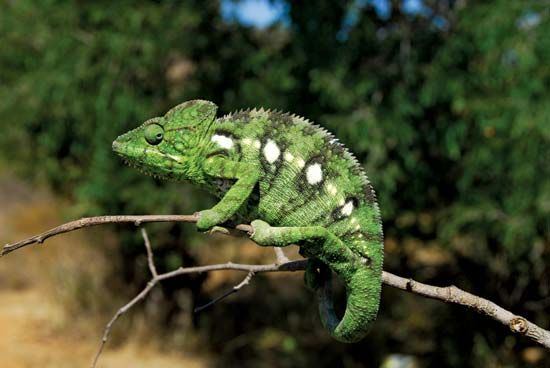
What are some of the most interesting or unusual species of chameleons?
Chameleons are a fascinating group of lizards known for their specialized anatomy and behaviors. While many people associate them with color-changing abilities, their diversity in size and life history is equally remarkable.1
Here are some of the most unusual species:
- Nano-chameleon (Brookesia nana): Recognized as the world’s shortest chameleon, the male of this species can measure as small as 21.6 mm (about 0.9 inch) in length.1
- Parson’s chameleon (Calumma parsonii): This is the longest chameleon in the world, capable of growing up to 69.5 cm (about 27 inches).1
- Labord’s chameleon (Furcifer labordi): This species is notable for having the shortest life span of any vertebrate. The entire adult population dies annually after a brief, intense breeding season, with the next generation hatching from eggs buried in the soil.1
- Jackson’s chameleon (C. jacksonii): Unlike most species that lay eggs, this chameleon bears its young live, with the embryos developing within the female’s oviduct without a placenta.1
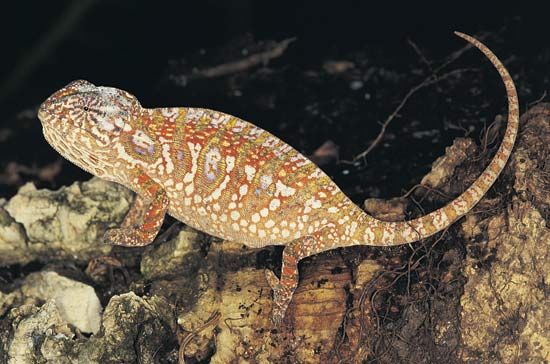
What are the unique physical characteristics of chameleons that set them apart from other reptiles?
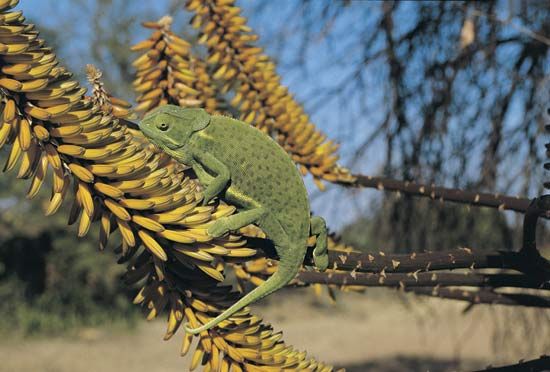
Chameleons (family Chamaeleonidae) possess a suite of highly specialized physical characteristics that distinguish them from other lizards and reptiles. These adaptations are primarily suited for their arboreal, or tree-dwelling, lifestyle.21
Unique Anatomical Features
- Zygodactylous Feet: Unlike the claws or adhesive pads found on many other lizards, chameleons have feet with toes fused into two opposed bundles. On the forelimbs, two toes face inward and three outward, while the pattern is reversed on the hind limbs. This allows them to grip branches securely like a pair of tongs.231
- Prehensile Tails: Many species, particularly those in the genus Chamaeleo, possess tails that act as a “fifth limb.” These tails can wrap around branches in a coil-like fashion to provide balance and stability.241
- Projectile Tongue: Chameleons utilize a specialized tongue-projection system that can launch at great speed to distances exceeding twice their body length. This is powered by the rapid contraction of a ringed accelerator muscle, which creates hydrostatic force to propel the tongue toward prey.2
- Independent Eye Movement: Their eyes are bulged and capable of moving independently of one another. The lenses are highly specialized, allowing for rapid focusing and the ability to enlarge visual images similarly to a telephoto lens.2
- Body Structure: They typically feature a laterally compressed body and, in some species, helmet-shaped heads or elaborate head ornamentation, such as horns or flaps, which are often used in territorial displays.2
How long do chameleons typically live, and how does this vary among different species?
The life span of chameleons varies significantly across species, ranging from extremely short, single-season cycles to longer periods of survival.
The most notable example of a brief life span is the Madagascan chameleon (Furcifer labordi), which is recognized as the vertebrate with the shortest life span. This species follows an annual cycle: eggs hatch in November, the individuals reach sexual maturity within two months, and after a brief breeding season in February, the entire adult population perishes.1
In contrast, other species exhibit different life history strategies. While detailed data on the natural population dynamics of many chameleon species remains limited, environmental factors such as climate and hibernation patterns can influence longevity in lizards generally. In captivity, many lizard species are known to be long-lived, sometimes surviving for decades, though specific longevity records for most wild chameleon species are not widely documented in the current knowledge base.6
How do chameleons change their colors, and what purposes does this serve?
Chameleons change their body color through a sophisticated biological mechanism involving the movement of pigment granules within specialized cells called melanophores. When these granules are concentrated, the animal appears lighter, and when they are dispersed throughout the cells, the chameleon takes on a darker appearance. This process is regulated by a complex interaction between the autonomic nervous system, hormones, and temperature.21
Contrary to popular belief, chameleons do not change color primarily to match their background. Instead, these shifts serve several functional purposes:27
- Environmental Regulation: Color changes are often a response to external factors such as light and temperature, helping the animal manage its body heat.27
- Communication and Emotion: Changes are frequently driven by the chameleon’s emotional state, including feelings of fright or the excitement associated with victory or defeat during territorial battles.27
- Mating Displays: Males often exhibit vivid and complex color patterns during mating, which play a significant role in attracting partners.27
Sources
- chameleon — Encyclopædia Britannica
- How Do Chameleons Change Colour? — Encyclopædia Britannica
- Tail — Encyclopædia Britannica
- reptile - Clinging and climbing — Encyclopædia Britannica
- lizard - Locomotion and limb adaptations — Encyclopædia Britannica
- lizard - Maturation — Encyclopædia Britannica
- lizard - Scales and colour change — Encyclopædia Britannica
- coloration - Background matching — Encyclopædia Britannica
- coloration - Short-term changes — Encyclopædia Britannica
Published on · 4 min read