Chestnut Oak
The chestnut oak (Quercus montana) is distinguished from other members of the white oak group primarily by its unique foliage and fruit characteristics.
How does the chestnut oak differ from other oak species in terms of its acorns and leaves?
The chestnut oak (Quercus montana) is distinguished from other members of the white oak group primarily by its unique foliage and fruit characteristics.
Leaves
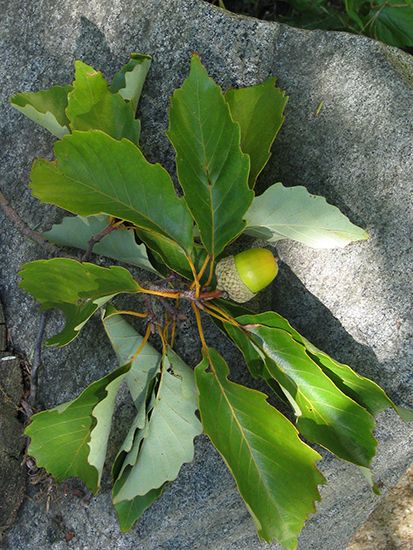
Unlike many other oaks that feature deeply lobed leaves, the chestnut oak possesses lance-shaped leaves that resemble those of the chestnut tree. These leaves are approximately 18 cm (7 inches) long and are characterized by 10 to 15 pairs of parallel veins, each terminating in a rounded tooth along the margin. In contrast, other species in the genus Quercus often exhibit more complex, deeply incised lobing patterns.1
Acorns
The chestnut oak is noted for producing relatively large acorns compared to many other oak species. While the swamp chestnut oak (Q. michauxii) is specifically recognized for its acorns being consumed by cattle—earning it the nickname “cow oak”—the general chestnut oak group is defined by these distinctively shaped leaves and specific ecological adaptations to rocky soils.21
What are the common uses of chestnut oak wood in industry and construction?
The term “chestnut oak” refers to several species of North American trees within the white oak group. While the provided information highlights the general utility of the white oak group in the lumber trade, specific industrial applications for the wood of the chestnut oak (Q. montana) are limited in the provided text.
However, the swamp chestnut oak (Q. michauxii) is explicitly noted for its historical use in the production of wood strips for basket material, which is why it is locally referred to as “basket oak.” More broadly, timber derived from all members of the white oak group is categorized as “white oak” within the lumber industry, where it is valued for various construction and manufacturing purposes.12
How do the tannins in chestnut oak bark contribute to its use in leather tanning?
The chestnut oak (Quercus montana) is highly valued in the leather industry due to its tannin-rich bark, which contains significant concentrations of tannin6.4
The Role of Tannins in Tanning
Tanning is a chemical process that converts raw animal hides into durable leather by displacing water from the spaces between protein fibers and cementing those fibers together. The tannins found in chestnut oak are classified as hydrolyzable tannins, which are water-soluble compounds that react with the protein constituents of animal skin to stabilize the material.56
Industrial Application
Because of these chemical properties, extracts derived from the wood and bark of the chestnut oak are specifically utilized in the production of heavy leathers, such as those used for soles and industrial belting. The process involves soaking hides in vats filled with increasingly concentrated liquors—liquid extracts of the vegetable tannin—to ensure thorough penetration and preservation of the hide. This traditional method of vegetable tanning has been a cornerstone of leather production for centuries, prized for creating high-quality, durable goods.758
What are the distinguishing physical characteristics of the chestnut oak tree?
The term “chestnut oak” refers to several species within the white oak group, primarily characterized by their chestnut-like leaves. The two most prominent species exhibit distinct physical traits:
Rock Chestnut Oak (Q. montana)
- Size: Typically reaches 21 meters (70 feet) in height, though it can grow up to 30 meters (98 feet).
- Bark: Features a blackish, tannin-rich exterior with deep longitudinal ridges.
- Leaves: Lance-shaped and approximately 18 cm (7 inches) long. They are yellow-green on the upper surface, paler and fuzzy beneath, and possess 10 to 15 pairs of parallel veins, each ending in a rounded tooth. They turn orange-red or rust brown in autumn.
Swamp Chestnut Oak (Q. michauxii)
- Size: A larger tree, typically 24 to 36 meters (79 to 118 feet) tall.
- Form: Features a columnar trunk with branches rising at narrow angles to form a round, compact head.
- Bark: Characterized by a silver-white appearance with red tinges.
- Leaves: Bright green and glossy, reaching about 20 cm in length. They are velvety and whitish on the underside and turn red in autumn.1
Sources
- chestnut oak — Encyclopædia Britannica
- chestnut oak — Merriam-Webster
- white oak — Encyclopædia Britannica
- oak leather — Merriam-Webster
- tanning — Encyclopædia Britannica
- tannin — Encyclopædia Britannica
- chestnut extract — Merriam-Webster
- leather - Origins of leather making — Encyclopædia Britannica
Published on · 3 min read