Are Iguanodons and Iguanas Related?
Iguanodons and iguanas are not closely related; their connection is limited to the fact that both are reptiles. The name Iguanodon literally means "iguana…
Are iguanodons and iguanas related?
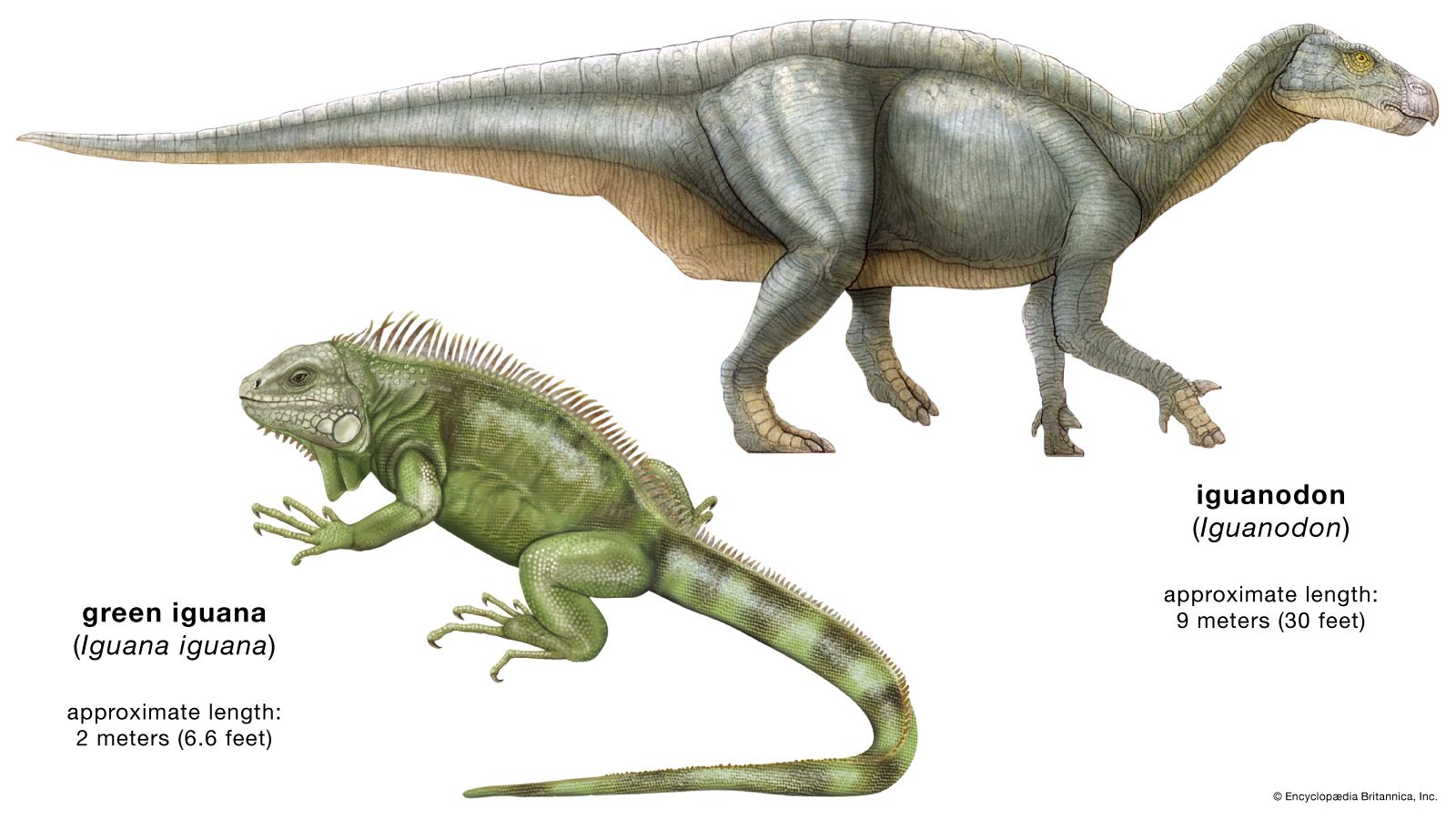
Iguanodons and iguanas are not closely related; their connection is limited to the fact that both are reptiles. The name Iguanodon literally means “iguana tooth,” a term coined by paleontologist Gideon Mantell after he observed that the fossilized teeth he discovered in 1822 resembled those of a modern iguana.12
Evolutionarily, the two are quite distant. Iguanas belong to the lizard family Iguanidae within the order Squamata. In contrast, iguanodons were dinosaurs, which fall under the archosaur subclass. Archosaurs are more closely related to modern crocodiles and birds than they are to lizards.13
While their names suggest an affinity, iguanas did not evolve from iguanodons, and the two groups occupy very different branches of the evolutionary tree.1
What are the main differences between archosaurs and lizards?
Archosaurs and lizards represent two distinct evolutionary lineages of reptiles, separated by significant anatomical and physiological differences.
Evolutionary Lineage
Archosaurs (subclass Archosauria) include dinosaurs, pterosaurs, crocodiles, and birds. In contrast, modern lizards belong to the lepidosaur lineage, which also includes snakes and the tuatara.67
Key Anatomical Differences
- Skull Structure: Archosaurs are characterized by an antorbital fenestra—a large opening in the snout in front of the eye—and a mandibular fenestra in the lower jaw. Lizards, as lepidosaurians, lack these specific openings.61
- Dentition: A primary distinction is how teeth are anchored. Archosaur teeth are set in deep sockets (thecodont dentition). Conversely, lizard teeth are attached superficially to the jawbone.61
- Skull Kinesis: Lizards possess highly kinetic skulls, meaning they have joints that allow parts of the skull to move relative to one another, which aids in swallowing large prey. While some dinosaurs exhibited limited kinesis, the overall skull structure and movement patterns in archosaurs differ significantly from the specialized kinetic systems found in lepidosaurians.4
- Locomotion: Archosaurs are divided into branches that evolved distinct ankle joints. Ornithosuchians (including dinosaurs and birds) have ankles that allow for an upright, bipedal gait, while pseudosuchians (including crocodiles) typically utilize a sprawling or “high walk” quadrupedal gait.6
How did scientists discover that Iguanodon walked on four legs instead of two?
The understanding of how Iguanodon moved has evolved significantly since its initial discovery. Early reconstructions by Gideon Mantell in the 1820s depicted the animal as a quadruped, though these models were based on incomplete remains and featured anatomical errors, such as placing the thumb spike on the nose.2
During the 1880s, the discovery of many complete skeletons in Bernissart, Belgium, led to a new interpretation. Scientists at the time reconstructed the animal in an upright, kangaroo-like stance with its tail dragging on the ground. This “upright” misconception persisted for nearly a century.2
It was not until the late 20th century that this view was corrected. By analyzing the skeletal structure and biomechanics, paleontologists determined that Iguanodon possessed a nearly horizontal backbone. This posture indicates that the animal primarily moved on four legs while grazing, though it retained the ability to walk on two legs when necessary.2
What are some other examples of dinosaurs that were named after modern animals?
Many dinosaurs were named for their physical resemblance to modern animals, often to highlight specific anatomical features or behaviors. Here are some notable examples:
- Ornithomimus: Its name means “bird mimic.” This dinosaur possessed long legs, a long neck, and a toothless beak, providing a striking superficial resemblance to the living ostrich.
- Struthiomimus: A relative of Ornithomimus, its name explicitly translates to “ostrich-mimic” due to its extreme similarity to the modern bird.
- Compsognathus: While its name refers to its “pretty jaw,” this small theropod is frequently noted for being roughly the size of a modern chicken.
- Iguanodon: Though not named for a bird, its name means “iguana tooth,” reflecting the resemblance paleontologists noted between its fossilized teeth and those of the modern iguana.
These names often serve as shorthand for paleontologists to describe the creature’s appearance or ecological niche, even when the dinosaur is not directly related to the modern animal mentioned in its name.
Sources
- Are iguanodons and iguanas related? — Encyclopædia Britannica
- Iguanodon — Encyclopædia Britannica
- iguanid — Encyclopædia Britannica
- reptile - Fossil distribution — Encyclopædia Britannica
- dinosaur - Dinosaur ancestors — Encyclopædia Britannica
- archosaur — Encyclopædia Britannica
- reptile - Annotated classification — Encyclopædia Britannica
- Archaeopteryx — Encyclopædia Britannica
- reptile - Skull and dentition — Encyclopædia Britannica
- reptile - Walking and crawling — Encyclopædia Britannica
- Ornithomimus — Encyclopædia Britannica
- dinosaur — Encyclopædia Britannica
- 5 Questions About Dinosaurs Answered — Encyclopædia Britannica
- Why Does -saur Appear So Often in Dinosaur Names? — Encyclopædia Britannica
- dinosaur - Tetanurae — Encyclopædia Britannica
Published on · 3 min read