Chough
A chough is not a single species but a name applied to three distinct crowlike birds characterized by their down-curved bills.
What is Chough?
A chough is not a single species but a name applied to three distinct crowlike birds characterized by their down-curved bills.1
The term primarily refers to two species within the family Corvidae:
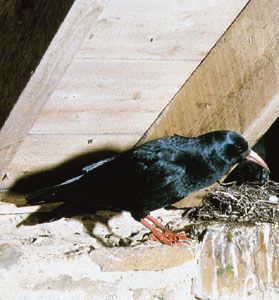
- Common chough (Pyrrhocorax pyrrhocorax): A red-billed bird found in rocky uplands and sea cliffs ranging from the British Isles to China. It is sometimes referred to as the Cornish chough the Cornish chough.13
- Alpine chough (P. graculus): A yellow-billed bird inhabiting high mountain regions from Morocco and Spain to the Himalayas.1
Both species are approximately 38 cm long, possess glossy blue-black plumage, and are known for their gregarious nature and aerial acrobatics.12
Additionally, the white-winged chough (Corcorax melanorhamphus) belongs to a different family, Corcoracidae. Native to Australian forests, this bird is physically similar to the corvid choughs but features white wing patches and a black bill. Unlike its counterparts, it is known for building mud-walled nests cooperatively.1
What other birds belong to the Corvidae family?
The Corvidae family is a diverse group of over 120 songbird species within the order Passeriformes. These birds are known for their high intelligence, strong social organization, and stout bills.4
Beyond the chough, the family includes several well-known groups categorized by their physical characteristics and regional prevalence:
- Larger, sombre-colored species: These birds are found globally, with the exception of South America. This group includes the crow, raven, rook, jackdaw, and nutcracker.4
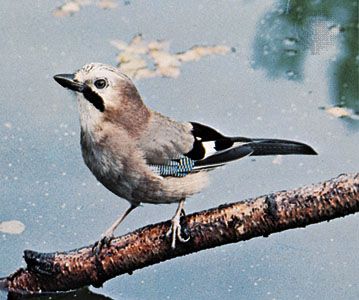
- Smaller, colorful species: Often featuring crests or long tails, these are most numerous in South America and southeastern Asia. This group includes the jay and the magpie.4
While crows and ravens are often confused, they are distinct species within the same genus (Corvus) and family, both exhibiting the complex social behaviors and problem-solving abilities characteristic of the Corvidae family.5
How do choughs adapt to living in high mountain environments?
The alpine chough (Pyrrhocorax graculus) is specifically adapted to high-mountain environments, including the Himalayas, where it has been observed at elevations as high as 18,600 feet (5,700 meters).16
While specific physiological studies on the chough’s high-altitude survival are limited in the provided text, birds generally thrive in such environments through several key adaptations:
- Efficient Respiration: Birds possess a highly efficient respiratory system that allows them to extract more oxygen from the air than mammals, which is essential in the thin atmosphere of high altitudes.7
- Aerial Agility: Choughs are noted as aerial acrobats, a trait that likely assists them in navigating the complex wind patterns and rugged terrain of mountain ranges.1
- Energy Management: Like other high-altitude birds, they may utilize thermal updrafts to gain elevation and conserve energy, and they possess lightweight, pneumatic bones that facilitate efficient flight.7
These traits allow the alpine chough to inhabit rocky, high-elevation zones where many other species cannot survive.1
What makes the white-winged chough’s nesting behavior unique?
The white-winged chough (Corcorax melanorhamphus) exhibits a distinct nesting behavior characterized by its cooperative nature. Unlike many other birds, these choughs construct a mud-walled nest high in a tree, which is both built and utilized by the group cooperatively.1
It is important to note that while the white-winged chough is often grouped with other birds called choughs, it actually belongs to the family Corcoracidae, rather than the Corvidae family that includes the common and alpine choughs.1
Sources
- Chough — Encyclopædia Britannica
- chough — Merriam-Webster
- Cornish chough — Merriam-Webster
- Corvidae — Encyclopædia Britannica
- What's the difference between ravens and crows? — Merriam-Webster
- How high do birds fly? — Encyclopædia Britannica
- Himalayas - Animal life — Encyclopædia Britannica
Published on · 2 min read