Chilean Cedar
The Chilean cedar (Austrocedrus chilensis) is an evergreen conifer belonging to the cypress family (Cupressaceae). It is the sole species within the genus…
What is Chilean cedar?
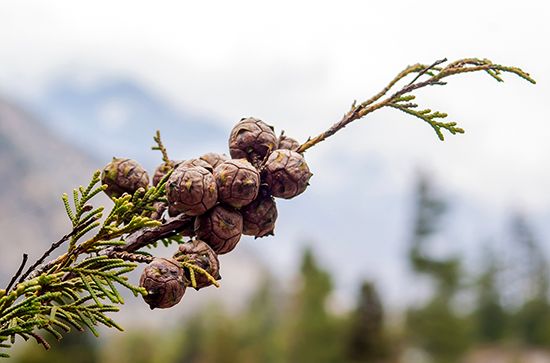
The Chilean cedar (Austrocedrus chilensis) is an evergreen conifer belonging to the cypress family (Cupressaceae). It is the sole species within the genus Austrocedrus and is native to the regions of southern Chile and southern Argentina1.
While this tree can reach heights of up to 24 metres (approximately 80 feet), it is typically found at shorter statures. Its wood is noted for being both fragrant and durable, making it a valued material for local carpentry. Additionally, the hardy tree is often cultivated as an ornamental plant in Great Britain.1
How does the cypress family differ from the pine family?
The cypress family (Cupressaceae) and the pine family (Pinaceae) are both members of the order Pinales, but they exhibit distinct differences in their physical characteristics and reproductive structures.234
Key Differences
- Leaf Arrangement: In the pine family, leaves are typically needlelike and arranged spirally, either singly or in clusters. In contrast, Cupressaceae leaves are often small and scalelike, arranged in opposite pairs or whorls of three, frequently giving branchlets a flattened or four-sided appearance.24356
- Seed Cones: The most significant distinction lies in the structure of the seed-bearing cones. In Pinaceae, the scales and bracts are distinct, with the scales bearing two inverted ovules. In Cupressaceae, the scales are intimately fused to the bracts, and the number of seeds per scale varies significantly, ranging from one to about twenty.243
- Diversity and Distribution: The pine family is primarily restricted to the Northern Hemisphere and consists of 11 genera. The cypress family is more globally distributed, encompassing 30 genera with considerable diversity in both the Northern and Southern hemispheres.243
What makes the wood of the Chilean cedar so durable?
While the Chilean cedar is widely recognized for its durable and fragrant wood, the specific chemical mechanisms behind its durability are attributed to the presence of wood extractives.
In general, the durability of wood is significantly influenced by its content of extractives—non-structural chemical compounds such as tannins and various terpenoid substances. These compounds are naturally deposited within the wood, where they act to protect the tree by conferring resistance to decay and insects, while also contributing to the wood’s characteristic colour and odour.1
Because the Chilean cedar is a member of the cypress family, it naturally produces these types of chemical compounds, which are common in many conifer species and are responsible for the high quality of its timber in local carpentry.71
Why is the Chilean cedar considered an ornamental tree?
The Chilean cedar (Austrocedrus chilensis) is valued as an ornamental tree primarily due to its status as a hardy evergreen conifer. Its ability to thrive in various environments, such as in Great Britain, makes it a popular choice for cultivation in gardens and landscapes.1
As the sole species within its genus, it offers a unique aesthetic appeal characteristic of the cypress family. While it can reach heights of up to 24 meters, its tendency to remain shorter in many cultivated settings allows it to fit well within diverse planting designs.1
Sources
- Chilean cedar — Encyclopædia Britannica
- Pinaceae — Encyclopædia Britannica
- Cupressaceae — Encyclopædia Britannica
- conifer - Annotated classification — Encyclopædia Britannica
- cypress — Encyclopædia Britannica
- cypress pine — Encyclopædia Britannica
- wood - Extractives — Encyclopædia Britannica
Published on · 2 min read