Chimborazo
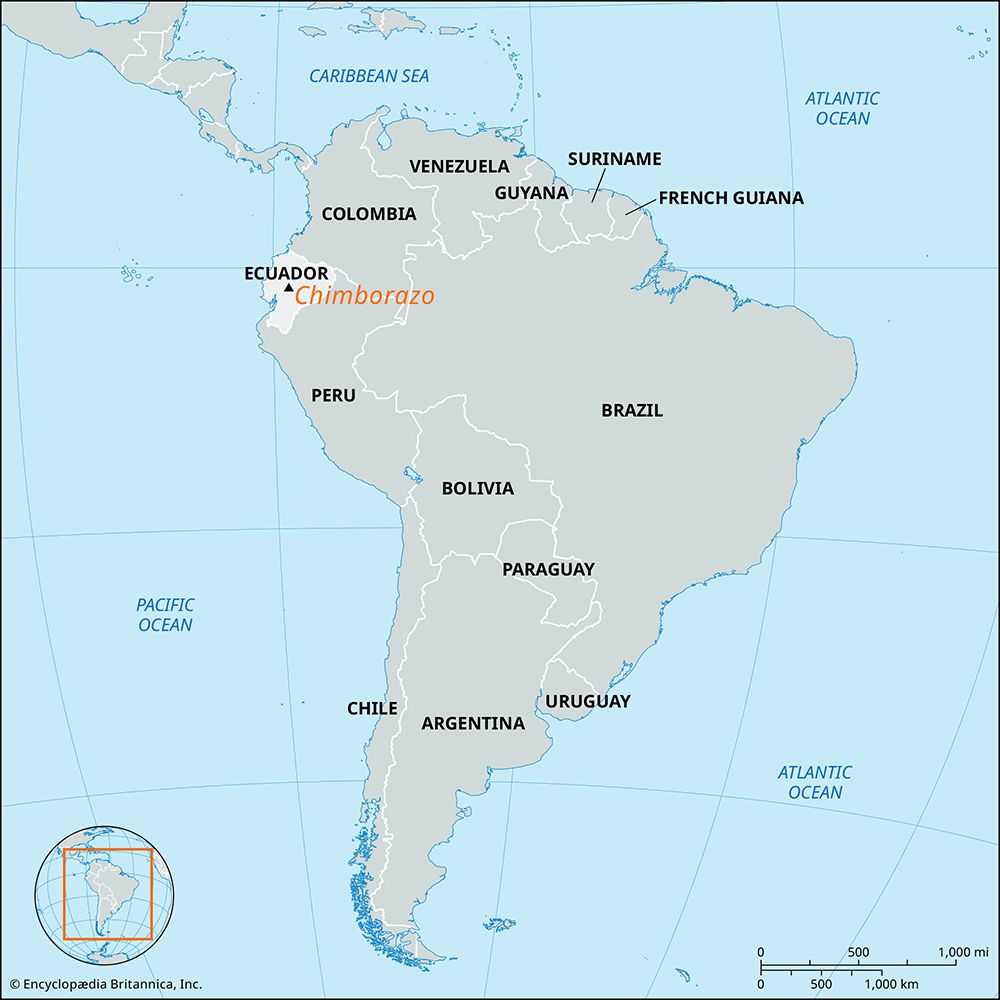
Chimborazo is an inactive volcano located in the Cordillera Occidental of the Andes in central Ecuador. Rising to an elevation of 20,702 feet (6,310 meters)…
What is Chimborazo?
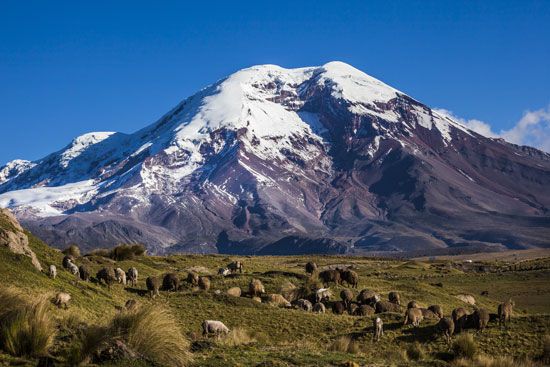
Chimborazo is an inactive volcano located in the Cordillera Occidental of the Andes in central Ecuador. Rising to an elevation of 20,702 feet (6,310 meters), it stands as the highest peak in Ecuador.1
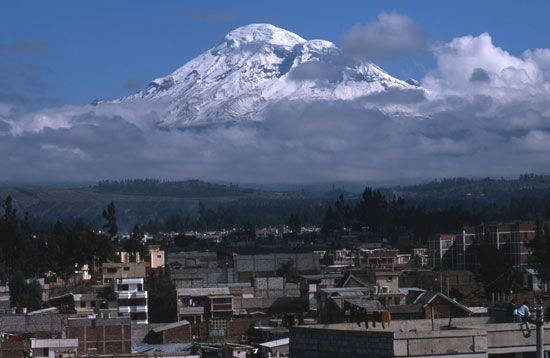
The mountain is heavily glaciated, with eternal snow covering the peak from approximately 15,400 feet (4,700 meters) upward. Historically, it was mistakenly believed to be the highest mountain in the Andes. Notable explorers and mountaineers have long been drawn to the peak; Alexander von Humboldt reached an altitude of 19,286 feet in 1802, and the first successful summit was achieved by Edward Whymper in 1880.1
Why is Chimborazo considered the closest point on Earth to the stars?
It is a common misconception that Chimborazo is the “closest point to the stars” in a literal sense; rather, it is the point on Earth’s surface that is farthest from the planet’s center.
Because Earth is not a perfect sphere but an oblate spheroid, it bulges at the Equator. Chimborazo is located very close to this equatorial bulge. Consequently, even though its elevation above sea level is lower than that of Mount Everest, the bulge pushes the summit of Chimborazo about 6,800 feet (2,070 meters) farther away from the Earth’s center than the summit of Everest.3
While Everest holds the title for the highest elevation above sea level, Chimborazo’s position on the equatorial bulge gives it the greatest distance from the Earth’s core, reaching nearly 4,000 miles (6,400 kilometers) from the center.3
What are the major mountain ranges in the Andes?
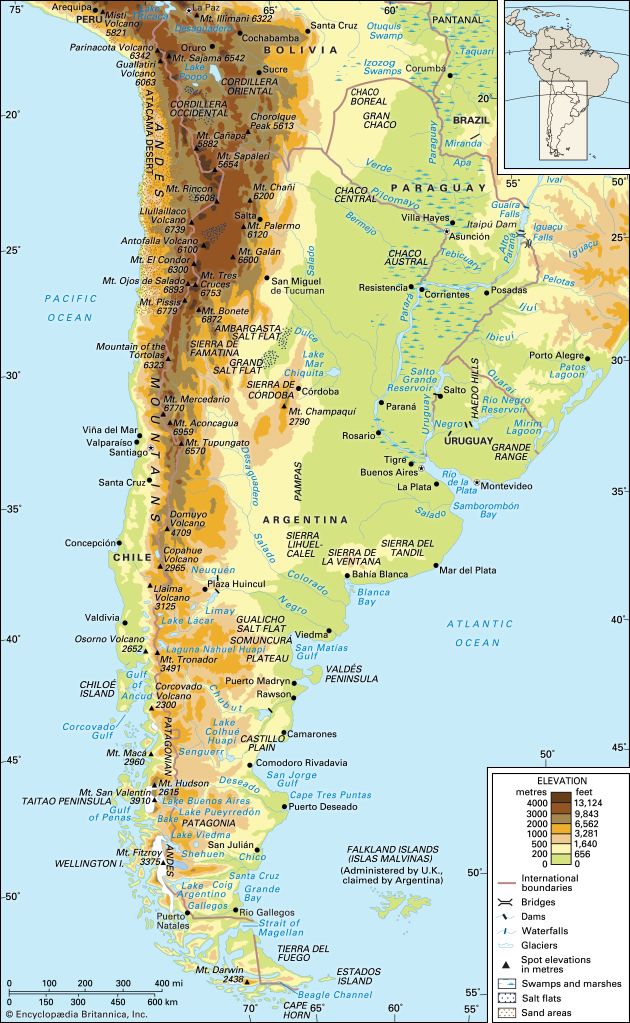
While there is no universal agreement on the subdivisions of the Andes Mountains, the system is generally categorized into three broad regions from south to north: the Southern Andes, the Central Andes, and the Northern Andes., and the Northern Andes.5
Regional Breakdown
- Southern Andes: Extending through Chile and Argentina, this region forms a single, lofty chain that includes Mount Aconcagua, the highest peak in the Western Hemisphere.4
- Central Andes: This section includes the Peruvian cordilleras and extends through western Bolivia. It is characterized by two distinct ranges that enclose the Altiplano, a vast high-altitude plateau.4
- Northern Andes: Encompassing the Ecuadorian, Colombian, and Venezuelan cordilleras, this region is defined by the divergence of the mountains into multiple parallel chains, such as the Cordillera Occidental, Cordillera Central, and Cordillera Oriental in Colombia.54
How do glaciers affect the landscape of high mountains?
Glaciers are powerful agents of landscape transformation in high mountains, primarily through the processes of erosion and deposition. By reshaping terrain, they create distinct features that differ significantly from those formed by rivers.
Erosional Landforms
Glaciers drastically alter the landscape by carving out deep, wide valleys. While rivers typically create narrow, V-shaped valleys, glaciers reshape these into characteristic U-shaped valleys with flat bottoms and steep, vertical sidewalls.8
Other prominent erosional features include:
- Cirques: Amphitheatre-shaped hollows formed at the heads of glacial valleys. Their basins often contain lakes known as tarns.8
- Arêtes: Jagged, knife-edge ridges that form between parallel glacial valleys or opposing cirques.8
- Horns: Sharp, pyramid-shaped peaks created when multiple cirques erode a mountain radially, such as the Matterhorn.89
Depositional Landforms
As glaciers move and eventually retreat, they deposit debris known as till. Ridges of this material, called moraines, mark the former margins of ice sheets. Other features, such as drumlins (streamlined hills) and eskers (sinuous ridges formed by subglacial streams), further demonstrate the profound impact of glacial activity on the topography of high-latitude and high-altitude regions.9
Sources
- Chimborazo — Encyclopædia Britannica
- Chimborazo — Merriam-Webster
- Is Mount Everest Really the Tallest Mountain in the World? — Encyclopædia Britannica
- mountain - The Andes — Encyclopædia Britannica
- Andes Mountains - Physical features — Encyclopædia Britannica
- Andes Mountains - Physiography of the Northern Andes — Encyclopædia Britannica
- South America - The Andes Mountains — Encyclopædia Britannica
- glacial landform - Cirques , tarns, U-shaped valleys, arêtes, and horns — Encyclopædia Britannica
- Quaternary - Landforms — Encyclopædia Britannica
Published on · 3 min read