Himalayan
The Himalayas are a vast mountain system in Asia that serves as a massive barrier between the Plateau of Tibet to the north and the alluvial plains of the…

What is Himalayan?
The Himalayas are a vast mountain system in Asia that serves as a massive barrier between the Plateau of Tibet to the north and the alluvial plains of the Indian subcontinent to the south. The name is derived from the Sanskrit words hima (“snow”) and alaya (“abode”).123
Stretching approximately 1,550 miles (2,500 km), the range includes the world’s highest peaks, such as Mount Everest, and features over 110 summits rising to at least 24,000 feet (7,300 meters). Geologically, the mountains were formed by the collision of the Indian subcontinent with the Eurasian Plate, a process that began millions of years ago and continues to shape the region today.234
The Himalayas act as a critical climatic divide, influencing weather patterns across South Asia by obstructing cold northern air and forcing monsoon winds to release moisture. Beyond their physical stature, they hold profound cultural and religious significance for the peoples of the region.523
How do tectonic plates create mountain ranges like the Himalayas?
The formation of mountain ranges like the Himalayas is a process known as orogeny, specifically driven by continental collision at convergent margins.910
The Process of Continental Collision
Mountain building occurs when two buoyant continental plates converge. Because continental crust is too buoyant to be subducted into the mantle, the collision forces the crust to thicken and deform, pushing it skyward to create massive mountain ranges.1011
In the case of the Himalayas, the process began approximately 40 million years ago when the Indian subcontinent collided with Asia. As the Tethys Sea between them was consumed, the leading edge of India—carrying ancient sedimentary and metamorphic rocks—was scraped off and thrust onto itself. This intense crustal shortening and thickening resulted in the high peaks seen today.1012
Key Mechanisms
- Crustal Thickening: As plates collide, the crust develops deep “roots” that extend as far as 80 km (50 miles) into the Earth, supporting the high elevation of the mountains according to the principles of isostasy.10
- Thrust Faulting: The range is characterized by complex faulting and folding, where slices of rock are stacked on top of one another.912
- Ongoing Uplift: The collision continues today, with India still pushing into Asia, causing rapid uplift in zones beneath the Great Himalayas and driving seismic activity across the region.1012
What are some of the unique animals that live in the high Himalayas?
The high Himalayas are home to a variety of specialized animals that have adapted to the region’s extreme cold, rugged terrain, and low oxygen levels. Many of these species are cold-tolerant and evolved from wildlife of the steppes following the uplift of the mountain range.14
Some of the most notable animals include:
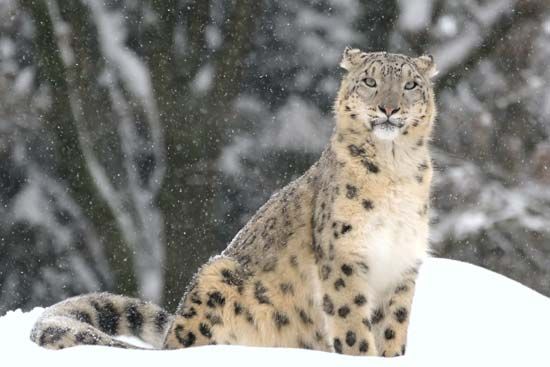
- Snow Leopard: A solitary, elusive predator that inhabits rocky, high-altitude environments. They are well-adapted to the cold with a thick, insulating coat and a wide head that helps warm the thin mountain air.1516
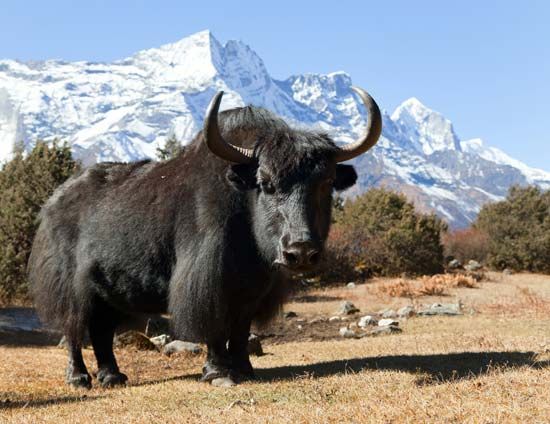
- Tibetan Yak: These animals are genetically adapted to high altitudes, possessing hemoglobin with a high oxygen affinity that allows them to thrive in low-oxygen environments. They are often used by humans as beasts of burden.1417
- Himalayan Tahr: A sure-footed, wild goatlike mammal that frequents steep, rocky mountainsides. They are known for their thick coats and are well-suited to the rugged Himalayan terrain.614
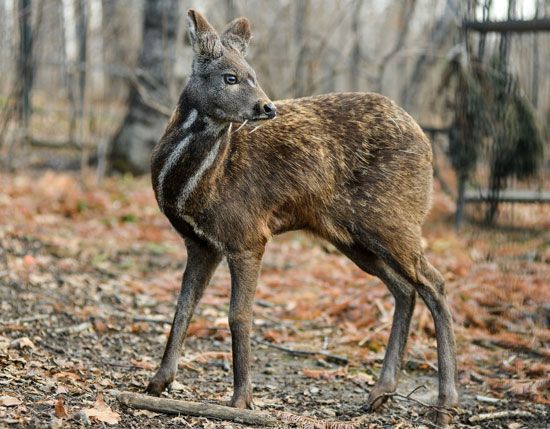
- Musk Deer: Found in the alpine zones, these animals are unfortunately endangered due to hunting for their musk pods.1418
- Other Species: The high-altitude fauna also includes brown bears, lesser pandas, and various goat antelopes such as the goral. Above the tree line, diverse types of insects, spiders, and mites are the most numerous animal forms, capable of surviving at extreme elevations.141819
Why is Mount Everest considered the highest point on Earth?
Mount Everest is considered the highest point on Earth because it possesses the greatest elevation above sea level, reaching approximately 29,032 feet (8,849 meters). Its status as the world’s highest peak was first established by the Survey of India in 1852.21
Determining an exact elevation has historically been complex due to factors such as light refraction, gravity deviation, and fluctuating snow levels. In 2020, China and Nepal jointly declared a height of 29,031.69 feet (8,848.86 meters), a measurement accepted by various international scientific bodies.2223
It is important to note that “highest” refers specifically to elevation above sea level. Other mountains may claim to be “tallest” using different metrics:
- Distance from Earth’s center: Chimborazo in Ecuador is farther from the Earth’s center because it sits near the equatorial bulge.24
- Base-to-peak height: Mauna Kea in Hawaii is significantly taller than Everest when measured from its base on the ocean floor.24
Sources
- Himalayas: Top Questions — Encyclopædia Britannica
- Great Himalayas — Encyclopædia Britannica
- Himalayas - Physiography of the Himalayas — Encyclopædia Britannica
- Himalayas — Encyclopædia Britannica
- Himalayas - Geologic history — Encyclopædia Britannica
- Exploring 7 of Earth’s Great Mountain Ranges - Himalayas — Encyclopædia Britannica
- Uttarakhand - Pilgrimage centres — Encyclopædia Britannica
- Himalayas - Climate of the Himalayas — Encyclopædia Britannica
- orogeny — Encyclopædia Britannica
- plate tectonics - Mountains by continental collision — Encyclopædia Britannica
- mountain - The Himalayan chain — Encyclopædia Britannica
- plate tectonics - Mountain building — Encyclopædia Britannica
- plate tectonics - Convergent margins — Encyclopædia Britannica
- tahr — Encyclopædia Britannica
- Snow leopard — Encyclopædia Britannica
- Snow leopard: Top Questions — Encyclopædia Britannica
- Himalayas - Animal life — Encyclopædia Britannica
- Himalayas - Plant life — Encyclopædia Britannica
- human respiratory system - High altitudes — Encyclopædia Britannica
- Nepal - Animal life — Encyclopædia Britannica
- Is Mount Everest Really the Tallest Mountain in the World? — Encyclopædia Britannica
- Mount Everest - The height of Everest — Encyclopædia Britannica
- Mount Everest — Encyclopædia Britannica
- Nepal Himalayas — Encyclopædia Britannica
- Mount Everest: Top Questions — Encyclopædia Britannica
Published on · 4 min read