Chinese Hibiscus
The Chinese hibiscus (Hibiscus rosa-sinensis) is a perennial shrub or small tree in the mallow family (Malvaceae) widely cultivated for its large, showy…
What is the Chinese hibiscus?
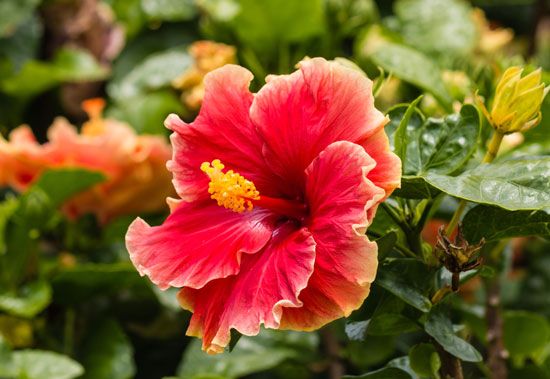
The Chinese hibiscus (Hibiscus rosa-sinensis) is a perennial shrub or small tree in the mallow family (Malvaceae) widely cultivated for its large, showy flowers. It is the most common species of hibiscus and is frequently grown as an ornamental hedge in tropical and subtropical regions.12
The plant typically reaches 1.2–3 meters in height and features simple, evergreen leaves. Its funnel-shaped flowers, which typically last only one day, are traditionally red but appear in various colors, including pink, orange, yellow, and white. While its exact origins are disputed, it is likely native to Southeast Asia.12
Beyond its ornamental value, the Chinese hibiscus holds cultural significance as the national flower of Malaysia. Its leaves are edible, and its flowers are used in teas and as garnishes. Researchers are also investigating the plant for potential medicinal properties, including anticancer effects and treatments for diabetes.1
What does the Chinese hibiscus plant look like?
The Chinese hibiscus (Hibiscus rosa-sinensis) is an evergreen shrub or small tree that typically grows 1.2–3 meters tall. Its bright green leaves are generally unlobed with serrated margins, measuring 5–12 cm in length.1
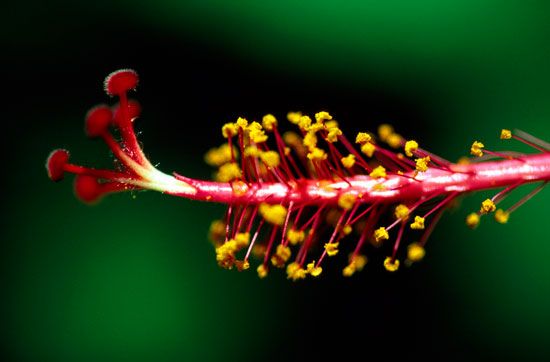
The plant is most notable for its large, showy, funnel-shaped flowers, which range from 5 to 25 cm in diameter. Key floral features include:1
- Petals: Typically 4–5 petals, which can be single or double depending on the cultivar.1
- Color: While traditionally red, blooms also appear in pink, orange, yellow, and white.12
- Structure: The stamens are fused into a central tube surrounding the pistil, and a green epicalyx surrounds the base of the petals.1
Although individual flowers last only one day, the plant blooms seasonally. When viewed under a microscope, the pollen is characteristically spiny, and the fruit develops as a capsule.12
Where does the Chinese hibiscus naturally grow?
The exact natural origins of the Chinese hibiscus (Hibiscus rosa-sinensis) remain a subject of debate among experts. While it is widely believed to be native to Southeast Asia, some authorities suggest it may have originated in Vanuatu or other tropical regions within Oceania.1
Notably, no wild populations of the plant have been discovered in modern times. Today, the species is cultivated globally as an ornamental hedge in tropical and subtropical regions, where it thrives in warm, humid environments with full sun.12
How is the Chinese hibiscus used in gardens or landscaping?
The Chinese hibiscus (Hibiscus rosa-sinensis) is widely cultivated as an ornamental shrub or small tree in tropical and subtropical regions worldwide. Its primary use in landscaping is as an ornamental hedge, valued for its large, brightly colored flowers and evergreen foliage.2
Gardeners often utilize the plant in the following ways:
- Hedges and Borders: Due to its size—typically reaching 1.2–3 meters—it is frequently planted to create flowering privacy screens or borders.2
- Container Gardening: Because the plant is frost-tender, it is often grown in containers. This allows gardeners in cooler climates to move the plant indoors to overwinter, or to maintain it as a houseplant that blooms during the spring and summer.2
- Pollinator Attraction: The showy blooms are effective at attracting a variety of pollinators, including hummingbirds.2
To maintain a desired shape, gardeners can prune the plant back by approximately half its height. It thrives best in full sun with rich, well-draining soil, though it can tolerate partial shade at the cost of flower production.2
Sources
- Did you know? — Merriam-Webster
- Chinese hibiscus — Encyclopædia Britannica
- hibiscus — Encyclopædia Britannica
Published on · 3 min read