Chinese Parasol Tree
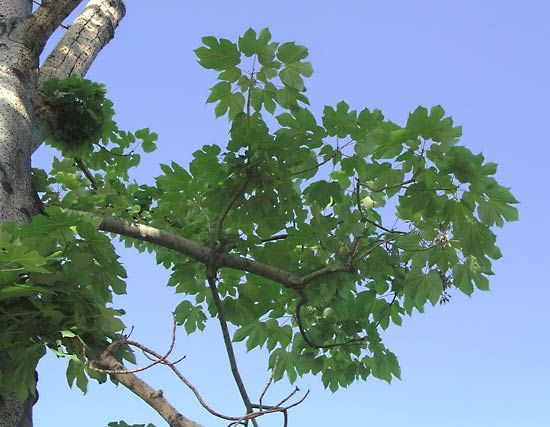
The Chinese parasol tree (Firmiana simplex) is a deciduous tree native to Asia that belongs to the mallow family (Malvaceae).
What is Chinese parasol tree?
The Chinese parasol tree (Firmiana simplex) is a deciduous tree native to Asia that belongs to the mallow family (Malvaceae).1
Growing to a height of approximately 12 meters (40 feet), the tree is characterized by large, alternate, maple-like leaves that can reach up to 30 cm (12 inches) across. It produces clusters of small, greenish-white flowers. The tree derives its common name from its unique fruits, which consist of radiating, leaf-like portions that hold the seeds. Due to its aesthetic appeal, it is widely cultivated as an ornamental plant in warmer regions of North America.12
What are some other plants in the mallow family?
The mallow family (Malvaceae) is a diverse group comprising over 4,200 species, including various herbs, shrubs, and trees. Many members are economically significant, serving as sources of food, natural fibers, and ornamental beauty.34
Notable plants in this family include:
- Food Crops: Cacao, okra, durian, and the kola nut.34
- Fiber and Wood Sources: Cotton, balsa, kapok, and jute.34
- Ornamentals: Hibiscus (including the rose of Sharon), hollyhock, linden (basswood), and the silk-floss tree.34
- Other Varieties: The marsh mallow, baobab, and velvetleaf.35
These plants are often recognized by their showy, five-petaled flowers and fibrous, tough bark.36
How do deciduous trees differ from evergreen trees?
The primary difference between deciduous and evergreen trees lies in their leaf-retention strategies and seasonal adaptations.
Deciduous Trees
Deciduous trees shed their leaves annually, typically in autumn or during a dry season. This is a protective adaptation; their leaves are generally thin and delicate, making them highly vulnerable to freezing temperatures, wind, and snow. By shedding foliage, these trees conserve energy and prevent damage during harsh conditions. The process, known as abscission, is triggered by environmental cues such as shortening day length and cooling temperatures.891011
Evergreen Trees
Evergreen trees retain their foliage throughout the year, with individual leaves often remaining on the tree for two years or longer. Their leaves are typically thicker, leathery, or needlelike, which helps them resist water loss and survive environmental stressors. Because these leaves are more costly to produce, the trees benefit from keeping them for multiple growing seasons rather than replacing them annually. In cold climates, many evergreens are conifers, while in milder or tropical regions, they are often broad-leaved.89
Why are certain trees chosen for ornamental landscaping?
The selection of trees for ornamental landscaping is a deliberate process driven by both aesthetic design and functional utility. Landscape architects and horticulturists evaluate trees based on a variety of characteristics to ensure they thrive in their intended environment while serving the desired purpose.1415
Design Elements
Trees are chosen as key structural elements to define the character of a space. Designers consider several visual and physical properties:
- Form and Texture: The shape (vertical, round, or irregular) and the texture of the foliage are used to create specific visual interest.15
- Seasonal Dynamics: Unlike static building materials, trees change throughout the year. Designers select species based on their seasonal effects, such as flowering times, fruit production, and foliage color changes in autumn.1415
- Growth Characteristics: The rate of growth (fast, medium, or slow) is a critical factor in planning how a landscape will evolve over time.15
Functional Utility
Beyond aesthetics, trees are manipulated as functional materials to solve environmental challenges:
- Environmental Control: Trees are used to provide shade, act as windbreaks, and serve as enclosures for privacy.14
- Site Management: They are often employed to control soil erosion and manage surface conditions.14
- Adaptability: Successful selection requires matching a tree’s environmental requirements—such as soil type, drainage, sun exposure, and temperature tolerance—to the specific site conditions to ensure long-term survival and health.15
Sources
- Chinese parasol tree — Encyclopædia Britannica
- Chinese parasol tree — Merriam-Webster
- list of plants in the family Malvaceae — Encyclopædia Britannica
- Malvales — Encyclopædia Britannica
- mallow — Encyclopædia Britannica
- Malvales - Common characteristics — Encyclopædia Britannica
- list of economically important members of the family Malvaceae — Encyclopædia Britannica
- evergreen — Encyclopædia Britannica
- plant development - Seasonal adaptations — Encyclopædia Britannica
- Temperate forest - Environment — Encyclopædia Britannica
- Temperate forest - Flora — Encyclopædia Britannica
- Deciduous forest: Top Questions — Encyclopædia Britannica
- How Can Some Trees Survive for Thousands of Years? — Encyclopædia Britannica
- horticulture - Trees — Encyclopædia Britannica
- tree - Adaptations — Encyclopædia Britannica
- garden and landscape design - Plants — Encyclopædia Britannica
Published on · 3 min read