Chinese Water Deer
The Chinese water deer (Hydropotes inermis) possesses specific physical traits that allow it to survive in its native riverine environments across changing…
How do Chinese water deer adapt to different seasons?
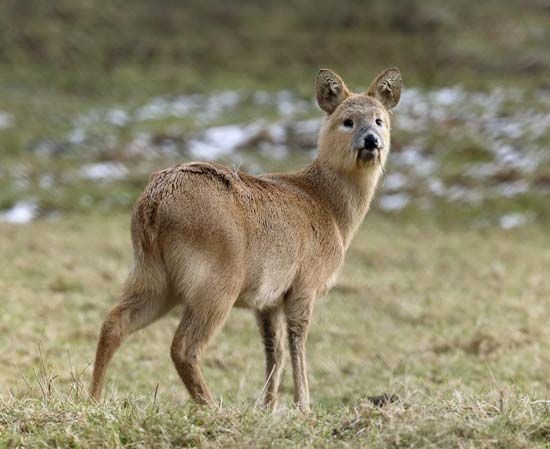
The Chinese water deer (Hydropotes inermis) possesses specific physical traits that allow it to survive in its native riverine environments across changing seasons. To endure cold, snowy winters, the species has evolved a coarse, thick coat and fur-covered ears, which provide essential insulation against low temperatures.1
Beyond these physical adaptations, the deer’s behavior is closely tied to the seasonal availability of its habitat. They prefer lush vegetation along river bottoms, where they consume large amounts of coarse-fibred grasses that provide both a consistent food source and necessary cover. Their reproductive cycle is also seasonally regulated: the breeding season occurs from early November to February, followed by a fawning season that takes place from late April to June.1
What is the average size and weight of an adult Chinese water deer?
The Chinese water deer (Hydropotes inermis) is a very small species of deer characterized by its compact size. Adult males stand approximately 50 cm (20 inches) tall at the shoulder and can reach a weight of up to 13 kg (29 pounds). Adult females are slightly smaller, weighing up to 11 kg (24 pounds).1
How do Chinese water deer differ from other species in the deer family?
The Chinese water deer (Hydropotes inermis) is unique among the Cervidae family due to several distinct evolutionary traits:
- Absence of Antlers: It is the only deer species in which males lack antlers entirely. While they evolved from ancestors that possessed them, the species reflects a primitive, pre-antler condition.123
- Presence of Tusks: In place of antlers, males are equipped with long, sharp, curved upper canine teeth, or tusks, which can exceed 5 cm (2 inches) in length. These are used for defense and territorial combat, a feature shared with the musk deer, though the water deer is the only one to lack antlers.13
- Inguinal Glands: The Chinese water deer is the only member of the deer family that possesses inguinal glands.1
- Dietary Specialization: Unlike many other deer that are highly selective feeders on low-fiber, high-protein plants, the Chinese water deer consumes a surprisingly large amount of coarse-fibred grasses, which serve as both a food source and cover in their riverine habitats.13
Where are Chinese water deer native to, and where else have they been introduced?
The Chinese water deer (Hydropotes inermis) is native to the fertile river bottoms of Korea and the Yangtze River valley in China.15
Regarding your query about where else they have been introduced, the provided search results do not contain information regarding populations outside of their native range in East Asia.
Sources
- Chinese water deer — Encyclopædia Britannica
- deer - Morphology and behaviour — Encyclopædia Britannica
- water deer — Merriam-Webster
- deer: Top Questions — Encyclopædia Britannica
- deer - New World deer — Encyclopædia Britannica
Published on · 2 min read