Christ’s Thorn
The term Christ’s thorn refers to several species of prickly or thorny shrubs, most notably Paliurus spina-christi of the buckthorn family (Rhamnaceae).…
What is Christ’s thorn?
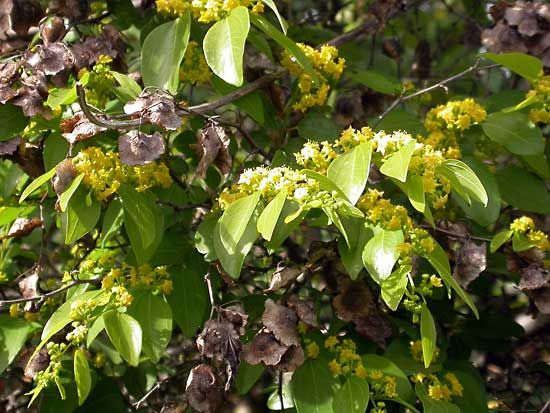
The term Christ’s thorn refers to several species of prickly or thorny shrubs, most notably Paliurus spina-christi of the buckthorn family (Rhamnaceae). Native to southern Europe and western Asia, this shrub grows up to 6 meters tall and features oval leaves and small, greenish-yellow flowers. The name is also applied to other thorny plants, such as the jujube (Ziziphus spina-christi).123
It is important to distinguish this from the crown of thorns (Euphorbia milii), a popular houseplant from the spurge family (Euphorbiaceae)3. While the common name “crown of thorns” refers to the relic of the thorny wreath placed on Jesus during his crucifixion, the plant itself is native to Madagascar and is not the same species as the shrubs historically associated with the name “Christ’s thorn” in the region of Palestine.453
What is the difference between Paliurus spina-christi and Euphorbia milii?
Paliurus spina-christi and Euphorbia milii are distinct plants belonging to different botanical families, though both are associated with the name “Christ’s thorn” or “crown of thorns.”
Key Differences
Feature
Paliurus spina-christi
Euphorbia milii
Common Name
Christ’s thorn
Crown of thorns
Family
Buckthorn
(Rhamnaceae)
Spurge
(Euphorbiaceae)
Native Region
Southern Europe and western
Asia
Madagascar
Growth Habit
Shrub growing up to 6 meters tall
Sprawling, vinelike stems; often a houseplant
Flowers
Small, greenish-yellow clusters
Small flowers with showy red or yellow
bracts
Sap
Noted for leathery fruit
Contains a poisonous, milky sap
Paliurus spina-christi is a woody shrub characterized by straight or hooked thorns and brownish-yellow fruit. In contrast, Euphorbia milii is a succulent-like perennial known for its stout gray thorns and its ability to bloom year-round, particularly in winter. While E. milii is widely cultivated as an ornamental houseplant, P. spina-christi is more commonly used in hedges within its native range.31
Why are certain plants named after religious events?
Plants are often named after religious events, figures, or symbols to establish a connection between the natural world and spiritual concepts. This practice frequently stems from the human tendency to perceive similarities between the attributes of a plant and the characteristics of a divine or sacred narrative.7
Reasons for Religious Naming
- Symbolic Representation: Many plants are named because their physical features—such as thorns, colors, or blooming times—evoke specific religious stories. For example, the crown of thorns (Euphorbia milii) is named for the wreath worn by Jesus during his crucifixion, with its red bracts symbolically representing his blood.3
- Timing and Observance: Some plants are named for their seasonal correlation with religious holidays. The Christmas cactus, for instance, is so named because it typically blooms annually around Christmastime.8
- Iconography and Sacred Status: Throughout history, plants have been viewed as sacred or as manifestations of the divine. In various traditions, plants are used as phytomorphic motifs to represent gods or divine attributes, such as the grapevine in Christian and Greco-Roman art, which symbolizes life and immortality.91011
- Archaic Associations: Historically, the “doctrine of signatures” led people to believe that plants could cure ailments based on their physical resemblance to human anatomy or specific objects, a practice that often intertwined with religious or superstitious beliefs.127
What are the characteristics of the buckthorn family?
The Rhamnaceae family, commonly known as the buckthorn family, is a widely distributed group of woody plants consisting of approximately 100 species of shrubs and trees.151617
Botanical Characteristics
Members of this family are typically characterized by the following features:
- Structure: They are often thorny shrubs or trees with undivided, stipulate leaves.17
- Flowers: The flowers are cymose, featuring stamens positioned opposite the petals.17
- Reproduction: They possess a superior ovary that develops into either a 3-celled capsule or a drupe.17
Economic and Ecological Importance
The family is ecologically significant, with some species serving as essential components of chaparral for erosion and flood control. Economically, the family provides various resources:18
- Medicinal: The bark of Rhamnus purshiana is used to produce cascara sagrada, a well-known cathartic.1618
- Timber and Food: Species such as Ziziphus jujuba (Chinese jujube) are valued for timber, while others provide edible fruits.18
- Dyes: Certain members yield natural dyes, including the green dye lokao.18
While some species are cultivated as ornamentals, others, such as Rhamnus cathartica and R. frangula, have become invasive pests in native forests.1618
Sources
- Christ’s thorn — Encyclopædia Britannica
- Christ's-thorn — Merriam-Webster
- crown of thorns — Encyclopædia Britannica
- Crown of Thorns: Top Questions — Encyclopædia Britannica
- crucifixion thorn — Encyclopædia Britannica
- spurge — Encyclopædia Britannica
- 7 Especially Fitting Common Names for Plants | Christmas Cactus — Merriam-Webster
- crown of thorns — Merriam-Webster
- religious symbolism and iconography - Phytomorphic motifs — Encyclopædia Britannica
- Biology - Botanical investigations — Encyclopædia Britannica
- ceremonial object - Plants and plant representations — Encyclopædia Britannica
- herbal — Encyclopædia Britannica
- myth - Animal and plant deities — Encyclopædia Britannica
- myth - Relationships of similarity — Encyclopædia Britannica
- buckthorn family — Merriam-Webster
- buckthorn — Encyclopædia Britannica
- Rhamnaceae — Merriam-Webster
- Rosales - Rhamnaceae — Encyclopædia Britannica
- Rhamnales — Merriam-Webster
Published on · 3 min read