Chrysaora
Chrysaora is a genus of marine jellyfish found in temperate and tropical seas worldwide. These jellyfish are carnivorous predators that sustain themselves on…
What are the feeding habits and prey preferences of Chrysaora jellyfish?
Chrysaora is a genus of marine jellyfish found in temperate and tropical seas worldwide. These jellyfish are carnivorous predators that sustain themselves on a diet of small planktonic animals.1
Their specific prey preferences include:
- Arrowworms (Sagitta)1
- Ctenophores, commonly known as comb jellies1
- Young polychaetes, such as Tomopteris1
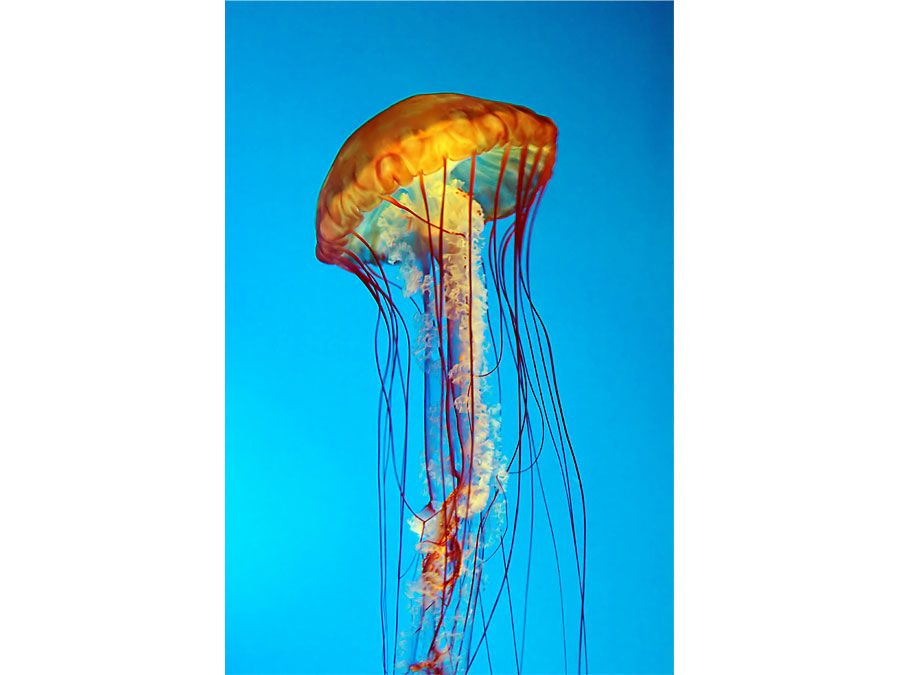
To capture and consume their food, Chrysaora utilize their physical anatomy to trap and transport prey. They possess 24 thin, extensile tentacles hanging from the rim of the bell, along with four long oral arms located at the center of the underside near the mouth. When prey is encountered, these marginal tentacles and mouth arms work together to capture the organisms and pass them directly to the mouth for ingestion.1
What are the defining characteristics of jellyfish in the Chrysaora genus?
The Chrysaora genus consists of marine jellyfish belonging to the class Scyphozoa and the order Semaeostomeae. These animals are found in temperate and tropical seas worldwide and are characterized by several distinct features:
- Body Structure: They possess a hemispherical, bell-shaped body. In the compass jellyfish (Chrysaora hysoscella), the bell can reach up to 200 mm (8 inches) in diameter and often features 16 brown, V-shaped radial markings against a cream or yellowish-brown background.
- Tentacles and Oral Arms: They typically have four long oral arms (mouth arms) hanging from the center of the underside, where the mouth is located. Additionally, most species have 24 thinner, extensile tentacles hanging from the rim of the bell.
- Feeding Habits: They are carnivorous predators that feed on small planktonic animals, including arrowworms, ctenophores, and young polychaetes. Their marginal tentacles and oral arms are used to capture prey and transport it to the mouth.
- Life Cycle: Their development involves a sessile polyp stage that buds off free-swimming medusae. Adults often brood their ciliated planula larvae internally before they are released to attach to solid surfaces.
What is the etymology of the name ‘Chrysaora’ and its significance?
The name Chrysaora is derived from Greek mythology, specifically referring to Chrysaor, a figure described as having a “golden sword” (from the Greek chrysos, meaning “gold,” and aor, meaning “sword”). In the context of this genus of jellyfish, the name is significant as it reflects the striking, often golden or yellowish-brown coloration characteristic of many species within the group, such as the compass jellyfish (Chrysaora hysoscella).
While the name evokes the imagery of a golden weapon, it serves taxonomically to identify these distinct, bell-shaped scyphozoans found in temperate and tropical waters worldwide. The genus is defined by its specific anatomical features, including its 24 marginal tentacles and four oral arms used for capturing planktonic prey.1
How do Chrysaora jellyfish reproduce and what is their life cycle like?
The life cycle of Chrysaora jellyfish is characteristic of the order Semaeostomeae and involves a complex alternation between sexual and asexual stages.12
The Life Cycle Stages
- Sexual Reproduction: Adult Chrysaora are typically male or female. Following the fusion of egg and sperm, an embryo is formed. In many species, this embryo is brooded within the adult’s gut until it develops into a ciliated planula larva, though in some species, this development occurs directly in the sea.12
- Settlement: Once the planula larva leaves the parent, it drifts in the plankton for a period before attaching to a solid surface, such as a rock.12
- Polyp Stage: Upon attachment, the larva grows into a sessile polyp, also known as a scyphistoma.12
- Asexual Budding: The scyphistoma reproduces asexually by budding off young, free-swimming medusae from its upper end. These young individuals, called ephyra, eventually grow into mature, bell-shaped adults, completing the cycle.12
Sources
- Chrysaora — Encyclopædia Britannica
- jellyfish — Encyclopædia Britannica
- cnidarian - Size range and diversity of structure — Encyclopædia Britannica
Published on · 3 min read