California Trapdoor Spider
The California trapdoor spider (Bothriocyrtum californicum) is a large, burrowing spider endemic to the cliffs and sunny hillsides of southern California. A…
What is California trapdoor spider?
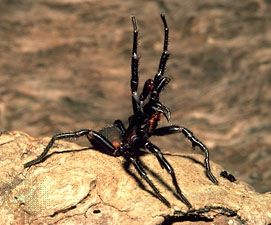
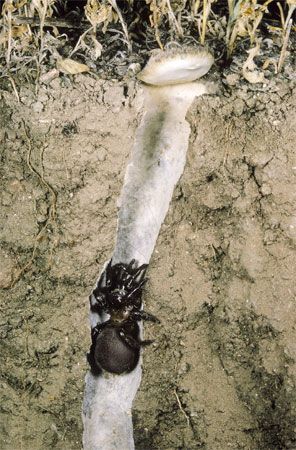
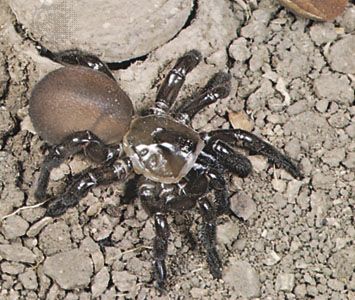
The California trapdoor spider (Bothriocyrtum californicum) is a large, burrowing spider endemic to the cliffs and sunny hillsides of southern California. A member of the family Halonoproctidae, it is a mygalomorph, meaning its fangs move forward and down rather than sideways.12
This spider is renowned for its strength; it can resist forces up to 38 times its own weight by bracing itself against the walls of its burrow while holding its camouflaged, silken-hinged trapdoor shut. It is an ambush predator that rarely leaves its burrow, instead waiting for prey to pass by before pulling it inside.12
The species is long-lived, with females capable of living up to 20 years. While they are formidable within their burrows, they face threats from parasitoid spider wasps, which may attempt to lay eggs on them. Like most trapdoor spiders, they are generally timid and not considered a medical threat to humans.12
How do parasitoid wasps hunt trapdoor spiders?
Spider wasps (family Pompilidae) are specialized predators that hunt trapdoor spiders to provide food for their developing larvae. Because trapdoor spiders are reclusive and protect themselves by retreating into their burrows and holding their camouflaged doors shut, the hunting process is a high-stakes interaction.3245
The hunting behavior generally involves the following steps:
- Locating and Attacking: Adult spider wasps, such as the tarantula hawk, actively search for prey on the ground. When they encounter a trapdoor spider, they may attack the spider even if it is significantly larger than themselves.3
- Stinging: The wasp uses a painful sting to subdue the spider. The method varies by species; some wasps deliver a precise sting between the spider’s fangs and near the junction of the cephalothorax and abdomen to induce complete immobility, while others may kill the spider outright.3
- Provisioning: Once the spider is paralyzed, the wasp transports it to a nest or cell—which may be constructed in soil, rock crevices, or rotten wood—either before or after the spider is captured.32
- Development: The wasp lays a single egg on the paralyzed spider. The spider remains alive but immobile, serving as a fresh food source for the wasp larva as it hatches and develops.32
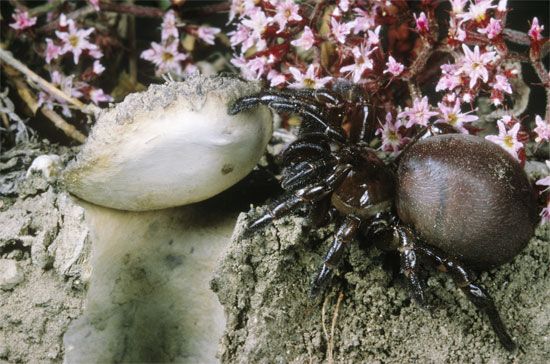
Some trapdoor spiders, such as the ravine trapdoor spider, have evolved physical defenses like a pluglike abdomen to help shield themselves from these predators.4
What are the main differences between mygalomorphs and araneomorphs?
The primary distinction between mygalomorphs (infraorder Mygalomorphae) and araneomorphs (infraorder Araneomorphae) lies in the orientation of their chelicerae (jaws) and several internal anatomical features.67
Key Differences
Feature
Mygalomorphs
Araneomorphs
Chelicerae Movement
Orthognath (paraxial): jaws move forward and down.
Labidognath (diaxial): jaws move sideways and together.
Respiratory Organs
Typically possess two pairs of book lungs.
Usually possess one pair of book lungs, sometimes replaced by tracheae.
Female Genitalia
Lack an epigynum (external genital plate).
Usually possess an epigynum.
Heart Ostia
Generally have four pairs of ostia.
Generally have three (sometimes two) pairs of ostia.
Additional Characteristics
- Mygalomorphs: Often referred to as “primitive” spiders, this group includes tarantulas and trapdoor spiders. They are typically large, long-lived, and ground-dwelling, often constructing silk-lined burrows.78
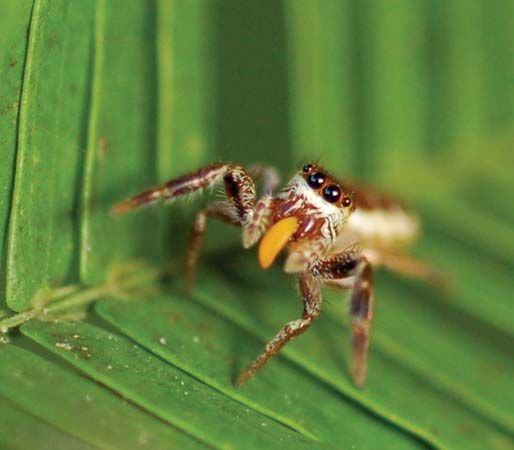
- Araneomorphs: This group comprises the vast majority of spider species, including jumping spiders, orb weavers, and wolf spiders. They exhibit a wider range of behaviors, including complex web-building and diverse hunting strategies.7
How do other trapdoor spider species protect their burrows?
Trapdoor spiders employ several strategies to protect their burrows, primarily relying on structural engineering and physical adaptations to deter predators.
Burrow Construction and Camouflage
The most common defense is the construction of a tubular, silk-lined burrow topped with a hinged lid. These doors are often expertly camouflaged with soil, moss, or other debris to blend into the surrounding environment, making the entrance difficult for predators to detect.211
- Structural Reinforcement: Spiders like the California trapdoor spider build thick, cork-like doors using layers of soil and silk, which are attached with a strong silken hinge. These spiders are remarkably strong, capable of resisting forces up to 38 times their own body weight to keep the door shut against intruders.42
- Complex Tunneling: Some species, particularly those in the family Ctenizidae, create branched tunnels. These secondary tubes may also be equipped with their own doors, providing additional layers of security if a predator manages to breach the primary entrance.2
Physical Defense
Beyond the burrow’s structure, some species utilize their own bodies as a defensive barrier. The ravine trapdoor spider possesses a uniquely shaped, hardened abdomen that acts as a plug, effectively sealing the burrow entrance against parasitoid wasps and other threats.2
Sources
- California trapdoor spider — Encyclopædia Britannica
- trapdoor spider — Encyclopædia Britannica
- spider wasp — Encyclopædia Britannica
- California trapdoor spider: Top Questions — Encyclopædia Britannica
- Hymenoptera - Solitary forms — Encyclopædia Britannica
- spider - Distinguishing taxonomic features — Encyclopædia Britannica
- spider - Annotated classification — Encyclopædia Britannica
- spider - Spiderwebs — Encyclopædia Britannica
- arthropod - Respiratory system — Encyclopædia Britannica
- mygalomorph — Merriam-Webster
- trapdoor spider — Merriam-Webster
Published on · 4 min read